

splitting by a photocatalytic process is one route that may be used to solve global
issues related to renewable energy and environmental pollution. Therefore, it has
attracted a great attention in both academic and industrial environments (Zhou et al.
2015a). The water-splitting reaction is first initiated by photon absorption which
generates numerous (e
À
/h
+
) pairs with sufficient potentials. These charge carriers
subsequently migrate to the surface of the catalysts and react with surface active
sites. Finally, the photogenerated electrons reduce water to hydrogen, and the holes
oxidize water molecules to give oxygen. The photogenerated electrons and holes
may recombine instantaneously, releasing the energy as photons or heat, when they
are not effectively separated. Thus, charge separation is a crucial factor in any
photocatalytic activity. If the charges are successfully separated, they migrate to
the surface of the semiconductor and participate in oxidation and reduction.
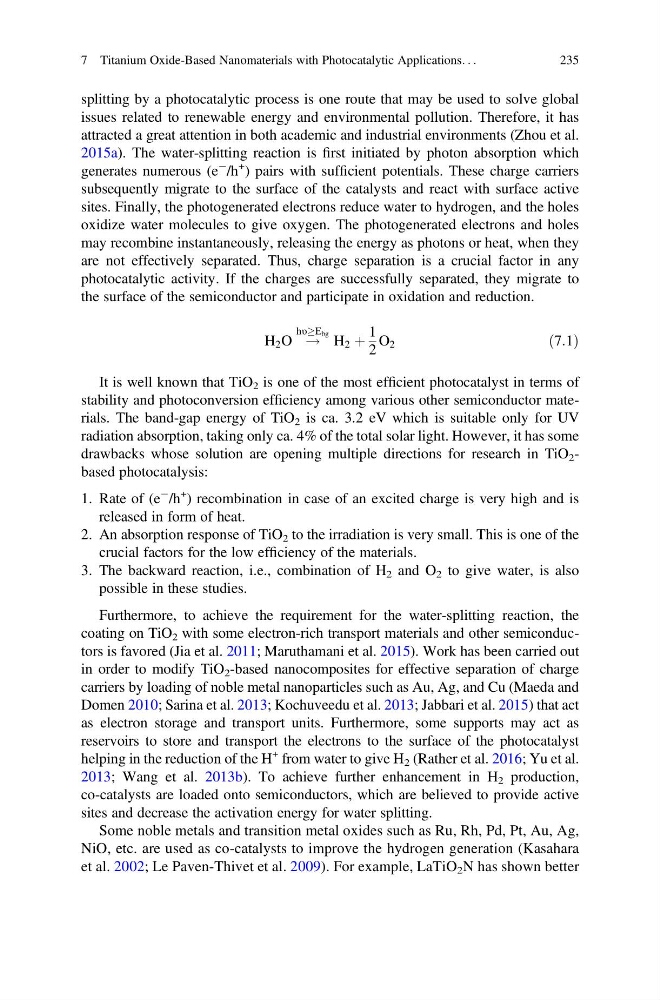
H 2 O !
hυ!E bg H 2 þ
1
2
O 2
ð7:1Þ
It is well known that TiO 2 is one of the most efficient photocatalyst in terms of
stability and photoconversion efficiency among various other semiconductor materials. The band-gap energy of TiO 2 is ca. 3.2 eV which is suitable only for UV
radiation absorption, taking only ca. 4% of the total solar light. However, it has some
drawbacks whose solution are opening multiple directions for research in TiO 2 -
based photocatalysis:
1. Rate of (e
À /h
+
) recombination in case of an excited charge is very high and is
released in form of heat.
2. An absorption response of TiO 2 to the irradiation is very small. This is one of the
crucial factors for the low efficiency of the materials.
3. The backward reaction, i.e., combination of H 2 and O 2 to give water, is also
possible in these studies.
Furthermore, to achieve the requirement for the water-splitting reaction, the
coating on TiO 2 with some electron-rich transport materials and other semiconductors is favored (Jia et al. 2011; Maruthamani et al. 2015). Work has been carried out
in order to modify TiO 2 -based nanocomposites for effective separation of charge
carriers by loading of noble metal nanoparticles such as Au, Ag, and Cu (Maeda and
Domen 2010; Sarina et al. 2013; Kochuveedu et al. 2013; Jabbari et al. 2015) that act
as electron storage and transport units. Furthermore, some supports may act as
reservoirs to store and transport the electrons to the surface of the photocatalyst
helping in the reduction of the H
+ from water to give H 2 (Rather et al. 2016; Yu et al.
2013; Wang et al. 2013b). To achieve further enhancement in H 2 production,
co-catalysts are loaded onto semiconductors, which are believed to provide active
sites and decrease the activation energy for water splitting.
Some noble metals and transition metal oxides such as Ru, Rh, Pd, Pt, Au, Ag,
NiO, etc. are used as co-catalysts to improve the hydrogen generation (Kasahara
et al. 2002; Le Paven-Thivet et al. 2009). For example, LaTiO 2 N has shown better
7 Titanium Oxide-Based Nanomaterials with Photocatalytic Applications. . .
235
issues related to renewable energy and environmental pollution. Therefore, it has
attracted a great attention in both academic and industrial environments (Zhou et al.
2015a). The water-splitting reaction is first initiated by photon absorption which
generates numerous (e
À
/h
+
) pairs with sufficient potentials. These charge carriers
subsequently migrate to the surface of the catalysts and react with surface active
sites. Finally, the photogenerated electrons reduce water to hydrogen, and the holes
oxidize water molecules to give oxygen. The photogenerated electrons and holes
may recombine instantaneously, releasing the energy as photons or heat, when they
are not effectively separated. Thus, charge separation is a crucial factor in any
photocatalytic activity. If the charges are successfully separated, they migrate to
the surface of the semiconductor and participate in oxidation and reduction.
H 2 O !
hυ!E bg H 2 þ
1
2
O 2
ð7:1Þ
It is well known that TiO 2 is one of the most efficient photocatalyst in terms of
stability and photoconversion efficiency among various other semiconductor materials. The band-gap energy of TiO 2 is ca. 3.2 eV which is suitable only for UV
radiation absorption, taking only ca. 4% of the total solar light. However, it has some
drawbacks whose solution are opening multiple directions for research in TiO 2 -
based photocatalysis:
1. Rate of (e
À /h
+
) recombination in case of an excited charge is very high and is
released in form of heat.
2. An absorption response of TiO 2 to the irradiation is very small. This is one of the
crucial factors for the low efficiency of the materials.
3. The backward reaction, i.e., combination of H 2 and O 2 to give water, is also
possible in these studies.
Furthermore, to achieve the requirement for the water-splitting reaction, the
coating on TiO 2 with some electron-rich transport materials and other semiconductors is favored (Jia et al. 2011; Maruthamani et al. 2015). Work has been carried out
in order to modify TiO 2 -based nanocomposites for effective separation of charge
carriers by loading of noble metal nanoparticles such as Au, Ag, and Cu (Maeda and
Domen 2010; Sarina et al. 2013; Kochuveedu et al. 2013; Jabbari et al. 2015) that act
as electron storage and transport units. Furthermore, some supports may act as
reservoirs to store and transport the electrons to the surface of the photocatalyst
helping in the reduction of the H
+ from water to give H 2 (Rather et al. 2016; Yu et al.
2013; Wang et al. 2013b). To achieve further enhancement in H 2 production,
co-catalysts are loaded onto semiconductors, which are believed to provide active
sites and decrease the activation energy for water splitting.
Some noble metals and transition metal oxides such as Ru, Rh, Pd, Pt, Au, Ag,
NiO, etc. are used as co-catalysts to improve the hydrogen generation (Kasahara
et al. 2002; Le Paven-Thivet et al. 2009). For example, LaTiO 2 N has shown better
7 Titanium Oxide-Based Nanomaterials with Photocatalytic Applications. . .
235