

2011). This photocatalyst degraded MB 17 times faster than TiO 2 /CNF after only 3 h
of irradiation. It is important to note that the AgNPs seemed to act as electron
acceptors and trapped the photogenerated electrons immediately, which caused an
increase in the photodegradation rate and reduced (e
À /h
+
) pair recombination.
Some of the most recent studies on the degradation of dyes including the
explanation of the effects of the photocatalytic materials, conditions, dye, and
textural properties have been recently reviewed by several groups (Thao et al.
2017; Kumar and Pandey 2017; Reza et al. 2017; Giovanetti et al. 2017). These
reports constitute very interesting revisions for understanding the correct design of
novel nanomaterials with improved photocatalytic activity in the degradation of
organic dyes.
7.3.4 Water Splitting
Photocatalytic water splitting using sunlight and particulate semiconductors is a
promising technology capable of converting solar energy into hydrogen (Chen
et al. 2010a; Walter et al. 2010; Pinaud et al. 2013). H 2 generation from water
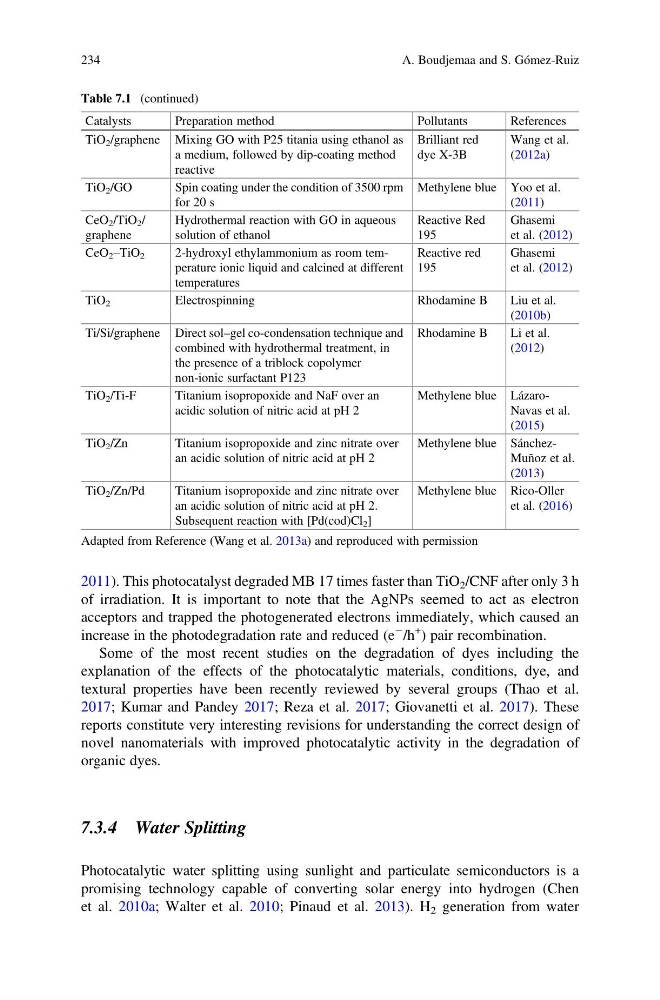
Table 7.1 (continued)
Catalysts
Preparation method
Pollutants
References
TiO 2 /graphene Mixing GO with P25 titania using ethanol as
a medium, followed by dip-coating method
reactive
Brilliant red
dye X-3B
Wang et al.
(2012a)
TiO 2 /GO
Spin coating under the condition of 3500 rpm
for 20 s
Methylene blue Yoo et al.
(2011)
CeO 2 /TiO 2 /
graphene
Hydrothermal reaction with GO in aqueous
solution of ethanol
Reactive Red
195
Ghasemi
et al. (2012)
CeO 2 –TiO 2
2-hydroxyl ethylammonium as room temperature ionic liquid and calcined at different
temperatures
Reactive red
195
Ghasemi
et al. (2012)
TiO 2
Electrospinning
Rhodamine B
Liu et al.
(2010b)
Ti/Si/graphene Direct sol–gel co-condensation technique and
combined with hydrothermal treatment, in
the presence of a triblock copolymer
non-ionic surfactant P123
Rhodamine B
Li et al.
(2012)
TiO 2 /Ti-F
Titanium isopropoxide and NaF over an
acidic solution of nitric acid at pH 2
Methylene blue LázaroNavas et al.
(2015)
TiO 2 /Zn
Titanium isopropoxide and zinc nitrate over
an acidic solution of nitric acid at pH 2
Methylene blue SánchezMuñoz et al.
(2013)
TiO 2 /Zn/Pd
Titanium isopropoxide and zinc nitrate over
an acidic solution of nitric acid at pH 2.
Subsequent reaction with [Pd(cod)Cl 2 ]
Methylene blue Rico-Oller
et al. (2016)
Adapted from Reference (Wang et al. 2013a) and reproduced with permission
234
A. Boudjemaa and S. Gómez-Ruiz
of irradiation. It is important to note that the AgNPs seemed to act as electron
acceptors and trapped the photogenerated electrons immediately, which caused an
increase in the photodegradation rate and reduced (e
À /h
+
) pair recombination.
Some of the most recent studies on the degradation of dyes including the
explanation of the effects of the photocatalytic materials, conditions, dye, and
textural properties have been recently reviewed by several groups (Thao et al.
2017; Kumar and Pandey 2017; Reza et al. 2017; Giovanetti et al. 2017). These
reports constitute very interesting revisions for understanding the correct design of
novel nanomaterials with improved photocatalytic activity in the degradation of
organic dyes.
7.3.4 Water Splitting
Photocatalytic water splitting using sunlight and particulate semiconductors is a
promising technology capable of converting solar energy into hydrogen (Chen
et al. 2010a; Walter et al. 2010; Pinaud et al. 2013). H 2 generation from water
Table 7.1 (continued)
Catalysts
Preparation method
Pollutants
References
TiO 2 /graphene Mixing GO with P25 titania using ethanol as
a medium, followed by dip-coating method
reactive
Brilliant red
dye X-3B
Wang et al.
(2012a)
TiO 2 /GO
Spin coating under the condition of 3500 rpm
for 20 s
Methylene blue Yoo et al.
(2011)
CeO 2 /TiO 2 /
graphene
Hydrothermal reaction with GO in aqueous
solution of ethanol
Reactive Red
195
Ghasemi
et al. (2012)
CeO 2 –TiO 2
2-hydroxyl ethylammonium as room temperature ionic liquid and calcined at different
temperatures
Reactive red
195
Ghasemi
et al. (2012)
TiO 2
Electrospinning
Rhodamine B
Liu et al.
(2010b)
Ti/Si/graphene Direct sol–gel co-condensation technique and
combined with hydrothermal treatment, in
the presence of a triblock copolymer
non-ionic surfactant P123
Rhodamine B
Li et al.
(2012)
TiO 2 /Ti-F
Titanium isopropoxide and NaF over an
acidic solution of nitric acid at pH 2
Methylene blue LázaroNavas et al.
(2015)
TiO 2 /Zn
Titanium isopropoxide and zinc nitrate over
an acidic solution of nitric acid at pH 2
Methylene blue SánchezMuñoz et al.
(2013)
TiO 2 /Zn/Pd
Titanium isopropoxide and zinc nitrate over
an acidic solution of nitric acid at pH 2.
Subsequent reaction with [Pd(cod)Cl 2 ]
Methylene blue Rico-Oller
et al. (2016)
Adapted from Reference (Wang et al. 2013a) and reproduced with permission
234
A. Boudjemaa and S. Gómez-Ruiz