

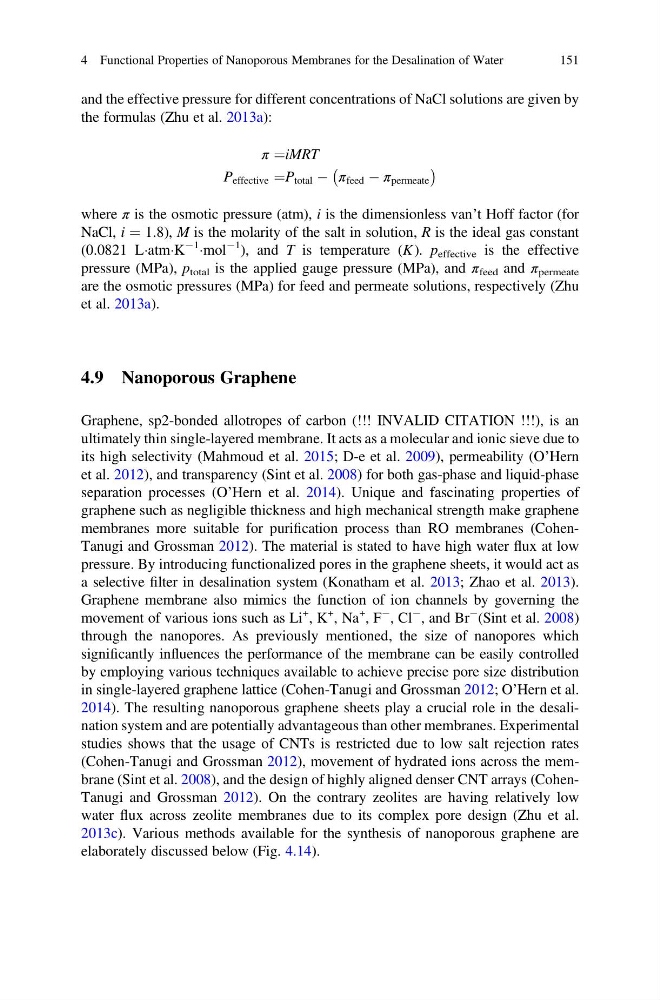
and the effective pressure for different concentrations of NaCl solutions are given by
the formulas (Zhu et al. 2013a):
π ¼iMRT
P effective ¼P total À π feed À π permeate
À
Á
where π is the osmotic pressure (atm), i is the dimensionless van’t Hoff factor (for
NaCl, i ¼ 1.8), M is the molarity of the salt in solution, R is the ideal gas constant
(0.0821 LÁatmÁK
À1
Ámol
À1 ), and T is temperature (K ). p effective is the effective
pressure (MPa), p total is the applied gauge pressure (MPa), and π feed and π permeate
are the osmotic pressures (MPa) for feed and permeate solutions, respectively (Zhu
et al. 2013a).
4.9 Nanoporous Graphene
Graphene, sp2-bonded allotropes of carbon (!!! INVALID CITATION !!!), is an
ultimately thin single-layered membrane. It acts as a molecular and ionic sieve due to
its high selectivity (Mahmoud et al. 2015; D-e et al. 2009), permeability (O’Hern
et al. 2012), and transparency (Sint et al. 2008) for both gas-phase and liquid-phase
separation processes (O’Hern et al. 2014). Unique and fascinating properties of
graphene such as negligible thickness and high mechanical strength make graphene
membranes more suitable for purification process than RO membranes (CohenTanugi and Grossman 2012). The material is stated to have high water flux at low
pressure. By introducing functionalized pores in the graphene sheets, it would act as
a selective filter in desalination system (Konatham et al. 2013; Zhao et al. 2013).
Graphene membrane also mimics the function of ion channels by governing the
movement of various ions such as Li
+ , K
+
, Na
+
, F
À , Cl
À , and Br
À (Sint et al. 2008)
through the nanopores. As previously mentioned, the size of nanopores which
significantly influences the performance of the membrane can be easily controlled
by employing various techniques available to achieve precise pore size distribution
in single-layered graphene lattice (Cohen-Tanugi and Grossman 2012; O’Hern et al.
2014). The resulting nanoporous graphene sheets play a crucial role in the desalination system and are potentially advantageous than other membranes. Experimental
studies shows that the usage of CNTs is restricted due to low salt rejection rates
(Cohen-Tanugi and Grossman 2012), movement of hydrated ions across the membrane (Sint et al. 2008), and the design of highly aligned denser CNT arrays (CohenTanugi and Grossman 2012). On the contrary zeolites are having relatively low
water flux across zeolite membranes due to its complex pore design (Zhu et al.
2013c). Various methods available for the synthesis of nanoporous graphene are
elaborately discussed below (Fig. 4.14).
4 Functional Properties of Nanoporous Membranes for the Desalination of Water
151
the formulas (Zhu et al. 2013a):
π ¼iMRT
P effective ¼P total À π feed À π permeate
À
Á
where π is the osmotic pressure (atm), i is the dimensionless van’t Hoff factor (for
NaCl, i ¼ 1.8), M is the molarity of the salt in solution, R is the ideal gas constant
(0.0821 LÁatmÁK
À1
Ámol
À1 ), and T is temperature (K ). p effective is the effective
pressure (MPa), p total is the applied gauge pressure (MPa), and π feed and π permeate
are the osmotic pressures (MPa) for feed and permeate solutions, respectively (Zhu
et al. 2013a).
4.9 Nanoporous Graphene
Graphene, sp2-bonded allotropes of carbon (!!! INVALID CITATION !!!), is an
ultimately thin single-layered membrane. It acts as a molecular and ionic sieve due to
its high selectivity (Mahmoud et al. 2015; D-e et al. 2009), permeability (O’Hern
et al. 2012), and transparency (Sint et al. 2008) for both gas-phase and liquid-phase
separation processes (O’Hern et al. 2014). Unique and fascinating properties of
graphene such as negligible thickness and high mechanical strength make graphene
membranes more suitable for purification process than RO membranes (CohenTanugi and Grossman 2012). The material is stated to have high water flux at low
pressure. By introducing functionalized pores in the graphene sheets, it would act as
a selective filter in desalination system (Konatham et al. 2013; Zhao et al. 2013).
Graphene membrane also mimics the function of ion channels by governing the
movement of various ions such as Li
+ , K
+
, Na
+
, F
À , Cl
À , and Br
À (Sint et al. 2008)
through the nanopores. As previously mentioned, the size of nanopores which
significantly influences the performance of the membrane can be easily controlled
by employing various techniques available to achieve precise pore size distribution
in single-layered graphene lattice (Cohen-Tanugi and Grossman 2012; O’Hern et al.
2014). The resulting nanoporous graphene sheets play a crucial role in the desalination system and are potentially advantageous than other membranes. Experimental
studies shows that the usage of CNTs is restricted due to low salt rejection rates
(Cohen-Tanugi and Grossman 2012), movement of hydrated ions across the membrane (Sint et al. 2008), and the design of highly aligned denser CNT arrays (CohenTanugi and Grossman 2012). On the contrary zeolites are having relatively low
water flux across zeolite membranes due to its complex pore design (Zhu et al.
2013c). Various methods available for the synthesis of nanoporous graphene are
elaborately discussed below (Fig. 4.14).
4 Functional Properties of Nanoporous Membranes for the Desalination of Water
151