

gained research interest for the synthesis of various composites of zeolites with
aluminophosphates and aluminosilicates (Cai et al. 2010). In recent decades
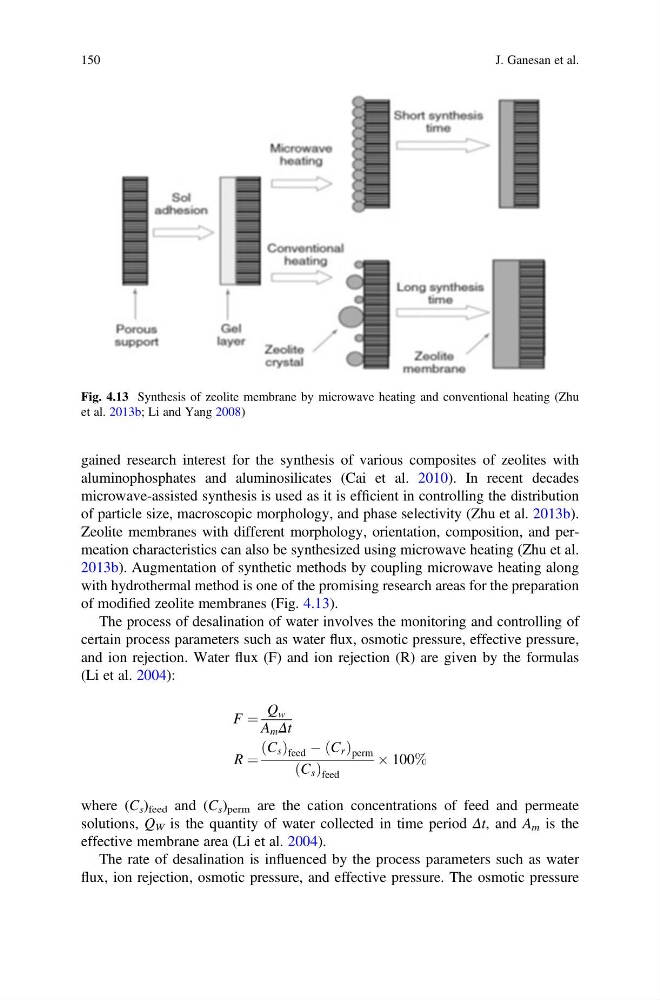
microwave-assisted synthesis is used as it is efficient in controlling the distribution
of particle size, macroscopic morphology, and phase selectivity (Zhu et al. 2013b).
Zeolite membranes with different morphology, orientation, composition, and permeation characteristics can also be synthesized using microwave heating (Zhu et al.
2013b). Augmentation of synthetic methods by coupling microwave heating along
with hydrothermal method is one of the promising research areas for the preparation
of modified zeolite membranes (Fig. 4.13).
The process of desalination of water involves the monitoring and controlling of
certain process parameters such as water flux, osmotic pressure, effective pressure,
and ion rejection. Water flux (F) and ion rejection (R) are given by the formulas
(Li et al. 2004):
F ¼
Q w
A m Δt
R ¼
C s
ð Þ feed À C r
ð Þ perm
C s
ð Þ feed
 100%
where (C s ) feed and (C s ) perm are the cation concentrations of feed and permeate
solutions, Q W is the quantity of water collected in time period Δt, and A m is the
effective membrane area (Li et al. 2004).
The rate of desalination is influenced by the process parameters such as water
flux, ion rejection, osmotic pressure, and effective pressure. The osmotic pressure
Fig. 4.13 Synthesis of zeolite membrane by microwave heating and conventional heating (Zhu
et al. 2013b; Li and Yang 2008)
150
J. Ganesan et al.
aluminophosphates and aluminosilicates (Cai et al. 2010). In recent decades
microwave-assisted synthesis is used as it is efficient in controlling the distribution
of particle size, macroscopic morphology, and phase selectivity (Zhu et al. 2013b).
Zeolite membranes with different morphology, orientation, composition, and permeation characteristics can also be synthesized using microwave heating (Zhu et al.
2013b). Augmentation of synthetic methods by coupling microwave heating along
with hydrothermal method is one of the promising research areas for the preparation
of modified zeolite membranes (Fig. 4.13).
The process of desalination of water involves the monitoring and controlling of
certain process parameters such as water flux, osmotic pressure, effective pressure,
and ion rejection. Water flux (F) and ion rejection (R) are given by the formulas
(Li et al. 2004):
F ¼
Q w
A m Δt
R ¼
C s
ð Þ feed À C r
ð Þ perm
C s
ð Þ feed
 100%
where (C s ) feed and (C s ) perm are the cation concentrations of feed and permeate
solutions, Q W is the quantity of water collected in time period Δt, and A m is the
effective membrane area (Li et al. 2004).
The rate of desalination is influenced by the process parameters such as water
flux, ion rejection, osmotic pressure, and effective pressure. The osmotic pressure
Fig. 4.13 Synthesis of zeolite membrane by microwave heating and conventional heating (Zhu
et al. 2013b; Li and Yang 2008)
150
J. Ganesan et al.