

to block the movement of ions is highly efficient because of its smaller aperture size
than the size of hydrated ions (Na
+
: 0.716 nm, Cl
À : 0.664 nm) but larger than the size
of water molecules (0.276 nm) (Zhu et al. 2013a). Structure and the porosity of the
zeolite membrane change when subjected to desalination which can be prevented to
some extent by incorporating fine techniques available for synthesizing MFI-type
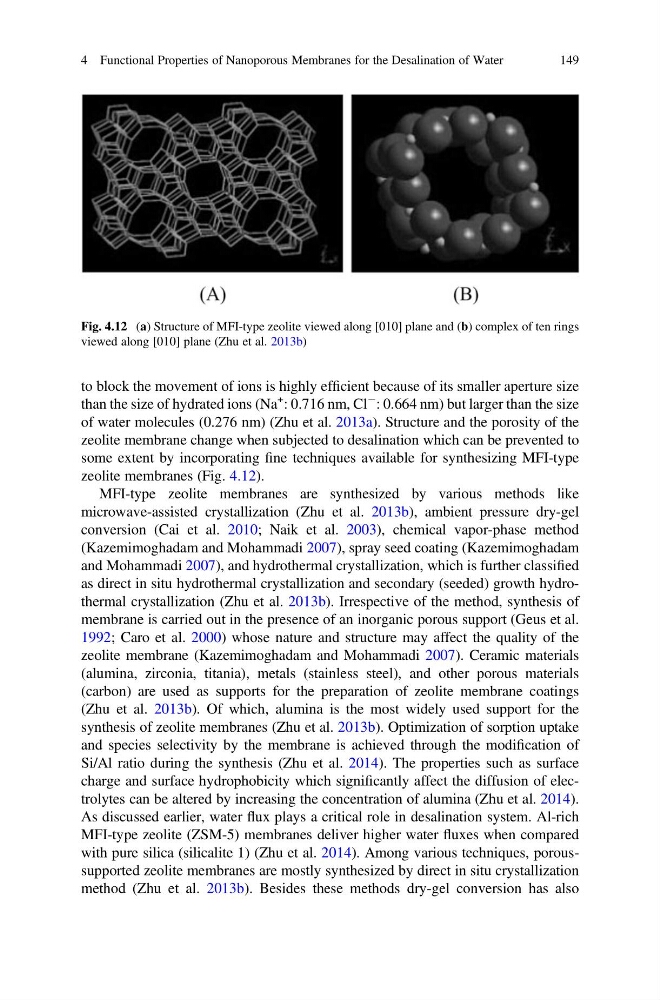
zeolite membranes (Fig. 4.12).
MFI-type zeolite membranes are synthesized by various methods like
microwave-assisted crystallization (Zhu et al. 2013b), ambient pressure dry-gel
conversion (Cai et al. 2010; Naik et al. 2003), chemical vapor-phase method
(Kazemimoghadam and Mohammadi 2007), spray seed coating (Kazemimoghadam
and Mohammadi 2007), and hydrothermal crystallization, which is further classified
as direct in situ hydrothermal crystallization and secondary (seeded) growth hydrothermal crystallization (Zhu et al. 2013b). Irrespective of the method, synthesis of
membrane is carried out in the presence of an inorganic porous support (Geus et al.
1992; Caro et al. 2000) whose nature and structure may affect the quality of the
zeolite membrane (Kazemimoghadam and Mohammadi 2007). Ceramic materials
(alumina, zirconia, titania), metals (stainless steel), and other porous materials
(carbon) are used as supports for the preparation of zeolite membrane coatings
(Zhu et al. 2013b). Of which, alumina is the most widely used support for the
synthesis of zeolite membranes (Zhu et al. 2013b). Optimization of sorption uptake
and species selectivity by the membrane is achieved through the modification of
Si/Al ratio during the synthesis (Zhu et al. 2014). The properties such as surface
charge and surface hydrophobicity which significantly affect the diffusion of electrolytes can be altered by increasing the concentration of alumina (Zhu et al. 2014).
As discussed earlier, water flux plays a critical role in desalination system. Al-rich
MFI-type zeolite (ZSM-5) membranes deliver higher water fluxes when compared
with pure silica (silicalite 1) (Zhu et al. 2014). Among various techniques, poroussupported zeolite membranes are mostly synthesized by direct in situ crystallization
method (Zhu et al. 2013b). Besides these methods dry-gel conversion has also
Fig. 4.12 (a) Structure of MFI-type zeolite viewed along [010] plane and (b) complex of ten rings
viewed along [010] plane (Zhu et al. 2013b)
4 Functional Properties of Nanoporous Membranes for the Desalination of Water
149
than the size of hydrated ions (Na
+
: 0.716 nm, Cl
À : 0.664 nm) but larger than the size
of water molecules (0.276 nm) (Zhu et al. 2013a). Structure and the porosity of the
zeolite membrane change when subjected to desalination which can be prevented to
some extent by incorporating fine techniques available for synthesizing MFI-type
zeolite membranes (Fig. 4.12).
MFI-type zeolite membranes are synthesized by various methods like
microwave-assisted crystallization (Zhu et al. 2013b), ambient pressure dry-gel
conversion (Cai et al. 2010; Naik et al. 2003), chemical vapor-phase method
(Kazemimoghadam and Mohammadi 2007), spray seed coating (Kazemimoghadam
and Mohammadi 2007), and hydrothermal crystallization, which is further classified
as direct in situ hydrothermal crystallization and secondary (seeded) growth hydrothermal crystallization (Zhu et al. 2013b). Irrespective of the method, synthesis of
membrane is carried out in the presence of an inorganic porous support (Geus et al.
1992; Caro et al. 2000) whose nature and structure may affect the quality of the
zeolite membrane (Kazemimoghadam and Mohammadi 2007). Ceramic materials
(alumina, zirconia, titania), metals (stainless steel), and other porous materials
(carbon) are used as supports for the preparation of zeolite membrane coatings
(Zhu et al. 2013b). Of which, alumina is the most widely used support for the
synthesis of zeolite membranes (Zhu et al. 2013b). Optimization of sorption uptake
and species selectivity by the membrane is achieved through the modification of
Si/Al ratio during the synthesis (Zhu et al. 2014). The properties such as surface
charge and surface hydrophobicity which significantly affect the diffusion of electrolytes can be altered by increasing the concentration of alumina (Zhu et al. 2014).
As discussed earlier, water flux plays a critical role in desalination system. Al-rich
MFI-type zeolite (ZSM-5) membranes deliver higher water fluxes when compared
with pure silica (silicalite 1) (Zhu et al. 2014). Among various techniques, poroussupported zeolite membranes are mostly synthesized by direct in situ crystallization
method (Zhu et al. 2013b). Besides these methods dry-gel conversion has also
Fig. 4.12 (a) Structure of MFI-type zeolite viewed along [010] plane and (b) complex of ten rings
viewed along [010] plane (Zhu et al. 2013b)
4 Functional Properties of Nanoporous Membranes for the Desalination of Water
149