

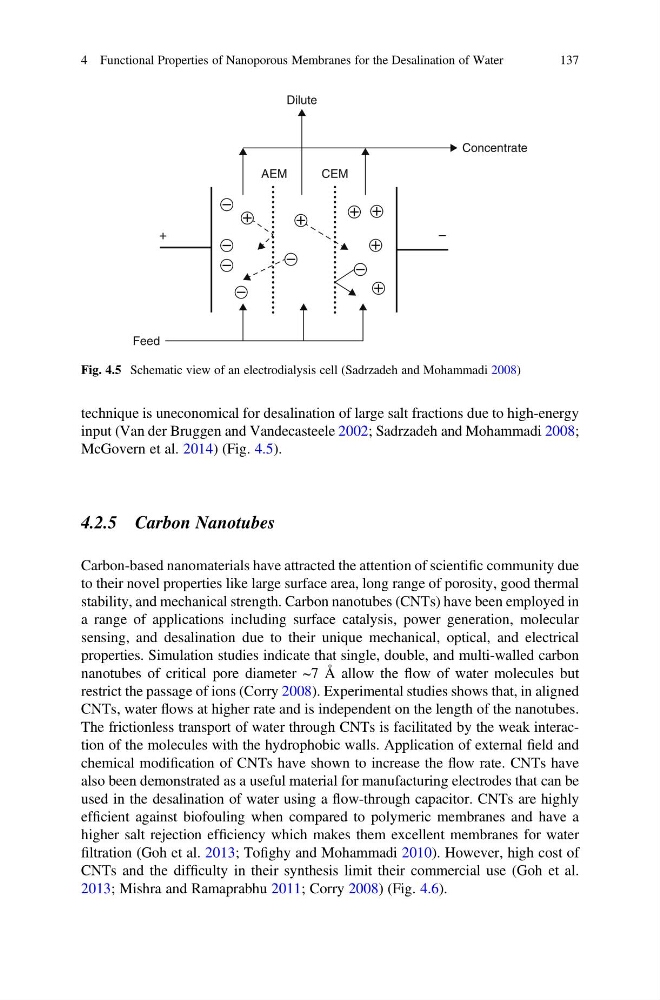
technique is uneconomical for desalination of large salt fractions due to high-energy
input (Van der Bruggen and Vandecasteele 2002; Sadrzadeh and Mohammadi 2008;
McGovern et al. 2014) (Fig. 4.5).
4.2.5 Carbon Nanotubes
Carbon-based nanomaterials have attracted the attention of scientific community due
to their novel properties like large surface area, long range of porosity, good thermal
stability, and mechanical strength. Carbon nanotubes (CNTs) have been employed in
a range of applications including surface catalysis, power generation, molecular
sensing, and desalination due to their unique mechanical, optical, and electrical
properties. Simulation studies indicate that single, double, and multi-walled carbon
nanotubes of critical pore diameter ~7 Å allow the flow of water molecules but
restrict the passage of ions (Corry 2008). Experimental studies shows that, in aligned
CNTs, water flows at higher rate and is independent on the length of the nanotubes.
The frictionless transport of water through CNTs is facilitated by the weak interaction of the molecules with the hydrophobic walls. Application of external field and
chemical modification of CNTs have shown to increase the flow rate. CNTs have
also been demonstrated as a useful material for manufacturing electrodes that can be
used in the desalination of water using a flow-through capacitor. CNTs are highly
efficient against biofouling when compared to polymeric membranes and have a
higher salt rejection efficiency which makes them excellent membranes for water
filtration (Goh et al. 2013; Tofighy and Mohammadi 2010). However, high cost of
CNTs and the difficulty in their synthesis limit their commercial use (Goh et al.
2013; Mishra and Ramaprabhu 2011; Corry 2008) (Fig. 4.6).
Feed
AEM
CEM
Dilute
Concentrate
+
–
Fig. 4.5 Schematic view of an electrodialysis cell (Sadrzadeh and Mohammadi 2008)
4 Functional Properties of Nanoporous Membranes for the Desalination of Water
137
input (Van der Bruggen and Vandecasteele 2002; Sadrzadeh and Mohammadi 2008;
McGovern et al. 2014) (Fig. 4.5).
4.2.5 Carbon Nanotubes
Carbon-based nanomaterials have attracted the attention of scientific community due
to their novel properties like large surface area, long range of porosity, good thermal
stability, and mechanical strength. Carbon nanotubes (CNTs) have been employed in
a range of applications including surface catalysis, power generation, molecular
sensing, and desalination due to their unique mechanical, optical, and electrical
properties. Simulation studies indicate that single, double, and multi-walled carbon
nanotubes of critical pore diameter ~7 Å allow the flow of water molecules but
restrict the passage of ions (Corry 2008). Experimental studies shows that, in aligned
CNTs, water flows at higher rate and is independent on the length of the nanotubes.
The frictionless transport of water through CNTs is facilitated by the weak interaction of the molecules with the hydrophobic walls. Application of external field and
chemical modification of CNTs have shown to increase the flow rate. CNTs have
also been demonstrated as a useful material for manufacturing electrodes that can be
used in the desalination of water using a flow-through capacitor. CNTs are highly
efficient against biofouling when compared to polymeric membranes and have a
higher salt rejection efficiency which makes them excellent membranes for water
filtration (Goh et al. 2013; Tofighy and Mohammadi 2010). However, high cost of
CNTs and the difficulty in their synthesis limit their commercial use (Goh et al.
2013; Mishra and Ramaprabhu 2011; Corry 2008) (Fig. 4.6).
Feed
AEM
CEM
Dilute
Concentrate
+
–
Fig. 4.5 Schematic view of an electrodialysis cell (Sadrzadeh and Mohammadi 2008)
4 Functional Properties of Nanoporous Membranes for the Desalination of Water
137