

The limitations in the above methods stirred the interest among researchers
working in the field of desalination to design an alternative and potential method
that is capable of complete salt rejection at a lower expense.
4.3 Nanoporous Desalination
4.3.1 Process
Water desalination across nanoporous membranes is based on the elementary concept that salt ions have a larger atomic radius than the actual water molecules
(Surwade et al. 2015; Killingsworth 2012). Thus the creation of a hole through
which water molecules can pass is the ultimate aim of nanoporous desalination.
Using certain principles that are discussed in this review, pores are created in
membranes of silica, graphene, and zeolites which allow water molecules to pass
through while blocking Na
+ and Cl
À ions which are comparatively larger in size
(Sint et al. 2008; Surwade et al. 2015; Xue et al. 2013). The pore diameter is based on
the water molecule size which is reported to be 5.5 angstroms (Killingsworth 2012;
Cohen-Tanugi and Grossman 2012). Furthermore, research work incorporating
functional groups in nanopores has been carried out to maximize the desalination
rate (Fig. 4.7).
4.3.2 Nanoporous Membranes
Development of nanoporous membranes has revolutionized the desalination process with superior performance at lower expense. The type of nanoporous membranes used for desalination plays a crucial role in determining the rate of
desalination. The nature of the material and the size of the pores are the two
basic properties that decide the efficiency of nanoporous desalination (Nicolaï
et al. 2014). Nanoporous membranes are developed by the artificial introduction
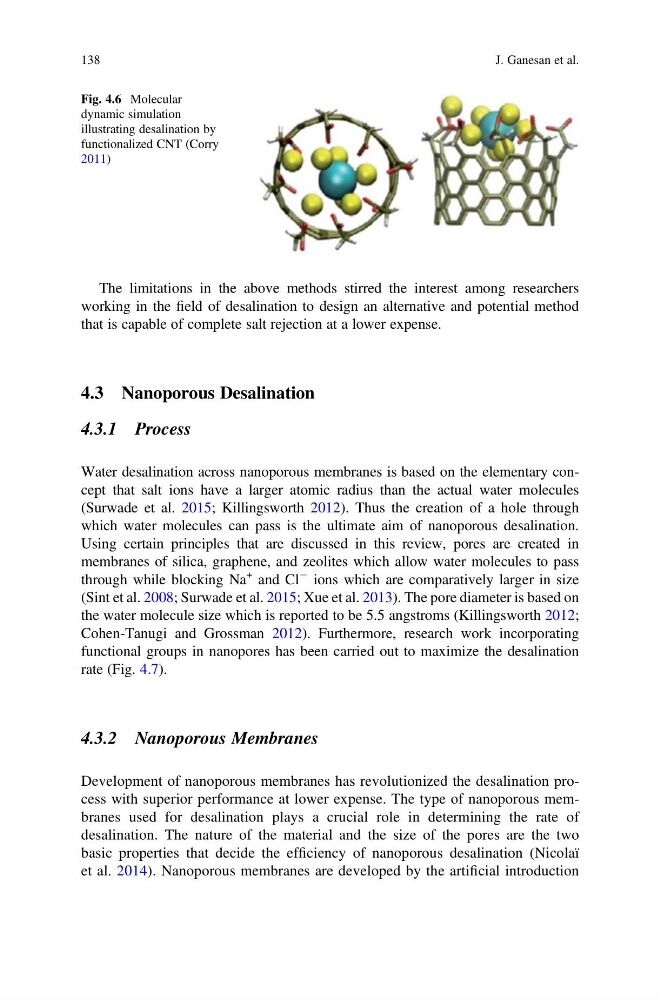
Fig. 4.6 Molecular
dynamic simulation
illustrating desalination by
functionalized CNT (Corry
2011)
138
J. Ganesan et al.
working in the field of desalination to design an alternative and potential method
that is capable of complete salt rejection at a lower expense.
4.3 Nanoporous Desalination
4.3.1 Process
Water desalination across nanoporous membranes is based on the elementary concept that salt ions have a larger atomic radius than the actual water molecules
(Surwade et al. 2015; Killingsworth 2012). Thus the creation of a hole through
which water molecules can pass is the ultimate aim of nanoporous desalination.
Using certain principles that are discussed in this review, pores are created in
membranes of silica, graphene, and zeolites which allow water molecules to pass
through while blocking Na
+ and Cl
À ions which are comparatively larger in size
(Sint et al. 2008; Surwade et al. 2015; Xue et al. 2013). The pore diameter is based on
the water molecule size which is reported to be 5.5 angstroms (Killingsworth 2012;
Cohen-Tanugi and Grossman 2012). Furthermore, research work incorporating
functional groups in nanopores has been carried out to maximize the desalination
rate (Fig. 4.7).
4.3.2 Nanoporous Membranes
Development of nanoporous membranes has revolutionized the desalination process with superior performance at lower expense. The type of nanoporous membranes used for desalination plays a crucial role in determining the rate of
desalination. The nature of the material and the size of the pores are the two
basic properties that decide the efficiency of nanoporous desalination (Nicolaï
et al. 2014). Nanoporous membranes are developed by the artificial introduction
Fig. 4.6 Molecular
dynamic simulation
illustrating desalination by
functionalized CNT (Corry
2011)
138
J. Ganesan et al.