

saline water is forced to permeate through a semipermeable membrane by applying a
pressure which is larger than the osmotic pressure of the seawater. In the early days
of RO application, the pressure needed for the separation was as high as 120 bar
which currently has been reduced to a level around 50 bar. The RO membrane allows
the free flow of water but restricts the entry of dissolved salts resulting in the
separation of pure water fraction (permeate) from the concentrated fraction (retentate
or concentrate) (Wilf and Bartels 2005). The desalinated water that leaves the
membrane is subjected to posttreatment where the dissolved gases are removed
and pH is adjusted. Fouling of the RO membrane by suspended solids, damage by
the presence of oxidizing compounds, organic blooms, and scaling are the major
disadvantages of this method which made the researchers look for alternative
methods of desalination. However, reverse osmosis remains an important desalination technique even today (Van der Bruggen and Vandecasteele 2002; Othmer 1966;
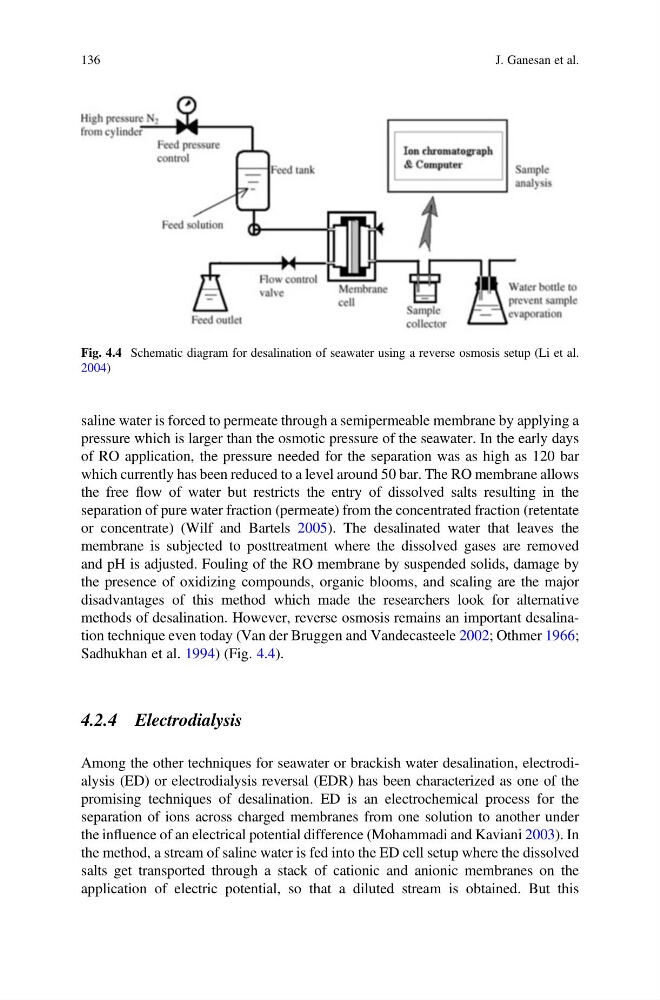
Sadhukhan et al. 1994) (Fig. 4.4).
4.2.4 Electrodialysis
Among the other techniques for seawater or brackish water desalination, electrodialysis (ED) or electrodialysis reversal (EDR) has been characterized as one of the
promising techniques of desalination. ED is an electrochemical process for the
separation of ions across charged membranes from one solution to another under
the influence of an electrical potential difference (Mohammadi and Kaviani 2003). In
the method, a stream of saline water is fed into the ED cell setup where the dissolved
salts get transported through a stack of cationic and anionic membranes on the
application of electric potential, so that a diluted stream is obtained. But this
Fig. 4.4 Schematic diagram for desalination of seawater using a reverse osmosis setup (Li et al.
2004)
136
J. Ganesan et al.
pressure which is larger than the osmotic pressure of the seawater. In the early days
of RO application, the pressure needed for the separation was as high as 120 bar
which currently has been reduced to a level around 50 bar. The RO membrane allows
the free flow of water but restricts the entry of dissolved salts resulting in the
separation of pure water fraction (permeate) from the concentrated fraction (retentate
or concentrate) (Wilf and Bartels 2005). The desalinated water that leaves the
membrane is subjected to posttreatment where the dissolved gases are removed
and pH is adjusted. Fouling of the RO membrane by suspended solids, damage by
the presence of oxidizing compounds, organic blooms, and scaling are the major
disadvantages of this method which made the researchers look for alternative
methods of desalination. However, reverse osmosis remains an important desalination technique even today (Van der Bruggen and Vandecasteele 2002; Othmer 1966;
Sadhukhan et al. 1994) (Fig. 4.4).
4.2.4 Electrodialysis
Among the other techniques for seawater or brackish water desalination, electrodialysis (ED) or electrodialysis reversal (EDR) has been characterized as one of the
promising techniques of desalination. ED is an electrochemical process for the
separation of ions across charged membranes from one solution to another under
the influence of an electrical potential difference (Mohammadi and Kaviani 2003). In
the method, a stream of saline water is fed into the ED cell setup where the dissolved
salts get transported through a stack of cationic and anionic membranes on the
application of electric potential, so that a diluted stream is obtained. But this
Fig. 4.4 Schematic diagram for desalination of seawater using a reverse osmosis setup (Li et al.
2004)
136
J. Ganesan et al.