

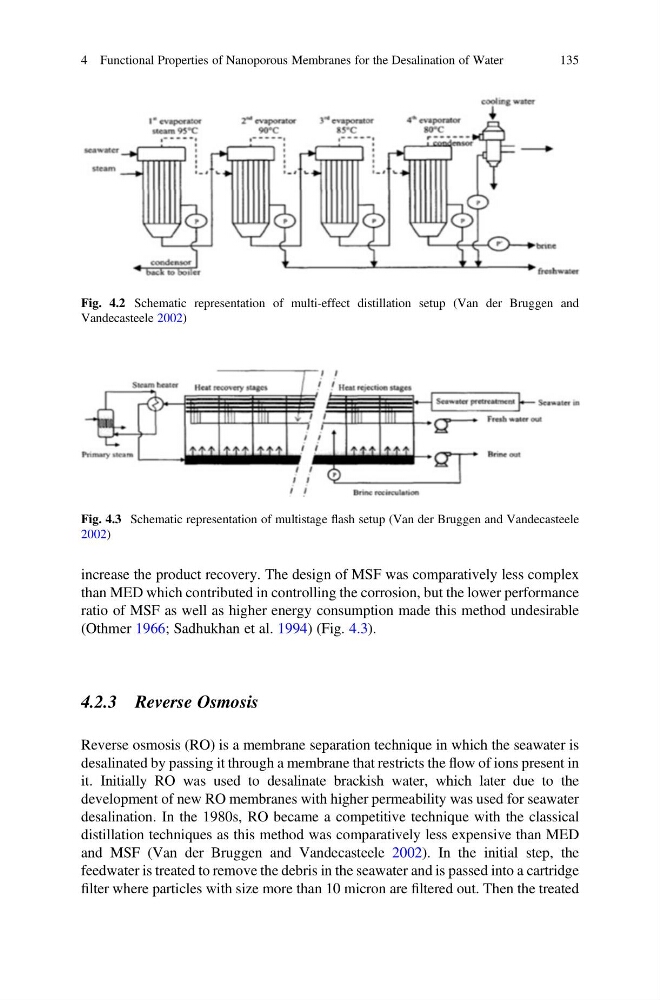
increase the product recovery. The design of MSF was comparatively less complex
than MED which contributed in controlling the corrosion, but the lower performance
ratio of MSF as well as higher energy consumption made this method undesirable
(Othmer 1966; Sadhukhan et al. 1994) (Fig. 4.3).
4.2.3 Reverse Osmosis
Reverse osmosis (RO) is a membrane separation technique in which the seawater is
desalinated by passing it through a membrane that restricts the flow of ions present in
it. Initially RO was used to desalinate brackish water, which later due to the
development of new RO membranes with higher permeability was used for seawater
desalination. In the 1980s, RO became a competitive technique with the classical
distillation techniques as this method was comparatively less expensive than MED
and MSF (Van der Bruggen and Vandecasteele 2002). In the initial step, the
feedwater is treated to remove the debris in the seawater and is passed into a cartridge
filter where particles with size more than 10 micron are filtered out. Then the treated
Fig. 4.3 Schematic representation of multistage flash setup (Van der Bruggen and Vandecasteele
2002)
Fig. 4.2 Schematic representation of multi-effect distillation setup (Van der Bruggen and
Vandecasteele 2002)
4 Functional Properties of Nanoporous Membranes for the Desalination of Water
135
than MED which contributed in controlling the corrosion, but the lower performance
ratio of MSF as well as higher energy consumption made this method undesirable
(Othmer 1966; Sadhukhan et al. 1994) (Fig. 4.3).
4.2.3 Reverse Osmosis
Reverse osmosis (RO) is a membrane separation technique in which the seawater is
desalinated by passing it through a membrane that restricts the flow of ions present in
it. Initially RO was used to desalinate brackish water, which later due to the
development of new RO membranes with higher permeability was used for seawater
desalination. In the 1980s, RO became a competitive technique with the classical
distillation techniques as this method was comparatively less expensive than MED
and MSF (Van der Bruggen and Vandecasteele 2002). In the initial step, the
feedwater is treated to remove the debris in the seawater and is passed into a cartridge
filter where particles with size more than 10 micron are filtered out. Then the treated
Fig. 4.3 Schematic representation of multistage flash setup (Van der Bruggen and Vandecasteele
2002)
Fig. 4.2 Schematic representation of multi-effect distillation setup (Van der Bruggen and
Vandecasteele 2002)
4 Functional Properties of Nanoporous Membranes for the Desalination of Water
135