

decreasing the ambient pressure. Initially, the seawater is fed into the tubes (horizontal or vertical or submerged) and is allowed to undergo repeated boiling without
any supplement of additional heat after the first effect where the temperature is raised
to its boiling point. It is followed by spraying of seawater that aids in rapid
evaporation, and consequently the steam is condensed on the opposite side of the
tubes. Only certain quantity of seawater moves into the second effect, the tube
bundle. Then these tubes are heated by the vapor produced from the first effect.
The process of evaporation and condensation is repeated from one effect to the other
based on the conditions of low pressure and temperature (Van der Bruggen and
Vandecasteele 2002). In order to increase the performance of MED, heat absorption
pumps can be fixed which are used for preheating the tubes. Corrosion and scaling of
supersaturated compounds such as CaSO 2 and intense contact of steam and brine
with the heat exchangers (Van der Bruggen and Vandecasteele 2002) were the major
drawbacks of this method. Such problems decrease the performance ratio of MED
and limit its use in desalination (Fig. 4.2).
4.2.2 Multistage Flash
Multistage flash (MSF) is a process based on the principle of flash evaporation which
came into practice in the early 1960s (Van der Bruggen and Vandecasteele 2002)
and became popular due to its reliability and simplicity. The operating system of
MSF consists of a series of flash chambers where steam is generated from saline
feedwater at a progressively reduced pressure. The generated steam is condensed by
heat exchange with a series of closed pipes where the seawater is preheated. The
condensate is the desired product with reduced total dissolved salt content which is
subjected to further potabilization process. The exhausted brine is recirculated to
Thermal
Desalination
Desalination
Techniques
Membrane
Seperation
Multi-effect
distillation
Multi-stage
flash
Reverse
Osmosis
Electrodialysis
Nanoporous
desalination
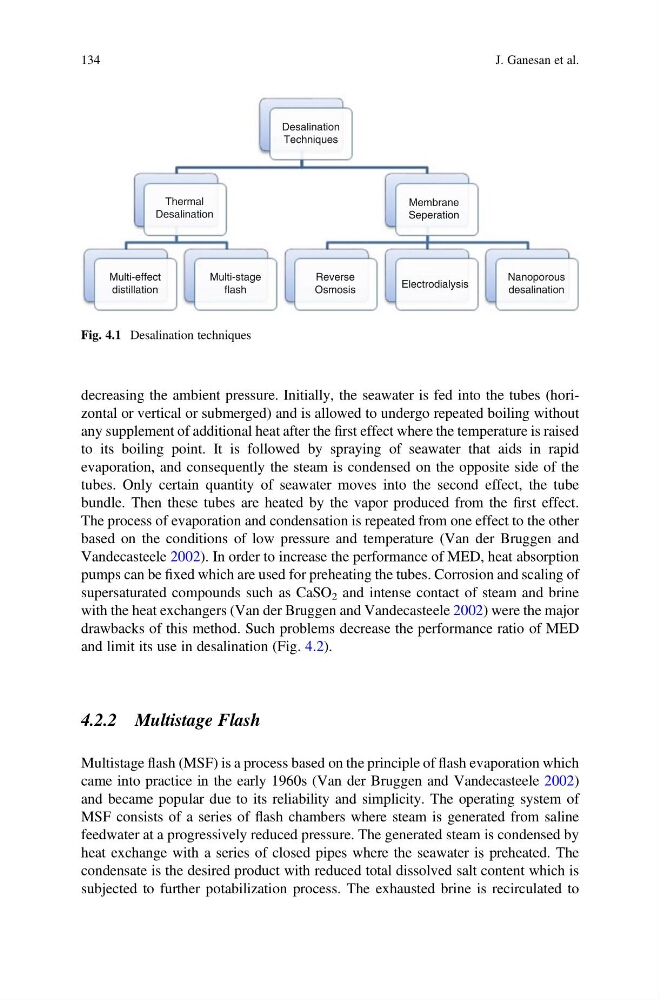
Fig. 4.1 Desalination techniques
134
J. Ganesan et al.
any supplement of additional heat after the first effect where the temperature is raised
to its boiling point. It is followed by spraying of seawater that aids in rapid
evaporation, and consequently the steam is condensed on the opposite side of the
tubes. Only certain quantity of seawater moves into the second effect, the tube
bundle. Then these tubes are heated by the vapor produced from the first effect.
The process of evaporation and condensation is repeated from one effect to the other
based on the conditions of low pressure and temperature (Van der Bruggen and
Vandecasteele 2002). In order to increase the performance of MED, heat absorption
pumps can be fixed which are used for preheating the tubes. Corrosion and scaling of
supersaturated compounds such as CaSO 2 and intense contact of steam and brine
with the heat exchangers (Van der Bruggen and Vandecasteele 2002) were the major
drawbacks of this method. Such problems decrease the performance ratio of MED
and limit its use in desalination (Fig. 4.2).
4.2.2 Multistage Flash
Multistage flash (MSF) is a process based on the principle of flash evaporation which
came into practice in the early 1960s (Van der Bruggen and Vandecasteele 2002)
and became popular due to its reliability and simplicity. The operating system of
MSF consists of a series of flash chambers where steam is generated from saline
feedwater at a progressively reduced pressure. The generated steam is condensed by
heat exchange with a series of closed pipes where the seawater is preheated. The
condensate is the desired product with reduced total dissolved salt content which is
subjected to further potabilization process. The exhausted brine is recirculated to
Thermal
Desalination
Desalination
Techniques
Membrane
Seperation
Multi-effect
distillation
Multi-stage
flash
Reverse
Osmosis
Electrodialysis
Nanoporous
desalination
Fig. 4.1 Desalination techniques
134
J. Ganesan et al.