

taking the derivative with respect to the arc
length, t ϭ dc/ds. For an arbitrary parameter, t, the
unit tangent vector is defined using the chain rule
and the fact that ds/dt ϭ |dc/dt| (Lipschutz, 1969,
p. 61):
(3.8)
This is a more general equation for the unit
tangent vector because it does not depend upon
the parameter being the arc length. Recalling
that c is a vector function of a single real variable, t or s, how does one take the derivative of
such a function? The answer is that one takes the
derivative of each component with respect to the
variable and uses these as the components of a
new vector. For example, given c(t) as in (3.1),
then:
(3.9)
The function c(t) is differentiable at some particular value of the variable, say t ϭ t 0 , if each component is differentiable at that point. Note that the
derivative of a vector function is a vector function:
higher-order derivatives may be calculated following the same procedure, and the standard formulae for derivatives of the common functions apply
(Selby, 1975).
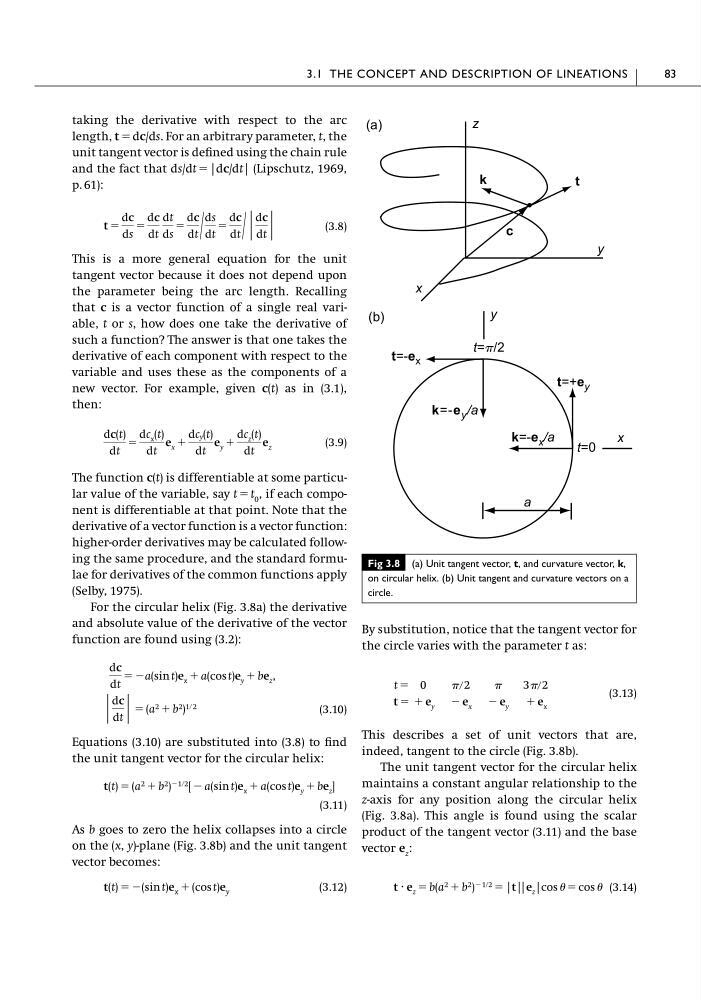
For the circular helix (Fig. 3.8a) the derivative
and absolute value of the derivative of the vector
function are found using (3.2):
(3.10)
Equations (3.10) are substituted into (3.8) to find
the unit tangent vector for the circular helix:
(3.11)
As b goes to zero the helix collapses into a circle
on the (x, y)-plane (Fig. 3.8b) and the unit tangent
vector becomes:
(3.12)
t(t) ϭ Ϫ(sin t)e x ϩ (cos t)e y
t(t) ϭ (a 2 ϩ b 2 ) Ϫ1ր2 [ Ϫ a(sin t)e x ϩ a(cos t)e y ϩ be z ]
|
dc
dt | ϭ (a 2 ϩ b 2 ) 1ր 2
dc
dt
ϭ Ϫa(sin t)e x ϩ a(cos t)e y ϩ be z ,
dc(t)
dt
ϭ
dc x (t)
dt
e x ϩ
dc y (t)
dt
e y ϩ
dc z (t)
dt
e z
t ϭ
dc
ds
ϭ
dc
dt
dt
ds
ϭ
dc
dt ր
ds
dt
ϭ
dc
dt ր |
dc
dt |
By substitution, notice that the tangent vector for
the circle varies with the parameter t as:
(3.13)
This describes a set of unit vectors that are,
indeed, tangent to the circle (Fig. 3.8b).
The unit tangent vector for the circular helix
maintains a constant angular relationship to the
z-axis for any position along the circular helix
(Fig. 3.8a). This angle is found using the scalar
product of the tangent vector (3.11) and the base
vector e z :
(3.14)
t · e z ϭ b(a 2 ϩ b 2 ) Ϫ1ր2 ϭ |t||e z |cos ϭ cos
t ϭ
t ϭ
0
ϩ e y
ր2
Ϫ e x
Ϫ e y
3ր2
ϩ e x
3.1 THE CONCEPT AND DESCRIPTION OF LINEATIONS
83
Fig 3.8 (a) Unit tangent vector, t, and curvature vector, k,
on circular helix. (b) Unit tangent and curvature vectors on a
circle.
x
y
z
(a)
(b)
c
x
y
t
k
t=0
t=-e x
t=/2
t=+e y
k=-e x /a
k= -e y /a
a
length, t ϭ dc/ds. For an arbitrary parameter, t, the
unit tangent vector is defined using the chain rule
and the fact that ds/dt ϭ |dc/dt| (Lipschutz, 1969,
p. 61):
(3.8)
This is a more general equation for the unit
tangent vector because it does not depend upon
the parameter being the arc length. Recalling
that c is a vector function of a single real variable, t or s, how does one take the derivative of
such a function? The answer is that one takes the
derivative of each component with respect to the
variable and uses these as the components of a
new vector. For example, given c(t) as in (3.1),
then:
(3.9)
The function c(t) is differentiable at some particular value of the variable, say t ϭ t 0 , if each component is differentiable at that point. Note that the
derivative of a vector function is a vector function:
higher-order derivatives may be calculated following the same procedure, and the standard formulae for derivatives of the common functions apply
(Selby, 1975).
For the circular helix (Fig. 3.8a) the derivative
and absolute value of the derivative of the vector
function are found using (3.2):
(3.10)
Equations (3.10) are substituted into (3.8) to find
the unit tangent vector for the circular helix:
(3.11)
As b goes to zero the helix collapses into a circle
on the (x, y)-plane (Fig. 3.8b) and the unit tangent
vector becomes:
(3.12)
t(t) ϭ Ϫ(sin t)e x ϩ (cos t)e y
t(t) ϭ (a 2 ϩ b 2 ) Ϫ1ր2 [ Ϫ a(sin t)e x ϩ a(cos t)e y ϩ be z ]
|
dc
dt | ϭ (a 2 ϩ b 2 ) 1ր 2
dc
dt
ϭ Ϫa(sin t)e x ϩ a(cos t)e y ϩ be z ,
dc(t)
dt
ϭ
dc x (t)
dt
e x ϩ
dc y (t)
dt
e y ϩ
dc z (t)
dt
e z
t ϭ
dc
ds
ϭ
dc
dt
dt
ds
ϭ
dc
dt ր
ds
dt
ϭ
dc
dt ր |
dc
dt |
By substitution, notice that the tangent vector for
the circle varies with the parameter t as:
(3.13)
This describes a set of unit vectors that are,
indeed, tangent to the circle (Fig. 3.8b).
The unit tangent vector for the circular helix
maintains a constant angular relationship to the
z-axis for any position along the circular helix
(Fig. 3.8a). This angle is found using the scalar
product of the tangent vector (3.11) and the base
vector e z :
(3.14)
t · e z ϭ b(a 2 ϩ b 2 ) Ϫ1ր2 ϭ |t||e z |cos ϭ cos
t ϭ
t ϭ
0
ϩ e y
ր2
Ϫ e x
Ϫ e y
3ր2
ϩ e x
3.1 THE CONCEPT AND DESCRIPTION OF LINEATIONS
83
Fig 3.8 (a) Unit tangent vector, t, and curvature vector, k,
on circular helix. (b) Unit tangent and curvature vectors on a
circle.
x
y
z
(a)
(b)
c
x
y
t
k
t=0
t=-e x
t=/2
t=+e y
k=-e x /a
k= -e y /a
a