

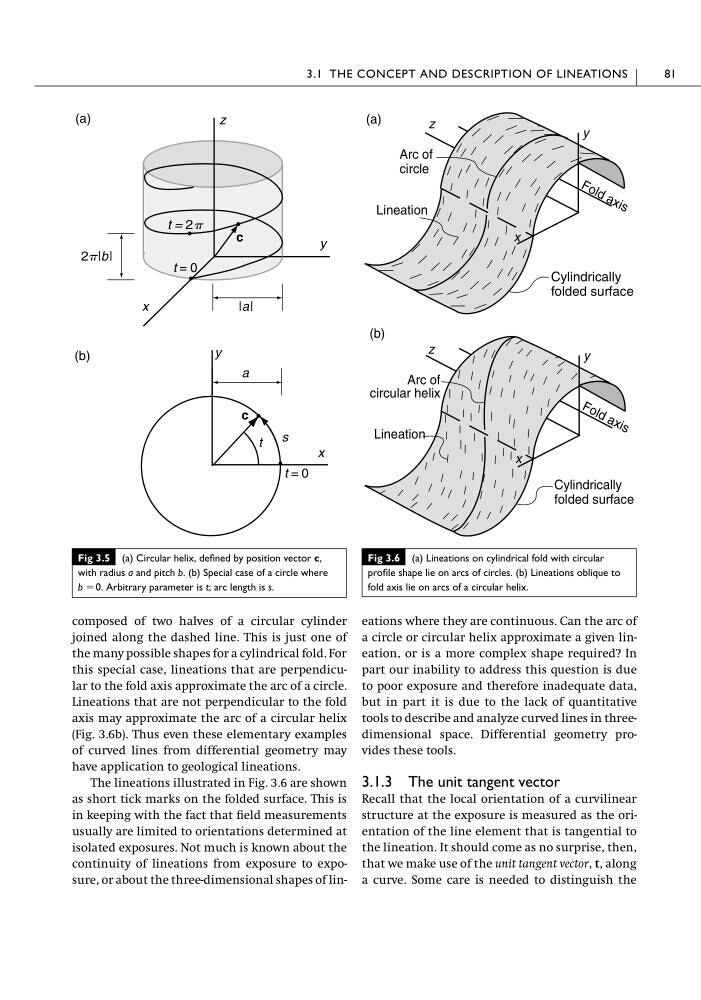
composed of two halves of a circular cylinder
joined along the dashed line. This is just one of
the many possible shapes for a cylindrical fold. For
this special case, lineations that are perpendicular to the fold axis approximate the arc of a circle.
Lineations that are not perpendicular to the fold
axis may approximate the arc of a circular helix
(Fig. 3.6b). Thus even these elementary examples
of curved lines from differential geometry may
have application to geological lineations.
The lineations illustrated in Fig. 3.6 are shown
as short tick marks on the folded surface. This is
in keeping with the fact that field measurements
usually are limited to orientations determined at
isolated exposures. Not much is known about the
continuity of lineations from exposure to exposure, or about the three-dimensional shapes of lineations where they are continuous. Can the arc of
a circle or circular helix approximate a given lineation, or is a more complex shape required? In
part our inability to address this question is due
to poor exposure and therefore inadequate data,
but in part it is due to the lack of quantitative
tools to describe and analyze curved lines in threedimensional space. Differential geometry provides these tools.
3.1.3 The unit tangent vector
Recall that the local orientation of a curvilinear
structure at the exposure is measured as the orientation of the line element that is tangential to
the lineation. It should come as no surprise, then,
that we make use of the unit tangent vector, t, along
a curve. Some care is needed to distinguish the
3.1 THE CONCEPT AND DESCRIPTION OF LINEATIONS
81
x
y
z
(a)
(b)
c
|a |
x
y
t = 0
c
t = 0
t s
a
2p|b |
t = 2p
Fig 3.5 (a) Circular helix, defined by position vector c,
with radius a and pitch b. (b) Special case of a circle where
b ϭ 0. Arbitrary parameter is t; arc length is s.
(a)
z
x
y
(b)
z
x
y
Arc of
circle
Lineation
Arc of
circular helix
Lineation
F o ld a x is
F o ld a x is
Cylindrically
folded surface
Cylindrically
folded surface
Fig 3.6 (a) Lineations on cylindrical fold with circular
profile shape lie on arcs of circles. (b) Lineations oblique to
fold axis lie on arcs of a circular helix.
joined along the dashed line. This is just one of
the many possible shapes for a cylindrical fold. For
this special case, lineations that are perpendicular to the fold axis approximate the arc of a circle.
Lineations that are not perpendicular to the fold
axis may approximate the arc of a circular helix
(Fig. 3.6b). Thus even these elementary examples
of curved lines from differential geometry may
have application to geological lineations.
The lineations illustrated in Fig. 3.6 are shown
as short tick marks on the folded surface. This is
in keeping with the fact that field measurements
usually are limited to orientations determined at
isolated exposures. Not much is known about the
continuity of lineations from exposure to exposure, or about the three-dimensional shapes of lineations where they are continuous. Can the arc of
a circle or circular helix approximate a given lineation, or is a more complex shape required? In
part our inability to address this question is due
to poor exposure and therefore inadequate data,
but in part it is due to the lack of quantitative
tools to describe and analyze curved lines in threedimensional space. Differential geometry provides these tools.
3.1.3 The unit tangent vector
Recall that the local orientation of a curvilinear
structure at the exposure is measured as the orientation of the line element that is tangential to
the lineation. It should come as no surprise, then,
that we make use of the unit tangent vector, t, along
a curve. Some care is needed to distinguish the
3.1 THE CONCEPT AND DESCRIPTION OF LINEATIONS
81
x
y
z
(a)
(b)
c
|a |
x
y
t = 0
c
t = 0
t s
a
2p|b |
t = 2p
Fig 3.5 (a) Circular helix, defined by position vector c,
with radius a and pitch b. (b) Special case of a circle where
b ϭ 0. Arbitrary parameter is t; arc length is s.
(a)
z
x
y
(b)
z
x
y
Arc of
circle
Lineation
Arc of
circular helix
Lineation
F o ld a x is
F o ld a x is
Cylindrically
folded surface
Cylindrically
folded surface
Fig 3.6 (a) Lineations on cylindrical fold with circular
profile shape lie on arcs of circles. (b) Lineations oblique to
fold axis lie on arcs of a circular helix.