

defined in terms of vector functions of a single
real variable, t, such that:
(3.1)
The three scalar functions (c x (t), c y (t), c z (t)) are the
components of the vector function with respect to
the base vectors (e x , e y , e z ). These functions, along
with the base vectors, determine the position
vectors for all points on the curve: as t varies
smoothly from one value to another, the points
c(t) ϭ c x (t)e x ϩ c y (t)e y ϩ c z (t)e z
trace out the curve. The vector equation (3.1) is
called the parametric representation of the curve,
and the real variable t is an arbitrary parameter
for this representation.
For example, consider the parametric representation for a circular helix (Fig. 3.5a) defined as
(Lipschutz, 1969, p. 63):
(3.2)
The components of this vector function and the
ranges of the constants, a and b, are:
(3.3)
The points on this curve lie on a right cylinder of
radius a with the cylindrical axis coincident with
the z-axis. As the parameter increases from t ϭ 0 to
t ϭ 2 the point on the curve “advances” in the zdirection a distance 2|b|, and the x and y components return to their original values. As t
continues to increase the points continue to
“advance” in the z-direction encircling the z-axis.
For a Ͼ 0 and b ϭ 0, (3.2) reduces to the special case
of a circle of radius a in the (x, y)-plane (Fig. 3.5b):
(3.4)
In this representation of a circle the parameter t is
the counterclockwise angle measured in radians
from 0 at the positive x-axis.
As we review the concepts of differential geometry the circular helix (3.2) and the circle (3.4) are
used as examples because they are well known
and because they are easily visualized. In the
classic review of lineations by Ernst Cloos (1946)
geological lineations are not reported with shapes
that approximate a complete circle or the full
cycle of a circular helix. However, lineations are
reported that lie on surfaces or within layers of
sedimentary or metamorphic rock that approximate a cylindrical fold (Turner and Weiss, 1963,
pp. 123–9). Folds are termed cylindrical if a
straight line moving parallel to itself can generate
the surfaces of the layers. The straight-line generator is called the fold axis. In Fig. 3.6a the idealized
shape of a folded surface containing a lineation is
c(t) ϭ a(cos t)e x ϩ a(sin t)e y (circle)
a Ͼ 0, Ϫϱ Ͻ b Ͻ ϩϱ
c z (t) ϭ bt,
c x (t) ϭ a(cos t), c y (t) ϭ a(sin t),
(circular helix)
c(t) ϭ a (cos t)e x ϩa( sin t)e y ϩbte z
80
CHARACTERIZING STRUCTURES USING DIFFERENTIAL GEOMETRY
(a)
(b)
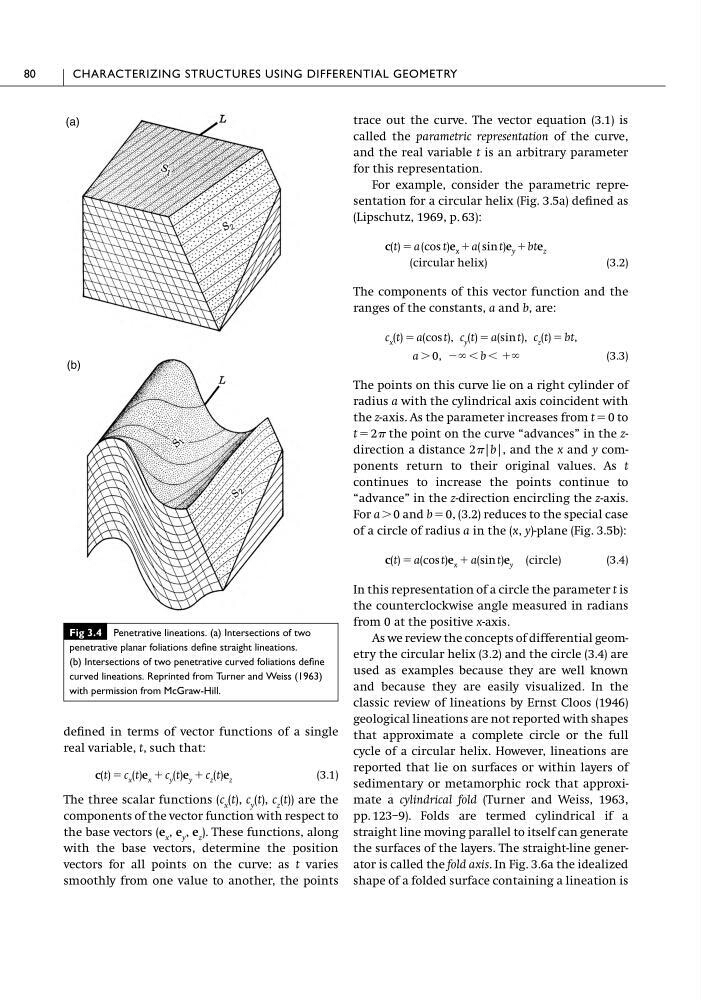
Fig 3.4 Penetrative lineations. (a) Intersections of two
penetrative planar foliations define straight lineations.
(b) Intersections of two penetrative curved foliations define
curved lineations. Reprinted from Turner and Weiss (1963)
with permission from McGraw-Hill.
real variable, t, such that:
(3.1)
The three scalar functions (c x (t), c y (t), c z (t)) are the
components of the vector function with respect to
the base vectors (e x , e y , e z ). These functions, along
with the base vectors, determine the position
vectors for all points on the curve: as t varies
smoothly from one value to another, the points
c(t) ϭ c x (t)e x ϩ c y (t)e y ϩ c z (t)e z
trace out the curve. The vector equation (3.1) is
called the parametric representation of the curve,
and the real variable t is an arbitrary parameter
for this representation.
For example, consider the parametric representation for a circular helix (Fig. 3.5a) defined as
(Lipschutz, 1969, p. 63):
(3.2)
The components of this vector function and the
ranges of the constants, a and b, are:
(3.3)
The points on this curve lie on a right cylinder of
radius a with the cylindrical axis coincident with
the z-axis. As the parameter increases from t ϭ 0 to
t ϭ 2 the point on the curve “advances” in the zdirection a distance 2|b|, and the x and y components return to their original values. As t
continues to increase the points continue to
“advance” in the z-direction encircling the z-axis.
For a Ͼ 0 and b ϭ 0, (3.2) reduces to the special case
of a circle of radius a in the (x, y)-plane (Fig. 3.5b):
(3.4)
In this representation of a circle the parameter t is
the counterclockwise angle measured in radians
from 0 at the positive x-axis.
As we review the concepts of differential geometry the circular helix (3.2) and the circle (3.4) are
used as examples because they are well known
and because they are easily visualized. In the
classic review of lineations by Ernst Cloos (1946)
geological lineations are not reported with shapes
that approximate a complete circle or the full
cycle of a circular helix. However, lineations are
reported that lie on surfaces or within layers of
sedimentary or metamorphic rock that approximate a cylindrical fold (Turner and Weiss, 1963,
pp. 123–9). Folds are termed cylindrical if a
straight line moving parallel to itself can generate
the surfaces of the layers. The straight-line generator is called the fold axis. In Fig. 3.6a the idealized
shape of a folded surface containing a lineation is
c(t) ϭ a(cos t)e x ϩ a(sin t)e y (circle)
a Ͼ 0, Ϫϱ Ͻ b Ͻ ϩϱ
c z (t) ϭ bt,
c x (t) ϭ a(cos t), c y (t) ϭ a(sin t),
(circular helix)
c(t) ϭ a (cos t)e x ϩa( sin t)e y ϩbte z
80
CHARACTERIZING STRUCTURES USING DIFFERENTIAL GEOMETRY
(a)
(b)
Fig 3.4 Penetrative lineations. (a) Intersections of two
penetrative planar foliations define straight lineations.
(b) Intersections of two penetrative curved foliations define
curved lineations. Reprinted from Turner and Weiss (1963)
with permission from McGraw-Hill.