

spatial relations of these outcrops are not depicted
on the stereogram one could not reconstruct the
curved intersection from these data. However, if
the geographic coordinates of these points were
recorded along with the attitudes one could reconstruct the curved intersection and study its geometric attributes using differential geometry.
A second type of lineation exists only on discrete surfaces such as the surfaces of a fault or
intrusive contact. An example (Fig. 3.3a) is taken
from a small fault in the Lake Edison granodiorite
in the Sierra Nevada of central California. There a
set of opening fractures formed in the granodiorite, presumably due to contraction during cooling
(Bergbauer and Martel, 1999), and these fractures
were filled with hydrothermal minerals, predominantly quartz, epidote, and chlorite (Segall and
Pollard, 1983a). During a later tectonic event
sufficient shear stress was resolved across these
weak surfaces to promote slip and the consequent
shearing of the hydrothermal minerals between
the two fault surfaces generated the slickenlines
(Segall and Pollard, 1983b; Martel et al., 1988). A
second example (Fig. 3.3b) is taken from the intrusive contact of a diorite porphyry sill in the Henry
Mountains, Utah. Here shearing of the highly
viscous magma against the sandstone host rock
generated the slickenlines (Johnson and Pollard,
1973), which are composed of fragmented
feldspar grains.
Both examples of slickenlines in Fig. 3.3 are
taken from individual exposures but nearby exposures also display these structures. If one could
observe the entire fault surface or igneous contact
surface, we suggest that the lineations would
cover much if not all of these surfaces. This type
of lineation is called a superficial lineation because
it is only found on a discrete surface. Furthermore
we suggest that the linear elements observed
locally would form coherent patterns over these
surfaces, reflecting the continuous relative
motion of the two sides of the fault and the continuous relative motion of the magma against the
host rock. That is, one could define a set of threedimensional curves lying in these surfaces that
are everywhere parallel to the local directions of
the slickenlines. These curves are the trajectories
of the relative motion of the surfaces. As with any
continuous curve the geometric attributes of
these trajectories can be defined and analyzed
using differential geometry.
In contrast consider foliations composed of
lithologic layering (Fig. 2.24a) or a set of subparallel fractures (Fig. 2.24b), or the preferred orientation of tabular mineral grains (Fig. 2.24c).
Where two roughly planar foliations with different
attitudes exist in the same rock mass, say litho78
CHARACTERIZING STRUCTURES USING DIFFERENTIAL GEOMETRY
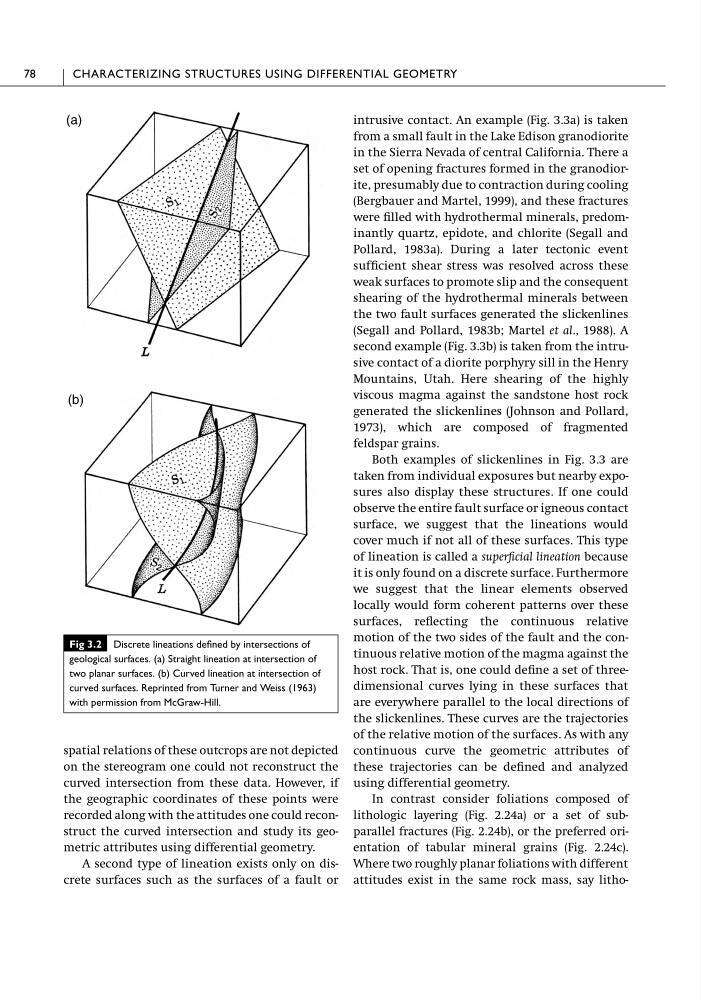
Fig 3.2 Discrete lineations defined by intersections of
geological surfaces. (a) Straight lineation at intersection of
two planar surfaces. (b) Curved lineation at intersection of
curved surfaces. Reprinted from Turner and Weiss (1963)
with permission from McGraw-Hill.
(a)
(b)
on the stereogram one could not reconstruct the
curved intersection from these data. However, if
the geographic coordinates of these points were
recorded along with the attitudes one could reconstruct the curved intersection and study its geometric attributes using differential geometry.
A second type of lineation exists only on discrete surfaces such as the surfaces of a fault or
intrusive contact. An example (Fig. 3.3a) is taken
from a small fault in the Lake Edison granodiorite
in the Sierra Nevada of central California. There a
set of opening fractures formed in the granodiorite, presumably due to contraction during cooling
(Bergbauer and Martel, 1999), and these fractures
were filled with hydrothermal minerals, predominantly quartz, epidote, and chlorite (Segall and
Pollard, 1983a). During a later tectonic event
sufficient shear stress was resolved across these
weak surfaces to promote slip and the consequent
shearing of the hydrothermal minerals between
the two fault surfaces generated the slickenlines
(Segall and Pollard, 1983b; Martel et al., 1988). A
second example (Fig. 3.3b) is taken from the intrusive contact of a diorite porphyry sill in the Henry
Mountains, Utah. Here shearing of the highly
viscous magma against the sandstone host rock
generated the slickenlines (Johnson and Pollard,
1973), which are composed of fragmented
feldspar grains.
Both examples of slickenlines in Fig. 3.3 are
taken from individual exposures but nearby exposures also display these structures. If one could
observe the entire fault surface or igneous contact
surface, we suggest that the lineations would
cover much if not all of these surfaces. This type
of lineation is called a superficial lineation because
it is only found on a discrete surface. Furthermore
we suggest that the linear elements observed
locally would form coherent patterns over these
surfaces, reflecting the continuous relative
motion of the two sides of the fault and the continuous relative motion of the magma against the
host rock. That is, one could define a set of threedimensional curves lying in these surfaces that
are everywhere parallel to the local directions of
the slickenlines. These curves are the trajectories
of the relative motion of the surfaces. As with any
continuous curve the geometric attributes of
these trajectories can be defined and analyzed
using differential geometry.
In contrast consider foliations composed of
lithologic layering (Fig. 2.24a) or a set of subparallel fractures (Fig. 2.24b), or the preferred orientation of tabular mineral grains (Fig. 2.24c).
Where two roughly planar foliations with different
attitudes exist in the same rock mass, say litho78
CHARACTERIZING STRUCTURES USING DIFFERENTIAL GEOMETRY
Fig 3.2 Discrete lineations defined by intersections of
geological surfaces. (a) Straight lineation at intersection of
two planar surfaces. (b) Curved lineation at intersection of
curved surfaces. Reprinted from Turner and Weiss (1963)
with permission from McGraw-Hill.
(a)
(b)