

3.1 The concept and description
of lineations
3.1.1 Discrete, superficial, and
penetrative lineations
Before proceeding to the analytical description of
lineations using differential geometry it is useful
to step back and review some qualitative aspects of
these structures. Some lineations are defined by
the intersection of two geological surfaces that
separate one volume of rock from another. For
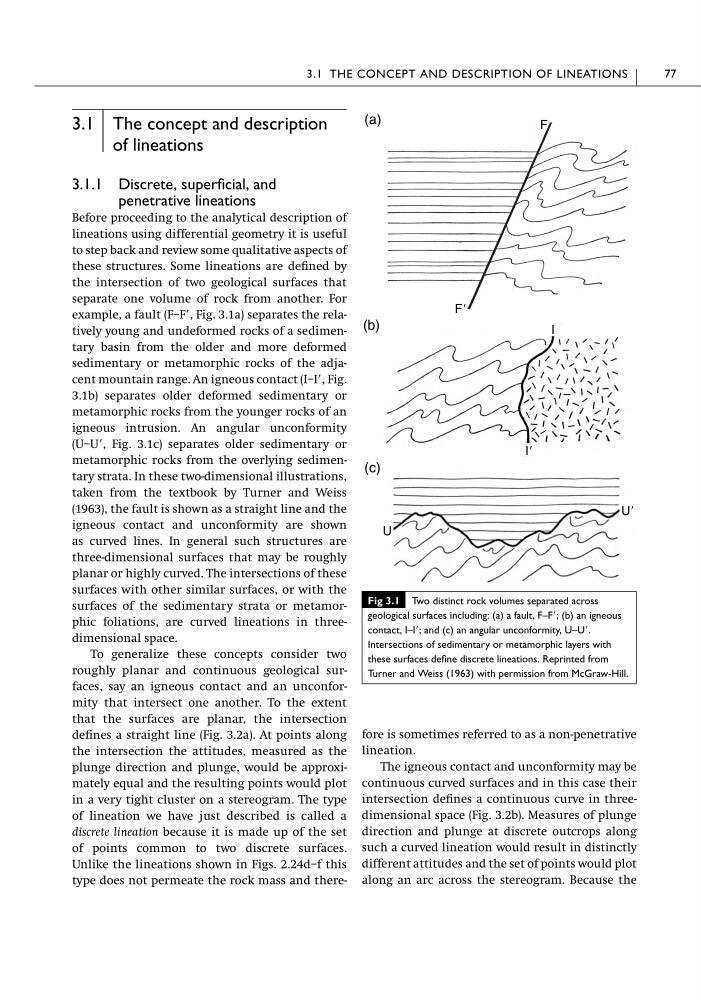
example, a fault (F–FЈ, Fig. 3.1a) separates the relatively young and undeformed rocks of a sedimentary basin from the older and more deformed
sedimentary or metamorphic rocks of the adjacent mountain range. An igneous contact (I–IЈ, Fig.
3.1b) separates older deformed sedimentary or
metamorphic rocks from the younger rocks of an
igneous intrusion. An angular unconformity
(U–UЈ, Fig. 3.1c) separates older sedimentary or
metamorphic rocks from the overlying sedimentary strata. In these two-dimensional illustrations,
taken from the textbook by Turner and Weiss
(1963), the fault is shown as a straight line and the
igneous contact and unconformity are shown
as curved lines. In general such structures are
three-dimensional surfaces that may be roughly
planar or highly curved. The intersections of these
surfaces with other similar surfaces, or with the
surfaces of the sedimentary strata or metamorphic foliations, are curved lineations in threedimensional space.
To generalize these concepts consider two
roughly planar and continuous geological surfaces, say an igneous contact and an unconformity that intersect one another. To the extent
that the surfaces are planar, the intersection
defines a straight line (Fig. 3.2a). At points along
the intersection the attitudes, measured as the
plunge direction and plunge, would be approximately equal and the resulting points would plot
in a very tight cluster on a stereogram. The type
of lineation we have just described is called a
discrete lineation because it is made up of the set
of points common to two discrete surfaces.
Unlike the lineations shown in Figs. 2.24d–f this
type does not permeate the rock mass and therefore is sometimes referred to as a non-penetrative
lineation.
The igneous contact and unconformity may be
continuous curved surfaces and in this case their
intersection defines a continuous curve in threedimensional space (Fig. 3.2b). Measures of plunge
direction and plunge at discrete outcrops along
such a curved lineation would result in distinctly
different attitudes and the set of points would plot
along an arc across the stereogram. Because the
3.1 THE CONCEPT AND DESCRIPTION OF LINEATIONS
77
Fig 3.1 Two distinct rock volumes separated across
geological surfaces including: (a) a fault, F–FЈ; (b) an igneous
contact, I–IЈ; and (c) an angular unconformity, U–UЈ.
Intersections of sedimentary or metamorphic layers with
these surfaces define discrete lineations. Reprinted from
Turner and Weiss (1963) with permission from McGraw-Hill.
(a)
(b)
(c)
F
FЈ
I
IЈ
U
UЈ
of lineations
3.1.1 Discrete, superficial, and
penetrative lineations
Before proceeding to the analytical description of
lineations using differential geometry it is useful
to step back and review some qualitative aspects of
these structures. Some lineations are defined by
the intersection of two geological surfaces that
separate one volume of rock from another. For
example, a fault (F–FЈ, Fig. 3.1a) separates the relatively young and undeformed rocks of a sedimentary basin from the older and more deformed
sedimentary or metamorphic rocks of the adjacent mountain range. An igneous contact (I–IЈ, Fig.
3.1b) separates older deformed sedimentary or
metamorphic rocks from the younger rocks of an
igneous intrusion. An angular unconformity
(U–UЈ, Fig. 3.1c) separates older sedimentary or
metamorphic rocks from the overlying sedimentary strata. In these two-dimensional illustrations,
taken from the textbook by Turner and Weiss
(1963), the fault is shown as a straight line and the
igneous contact and unconformity are shown
as curved lines. In general such structures are
three-dimensional surfaces that may be roughly
planar or highly curved. The intersections of these
surfaces with other similar surfaces, or with the
surfaces of the sedimentary strata or metamorphic foliations, are curved lineations in threedimensional space.
To generalize these concepts consider two
roughly planar and continuous geological surfaces, say an igneous contact and an unconformity that intersect one another. To the extent
that the surfaces are planar, the intersection
defines a straight line (Fig. 3.2a). At points along
the intersection the attitudes, measured as the
plunge direction and plunge, would be approximately equal and the resulting points would plot
in a very tight cluster on a stereogram. The type
of lineation we have just described is called a
discrete lineation because it is made up of the set
of points common to two discrete surfaces.
Unlike the lineations shown in Figs. 2.24d–f this
type does not permeate the rock mass and therefore is sometimes referred to as a non-penetrative
lineation.
The igneous contact and unconformity may be
continuous curved surfaces and in this case their
intersection defines a continuous curve in threedimensional space (Fig. 3.2b). Measures of plunge
direction and plunge at discrete outcrops along
such a curved lineation would result in distinctly
different attitudes and the set of points would plot
along an arc across the stereogram. Because the
3.1 THE CONCEPT AND DESCRIPTION OF LINEATIONS
77
Fig 3.1 Two distinct rock volumes separated across
geological surfaces including: (a) a fault, F–FЈ; (b) an igneous
contact, I–IЈ; and (c) an angular unconformity, U–UЈ.
Intersections of sedimentary or metamorphic layers with
these surfaces define discrete lineations. Reprinted from
Turner and Weiss (1963) with permission from McGraw-Hill.
(a)
(b)
(c)
F
FЈ
I
IЈ
U
UЈ