

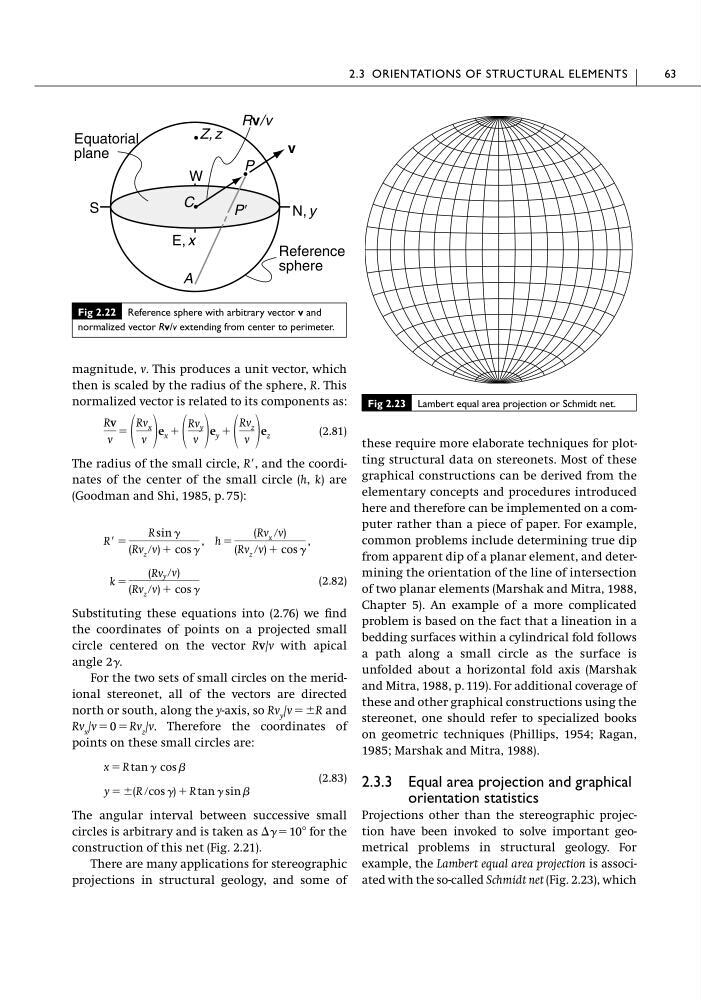
magnitude, v. This produces a unit vector, which
then is scaled by the radius of the sphere, R. This
normalized vector is related to its components as:
(2.81)
The radius of the small circle, R�, and the coordinates of the center of the small circle (h, k) are
(Goodman and Shi, 1985, p. 75):
(2.82)
Substituting these equations into (2.76) we find
the coordinates of points on a projected small
circle centered on the vector Rv/v with apical
angle 2�.
For the two sets of small circles on the meridional stereonet, all of the vectors are directed
north or south, along the y-axis, so Rv y /v ��R and
Rv x /v � 0 � Rv z /v. Therefore the coordinates of
points on these small circles are:
(2.83)
The angular interval between successive small
circles is arbitrary and is taken as �� � 10� for the
construction of this net (Fig. 2.21).
There are many applications for stereographic
projections in structural geology, and some of
y � �(R �cos �) � R tan � sin �
x � R tan � cos �
k �
(Rv y �v)
(Rv z �v) � cos �
R� �
R sin �
(Rv z �v) � cos �
, h �
(Rv x �v)
(Rv z �v) � cos �
,
Rv
v
�
Rv x
v e x �
Rv y
v e y �
Rv z
v e z
these require more elaborate techniques for plotting structural data on stereonets. Most of these
graphical constructions can be derived from the
elementary concepts and procedures introduced
here and therefore can be implemented on a computer rather than a piece of paper. For example,
common problems include determining true dip
from apparent dip of a planar element, and determining the orientation of the line of intersection
of two planar elements (Marshak and Mitra, 1988,
Chapter 5). An example of a more complicated
problem is based on the fact that a lineation in a
bedding surfaces within a cylindrical fold follows
a path along a small circle as the surface is
unfolded about a horizontal fold axis (Marshak
and Mitra, 1988, p. 119). For additional coverage of
these and other graphical constructions using the
stereonet, one should refer to specialized books
on geometric techniques (Phillips, 1954; Ragan,
1985; Marshak and Mitra, 1988).
2.3.3 Equal area projection and graphical
orientation statistics
Projections other than the stereographic projection have been invoked to solve important geometrical problems in structural geology. For
example, the Lambert equal area projection is associated with the so-called Schmidt net (Fig. 2.23), which
2.3 ORIENTATIONS OF STRUCTURAL ELEMENTS
63
Fig 2.22 Reference sphere with arbitrary vector v and
normalized vector Rv/v extending from center to perimeter.
W
S
Z, z
P
P�
C
v
Rv/v
A
E, x
Equatorial
plane
N, y
Reference
sphere
Fig 2.23 Lambert equal area projection or Schmidt net.
then is scaled by the radius of the sphere, R. This
normalized vector is related to its components as:
(2.81)
The radius of the small circle, R�, and the coordinates of the center of the small circle (h, k) are
(Goodman and Shi, 1985, p. 75):
(2.82)
Substituting these equations into (2.76) we find
the coordinates of points on a projected small
circle centered on the vector Rv/v with apical
angle 2�.
For the two sets of small circles on the meridional stereonet, all of the vectors are directed
north or south, along the y-axis, so Rv y /v ��R and
Rv x /v � 0 � Rv z /v. Therefore the coordinates of
points on these small circles are:
(2.83)
The angular interval between successive small
circles is arbitrary and is taken as �� � 10� for the
construction of this net (Fig. 2.21).
There are many applications for stereographic
projections in structural geology, and some of
y � �(R �cos �) � R tan � sin �
x � R tan � cos �
k �
(Rv y �v)
(Rv z �v) � cos �
R� �
R sin �
(Rv z �v) � cos �
, h �
(Rv x �v)
(Rv z �v) � cos �
,
Rv
v
�
Rv x
v e x �
Rv y
v e y �
Rv z
v e z
these require more elaborate techniques for plotting structural data on stereonets. Most of these
graphical constructions can be derived from the
elementary concepts and procedures introduced
here and therefore can be implemented on a computer rather than a piece of paper. For example,
common problems include determining true dip
from apparent dip of a planar element, and determining the orientation of the line of intersection
of two planar elements (Marshak and Mitra, 1988,
Chapter 5). An example of a more complicated
problem is based on the fact that a lineation in a
bedding surfaces within a cylindrical fold follows
a path along a small circle as the surface is
unfolded about a horizontal fold axis (Marshak
and Mitra, 1988, p. 119). For additional coverage of
these and other graphical constructions using the
stereonet, one should refer to specialized books
on geometric techniques (Phillips, 1954; Ragan,
1985; Marshak and Mitra, 1988).
2.3.3 Equal area projection and graphical
orientation statistics
Projections other than the stereographic projection have been invoked to solve important geometrical problems in structural geology. For
example, the Lambert equal area projection is associated with the so-called Schmidt net (Fig. 2.23), which
2.3 ORIENTATIONS OF STRUCTURAL ELEMENTS
63
Fig 2.22 Reference sphere with arbitrary vector v and
normalized vector Rv/v extending from center to perimeter.
W
S
Z, z
P
P�
C
v
Rv/v
A
E, x
Equatorial
plane
N, y
Reference
sphere
Fig 2.23 Lambert equal area projection or Schmidt net.