

coordinates (2.41). Using indicial notation and in
expanded form these direction cosines are
written:
(2.52)
The matrix representation of the direction
cosines follows quite naturally because the row
and column numbers of the matrix, M, are the
same as the indices of m ij :
(2.53)
This is a 3 by 3 matrix and any matrix where the
number of rows and columns are identical, m ϭ n,
is termed a square matrix. The number of rows and
columns is referred to as the order of a matrix
and, in general, there are no restrictions on the
order of a matrix.
Just as two vectors are added (or subtracted)
component by component (2.12) two matrices are
added (or subtracted) element by element. For
example, the addition of two 3 by 2 matrices, Q
and R, is carried out as:
(2.54)
This results in a row matrix of exactly the same
order, 3 by 2. The addition (or subtraction) of
matrices requires that they be of the same order.
The 3 by 2 matrix R is scaled by a constant
numerical factor as follows:
(2.55)
In general, the multiplication of a matrix by a constant is accomplished by multiplying each
element of the matrix by that constant. The division of a matrix by a constant is equivalent to multiplying by the reciprocal of that constant.
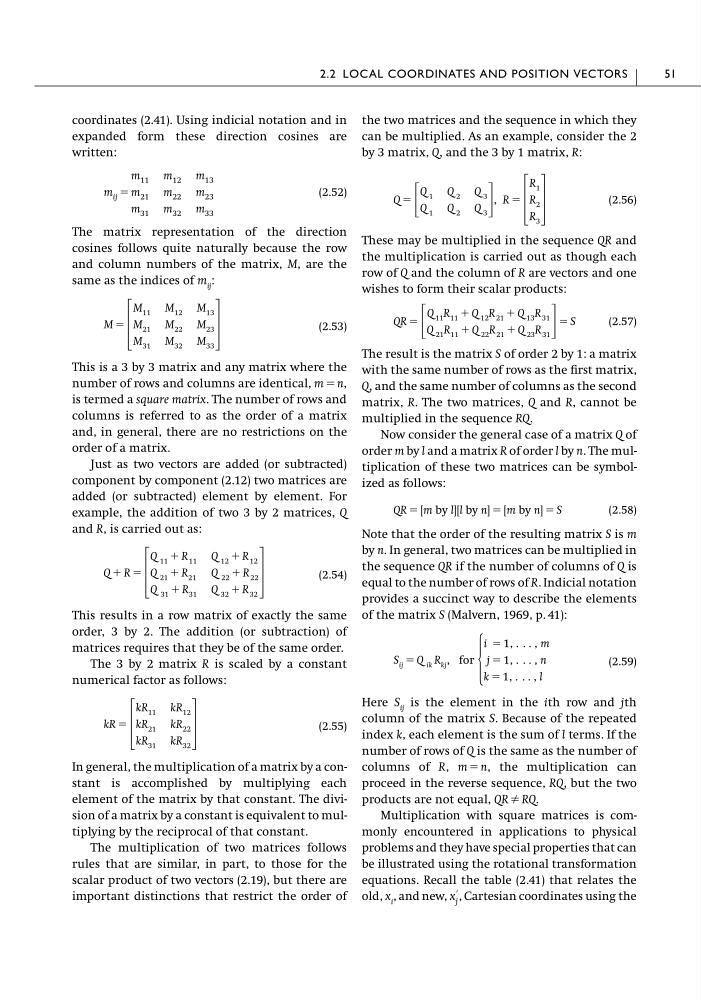
The multiplication of two matrices follows
rules that are similar, in part, to those for the
scalar product of two vectors (2.19), but there are
important distinctions that restrict the order of
kR ϭ
΄
kR 11 kR 12
kR 21 kR 22
kR 31 kR 32
΅
Q ϩ R ϭ
΄
Q 11 ϩ R 11 Q 12 ϩ R 12
Q 21 ϩ R 21 Q 22 ϩ R 22
Q 31 ϩ R 31 Q 32 ϩ R 32
΅
M ϭ
΄
M 11 M 12 M 13
M 21 M 22 M 23
M 31 M 32 M 33
΅
m ij ϭ
m 11 m 12 m 13
m 21 m 22 m 23
m 31 m 32 m 33
the two matrices and the sequence in which they
can be multiplied. As an example, consider the 2
by 3 matrix, Q, and the 3 by 1 matrix, R:
(2.56)
These may be multiplied in the sequence QR and
the multiplication is carried out as though each
row of Q and the column of R are vectors and one
wishes to form their scalar products:
(2.57)
The result is the matrix S of order 2 by 1: a matrix
with the same number of rows as the first matrix,
Q, and the same number of columns as the second
matrix, R. The two matrices, Q and R, cannot be
multiplied in the sequence RQ.
Now consider the general case of a matrix Q of
order m by l and a matrix R of order l by n. The multiplication of these two matrices can be symbolized as follows:
(2.58)
Note that the order of the resulting matrix S is m
by n. In general, two matrices can be multiplied in
the sequence QR if the number of columns of Q is
equal to the number of rows of R. Indicial notation
provides a succinct way to describe the elements
of the matrix S (Malvern, 1969, p. 41):
(2.59)
Here S ij is the element in the ith row and jth
column of the matrix S. Because of the repeated
index k, each element is the sum of l terms. If the
number of rows of Q is the same as the number of
columns of R, m ϭ n, the multiplication can
proceed in the reverse sequence, RQ, but the two
products are not equal, QR RQ.
Multiplication with square matrices is commonly encountered in applications to physical
problems and they have special properties that can
be illustrated using the rotational transformation
equations. Recall the table (2.41) that relates the
old, x i , and new, , Cartesian coordinates using the
x Ј
j
S ij ϭ Q ik R kj , for
Ά
i ϭ 1, . . . , m
j ϭ 1, . . . , n
k ϭ 1, . . . , l
QR ϭ [m by l][l by n] ϭ [m by n] ϭ S
QR ϭ ΄
Q 11 R 11 ϩ Q 12 R 21 ϩ Q 13 R 31
Q 21 R 11 ϩ Q 22 R 21 ϩ Q 23 R 31 ΅ ϭ S
Q ϭ ΄
Q 1 Q 2 Q 3
Q 1 Q 2 Q 3
΅ , R ϭ ΄
R 1
R 2
R 3
΅
2.2 LOCAL COORDINATES AND POSITION VECTORS
51
expanded form these direction cosines are
written:
(2.52)
The matrix representation of the direction
cosines follows quite naturally because the row
and column numbers of the matrix, M, are the
same as the indices of m ij :
(2.53)
This is a 3 by 3 matrix and any matrix where the
number of rows and columns are identical, m ϭ n,
is termed a square matrix. The number of rows and
columns is referred to as the order of a matrix
and, in general, there are no restrictions on the
order of a matrix.
Just as two vectors are added (or subtracted)
component by component (2.12) two matrices are
added (or subtracted) element by element. For
example, the addition of two 3 by 2 matrices, Q
and R, is carried out as:
(2.54)
This results in a row matrix of exactly the same
order, 3 by 2. The addition (or subtraction) of
matrices requires that they be of the same order.
The 3 by 2 matrix R is scaled by a constant
numerical factor as follows:
(2.55)
In general, the multiplication of a matrix by a constant is accomplished by multiplying each
element of the matrix by that constant. The division of a matrix by a constant is equivalent to multiplying by the reciprocal of that constant.
The multiplication of two matrices follows
rules that are similar, in part, to those for the
scalar product of two vectors (2.19), but there are
important distinctions that restrict the order of
kR ϭ
΄
kR 11 kR 12
kR 21 kR 22
kR 31 kR 32
΅
Q ϩ R ϭ
΄
Q 11 ϩ R 11 Q 12 ϩ R 12
Q 21 ϩ R 21 Q 22 ϩ R 22
Q 31 ϩ R 31 Q 32 ϩ R 32
΅
M ϭ
΄
M 11 M 12 M 13
M 21 M 22 M 23
M 31 M 32 M 33
΅
m ij ϭ
m 11 m 12 m 13
m 21 m 22 m 23
m 31 m 32 m 33
the two matrices and the sequence in which they
can be multiplied. As an example, consider the 2
by 3 matrix, Q, and the 3 by 1 matrix, R:
(2.56)
These may be multiplied in the sequence QR and
the multiplication is carried out as though each
row of Q and the column of R are vectors and one
wishes to form their scalar products:
(2.57)
The result is the matrix S of order 2 by 1: a matrix
with the same number of rows as the first matrix,
Q, and the same number of columns as the second
matrix, R. The two matrices, Q and R, cannot be
multiplied in the sequence RQ.
Now consider the general case of a matrix Q of
order m by l and a matrix R of order l by n. The multiplication of these two matrices can be symbolized as follows:
(2.58)
Note that the order of the resulting matrix S is m
by n. In general, two matrices can be multiplied in
the sequence QR if the number of columns of Q is
equal to the number of rows of R. Indicial notation
provides a succinct way to describe the elements
of the matrix S (Malvern, 1969, p. 41):
(2.59)
Here S ij is the element in the ith row and jth
column of the matrix S. Because of the repeated
index k, each element is the sum of l terms. If the
number of rows of Q is the same as the number of
columns of R, m ϭ n, the multiplication can
proceed in the reverse sequence, RQ, but the two
products are not equal, QR RQ.
Multiplication with square matrices is commonly encountered in applications to physical
problems and they have special properties that can
be illustrated using the rotational transformation
equations. Recall the table (2.41) that relates the
old, x i , and new, , Cartesian coordinates using the
x Ј
j
S ij ϭ Q ik R kj , for
Ά
i ϭ 1, . . . , m
j ϭ 1, . . . , n
k ϭ 1, . . . , l
QR ϭ [m by l][l by n] ϭ [m by n] ϭ S
QR ϭ ΄
Q 11 R 11 ϩ Q 12 R 21 ϩ Q 13 R 31
Q 21 R 11 ϩ Q 22 R 21 ϩ Q 23 R 31 ΅ ϭ S
Q ϭ ΄
Q 1 Q 2 Q 3
Q 1 Q 2 Q 3
΅ , R ϭ ΄
R 1
R 2
R 3
΅
2.2 LOCAL COORDINATES AND POSITION VECTORS
51