

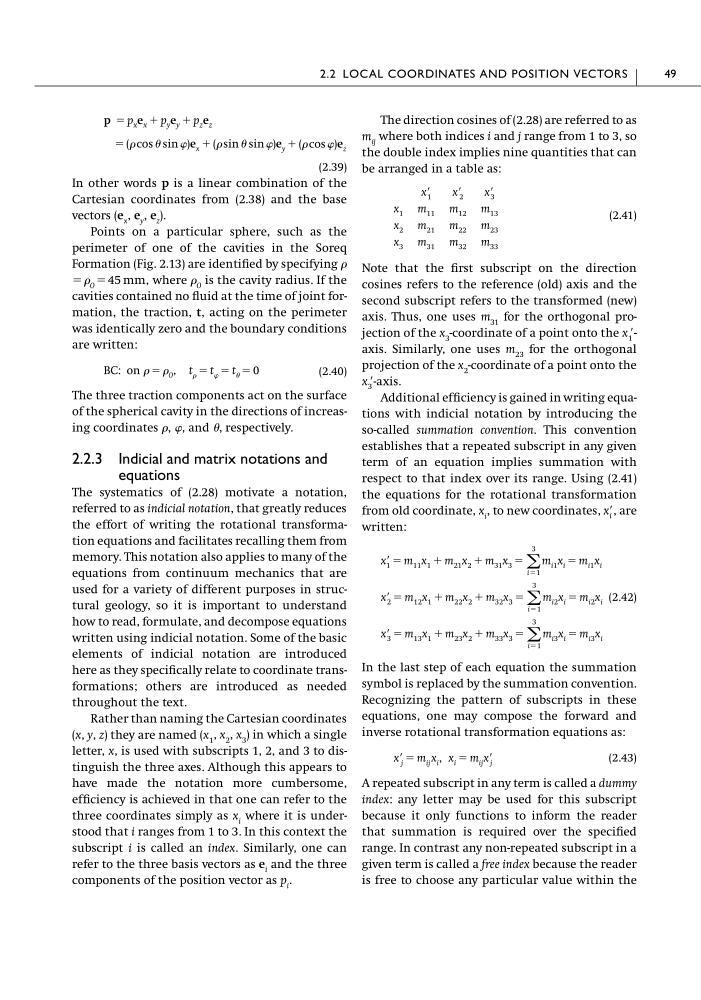
(2.39)
In other words p is a linear combination of the
Cartesian coordinates from (2.38) and the base
vectors (e x , e y , e z ).
Points on a particular sphere, such as the
perimeter of one of the cavities in the Soreq
Formation (Fig. 2.13) are identified by specifying
ϭ O ϭ 45 mm, where O is the cavity radius. If the
cavities contained no fluid at the time of joint formation, the traction, t, acting on the perimeter
was identically zero and the boundary conditions
are written:
(2.40)
The three traction components act on the surface
of the spherical cavity in the directions of increasing coordinates , , and , respectively.
2.2.3 Indicial and matrix notations and
equations
The systematics of (2.28) motivate a notation,
referred to as indicial notation, that greatly reduces
the effort of writing the rotational transformation equations and facilitates recalling them from
memory. This notation also applies to many of the
equations from continuum mechanics that are
used for a variety of different purposes in structural geology, so it is important to understand
how to read, formulate, and decompose equations
written using indicial notation. Some of the basic
elements of indicial notation are introduced
here as they specifically relate to coordinate transformations; others are introduced as needed
throughout the text.
Rather than naming the Cartesian coordinates
(x, y, z) they are named (x 1 , x 2 , x 3 ) in which a single
letter, x, is used with subscripts 1, 2, and 3 to distinguish the three axes. Although this appears to
have made the notation more cumbersome,
efficiency is achieved in that one can refer to the
three coordinates simply as x i where it is understood that i ranges from 1 to 3. In this context the
subscript i is called an index. Similarly, one can
refer to the three basis vectors as e i and the three
components of the position vector as p i .
BC: on ϭ O , t ϭ t ϭ t ϭ 0
ϩ ( cos )e z
ϭ ( cos sin )e x ϩ ( sin sin )e y
p ϭ p x e x ϩ p y e y ϩ p z e z
The direction cosines of (2.28) are referred to as
m ij where both indices i and j range from 1 to 3, so
the double index implies nine quantities that can
be arranged in a table as:
(2.41)
Note that the first subscript on the direction
cosines refers to the reference (old) axis and the
second subscript refers to the transformed (new)
axis. Thus, one uses m 31 for the orthogonal projection of the x 3 -coordinate of a point onto the -
axis. Similarly, one uses m 23 for the orthogonal
projection of the x 2 -coordinate of a point onto the
-axis.
Additional efficiency is gained in writing equations with indicial notation by introducing the
so-called summation convention. This convention
establishes that a repeated subscript in any given
term of an equation implies summation with
respect to that index over its range. Using (2.41)
the equations for the rotational transformation
from old coordinate, x i , to new coordinates, , are
written:
(2.42)
In the last step of each equation the summation
symbol is replaced by the summation convention.
Recognizing the pattern of subscripts in these
equations, one may compose the forward and
inverse rotational transformation equations as:
(2.43)
A repeated subscript in any term is called a dummy
index: any letter may be used for this subscript
because it only functions to inform the reader
that summation is required over the specified
range. In contrast any non-repeated subscript in a
given term is called a free index because the reader
is free to choose any particular value within the
xЈ j ϭ m ij x i , x i ϭ m ij xЈ j
xЈ 3 ϭ m 13 x 1 ϩ m 23 x 2 ϩ m 33 x 3 ϭ ͚
3
iϭ1
m i3 x i ϭ m i3 x i
xЈ 2 ϭ m 12 x 1 ϩ m 22 x 2 ϩ m 32 x 3 ϭ ͚
3
iϭ1
m i2 x i ϭ m i2 x i
xЈ 1 ϭ m 11 x 1 ϩ m 21 x 2 ϩ m 31 x 3 ϭ ͚
3
iϭ1
m i1 x i ϭ m i1 x i
x i
Ј
x 3 Ј
x 1 Ј
xЈ 1
xЈ 2
xЈ 3
x 1 m 11 m 12 m 13
x 2 m 21 m 22 m 23
x 3 m 31 m 32 m 33
2.2 LOCAL COORDINATES AND POSITION VECTORS
49
In other words p is a linear combination of the
Cartesian coordinates from (2.38) and the base
vectors (e x , e y , e z ).
Points on a particular sphere, such as the
perimeter of one of the cavities in the Soreq
Formation (Fig. 2.13) are identified by specifying
ϭ O ϭ 45 mm, where O is the cavity radius. If the
cavities contained no fluid at the time of joint formation, the traction, t, acting on the perimeter
was identically zero and the boundary conditions
are written:
(2.40)
The three traction components act on the surface
of the spherical cavity in the directions of increasing coordinates , , and , respectively.
2.2.3 Indicial and matrix notations and
equations
The systematics of (2.28) motivate a notation,
referred to as indicial notation, that greatly reduces
the effort of writing the rotational transformation equations and facilitates recalling them from
memory. This notation also applies to many of the
equations from continuum mechanics that are
used for a variety of different purposes in structural geology, so it is important to understand
how to read, formulate, and decompose equations
written using indicial notation. Some of the basic
elements of indicial notation are introduced
here as they specifically relate to coordinate transformations; others are introduced as needed
throughout the text.
Rather than naming the Cartesian coordinates
(x, y, z) they are named (x 1 , x 2 , x 3 ) in which a single
letter, x, is used with subscripts 1, 2, and 3 to distinguish the three axes. Although this appears to
have made the notation more cumbersome,
efficiency is achieved in that one can refer to the
three coordinates simply as x i where it is understood that i ranges from 1 to 3. In this context the
subscript i is called an index. Similarly, one can
refer to the three basis vectors as e i and the three
components of the position vector as p i .
BC: on ϭ O , t ϭ t ϭ t ϭ 0
ϩ ( cos )e z
ϭ ( cos sin )e x ϩ ( sin sin )e y
p ϭ p x e x ϩ p y e y ϩ p z e z
The direction cosines of (2.28) are referred to as
m ij where both indices i and j range from 1 to 3, so
the double index implies nine quantities that can
be arranged in a table as:
(2.41)
Note that the first subscript on the direction
cosines refers to the reference (old) axis and the
second subscript refers to the transformed (new)
axis. Thus, one uses m 31 for the orthogonal projection of the x 3 -coordinate of a point onto the -
axis. Similarly, one uses m 23 for the orthogonal
projection of the x 2 -coordinate of a point onto the
-axis.
Additional efficiency is gained in writing equations with indicial notation by introducing the
so-called summation convention. This convention
establishes that a repeated subscript in any given
term of an equation implies summation with
respect to that index over its range. Using (2.41)
the equations for the rotational transformation
from old coordinate, x i , to new coordinates, , are
written:
(2.42)
In the last step of each equation the summation
symbol is replaced by the summation convention.
Recognizing the pattern of subscripts in these
equations, one may compose the forward and
inverse rotational transformation equations as:
(2.43)
A repeated subscript in any term is called a dummy
index: any letter may be used for this subscript
because it only functions to inform the reader
that summation is required over the specified
range. In contrast any non-repeated subscript in a
given term is called a free index because the reader
is free to choose any particular value within the
xЈ j ϭ m ij x i , x i ϭ m ij xЈ j
xЈ 3 ϭ m 13 x 1 ϩ m 23 x 2 ϩ m 33 x 3 ϭ ͚
3
iϭ1
m i3 x i ϭ m i3 x i
xЈ 2 ϭ m 12 x 1 ϩ m 22 x 2 ϩ m 32 x 3 ϭ ͚
3
iϭ1
m i2 x i ϭ m i2 x i
xЈ 1 ϭ m 11 x 1 ϩ m 21 x 2 ϩ m 31 x 3 ϭ ͚
3
iϭ1
m i1 x i ϭ m i1 x i
x i
Ј
x 3 Ј
x 1 Ј
xЈ 1
xЈ 2
xЈ 3
x 1 m 11 m 12 m 13
x 2 m 21 m 22 m 23
x 3 m 31 m 32 m 33
2.2 LOCAL COORDINATES AND POSITION VECTORS
49