

marily of a volcanic igneous rock called minette,
but breccias of minette and Mancos Shale crop
out around the perimeter. From the side of the
neck a thin dike extends about 440 m to the
northeast along a gently curving outcrop (Fig.
2.5a), and a dike with similar trend extends from
the opposite side of the neck a few meters to the
southwest. The crosscutting relationships (Fig.
2.10b) between the minette of the dike and the
minette and breccias of the neck suggest that the
dike formed first and solidified while local brecciation and erosion of the Mancos Shale and the
dike rock enabled the neck to grow in diameter to
its present size (Delaney and Pollard, 1981). This
interpretation is surprising because the analogy
to hydraulic fracturing of wells (Hubbert and
Willis, 1957) would suggest that the neck formed
first and that pressurized magma in the neck fractured the contact, initiating dike propagation
into the Mancos Shale. The interpretation that
dikes form first and necks grow from them is supported by observations on active volcanoes where
short-lived fissure eruptions precede longer-lived
eruptions from cylindrical vents located along
the fissure.
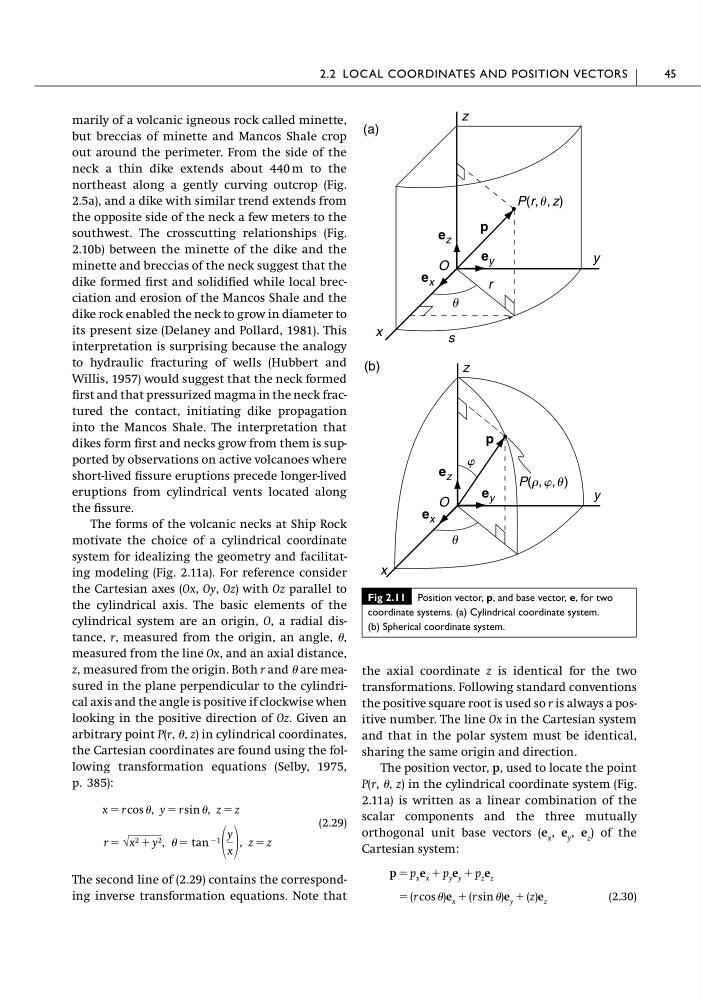
The forms of the volcanic necks at Ship Rock
motivate the choice of a cylindrical coordinate
system for idealizing the geometry and facilitating modeling (Fig. 2.11a). For reference consider
the Cartesian axes (Ox, Oy, Oz) with Oz parallel to
the cylindrical axis. The basic elements of the
cylindrical system are an origin, O, a radial distance, r, measured from the origin, an angle, ,
measured from the line Ox, and an axial distance,
z, measured from the origin. Both r and are measured in the plane perpendicular to the cylindrical axis and the angle is positive if clockwise when
looking in the positive direction of Oz. Given an
arbitrary point P(r, , z) in cylindrical coordinates,
the Cartesian coordinates are found using the following transformation equations (Selby, 1975,
p. 385):
(2.29)
The second line of (2.29) contains the corresponding inverse transformation equations. Note that
r ϭ √x 2 ϩ y 2 , ϭ tan Ϫ1
y
x , z ϭ z
x ϭ r cos , y ϭ r sin , z ϭ z
the axial coordinate z is identical for the two
transformations. Following standard conventions
the positive square root is used so r is always a positive number. The line Ox in the Cartesian system
and that in the polar system must be identical,
sharing the same origin and direction.
The position vector, p, used to locate the point
P(r, , z) in the cylindrical coordinate system (Fig.
2.11a) is written as a linear combination of the
scalar components and the three mutually
orthogonal unit base vectors (e x , e y , e z ) of the
Cartesian system:
(2.30)
ϭ (r cos )e x ϩ (r sin )e y ϩ (z)e z
p ϭ p x e x ϩ p y e y ϩ p z e z
2.2 LOCAL COORDINATES AND POSITION VECTORS
45
(a)
x
y
z
O
r
u
(b)
x
y
z
O
u
w
p
e y
e z
e x
p
s
P(r, u, z)
e y
e z
e x
P(r, w, u)
Fig 2.11 Position vector, p, and base vector, e, for two
coordinate systems. (a) Cylindrical coordinate system.
(b) Spherical coordinate system.
but breccias of minette and Mancos Shale crop
out around the perimeter. From the side of the
neck a thin dike extends about 440 m to the
northeast along a gently curving outcrop (Fig.
2.5a), and a dike with similar trend extends from
the opposite side of the neck a few meters to the
southwest. The crosscutting relationships (Fig.
2.10b) between the minette of the dike and the
minette and breccias of the neck suggest that the
dike formed first and solidified while local brecciation and erosion of the Mancos Shale and the
dike rock enabled the neck to grow in diameter to
its present size (Delaney and Pollard, 1981). This
interpretation is surprising because the analogy
to hydraulic fracturing of wells (Hubbert and
Willis, 1957) would suggest that the neck formed
first and that pressurized magma in the neck fractured the contact, initiating dike propagation
into the Mancos Shale. The interpretation that
dikes form first and necks grow from them is supported by observations on active volcanoes where
short-lived fissure eruptions precede longer-lived
eruptions from cylindrical vents located along
the fissure.
The forms of the volcanic necks at Ship Rock
motivate the choice of a cylindrical coordinate
system for idealizing the geometry and facilitating modeling (Fig. 2.11a). For reference consider
the Cartesian axes (Ox, Oy, Oz) with Oz parallel to
the cylindrical axis. The basic elements of the
cylindrical system are an origin, O, a radial distance, r, measured from the origin, an angle, ,
measured from the line Ox, and an axial distance,
z, measured from the origin. Both r and are measured in the plane perpendicular to the cylindrical axis and the angle is positive if clockwise when
looking in the positive direction of Oz. Given an
arbitrary point P(r, , z) in cylindrical coordinates,
the Cartesian coordinates are found using the following transformation equations (Selby, 1975,
p. 385):
(2.29)
The second line of (2.29) contains the corresponding inverse transformation equations. Note that
r ϭ √x 2 ϩ y 2 , ϭ tan Ϫ1
y
x , z ϭ z
x ϭ r cos , y ϭ r sin , z ϭ z
the axial coordinate z is identical for the two
transformations. Following standard conventions
the positive square root is used so r is always a positive number. The line Ox in the Cartesian system
and that in the polar system must be identical,
sharing the same origin and direction.
The position vector, p, used to locate the point
P(r, , z) in the cylindrical coordinate system (Fig.
2.11a) is written as a linear combination of the
scalar components and the three mutually
orthogonal unit base vectors (e x , e y , e z ) of the
Cartesian system:
(2.30)
ϭ (r cos )e x ϩ (r sin )e y ϩ (z)e z
p ϭ p x e x ϩ p y e y ϩ p z e z
2.2 LOCAL COORDINATES AND POSITION VECTORS
45
(a)
x
y
z
O
r
u
(b)
x
y
z
O
u
w
p
e y
e z
e x
p
s
P(r, u, z)
e y
e z
e x
P(r, w, u)
Fig 2.11 Position vector, p, and base vector, e, for two
coordinate systems. (a) Cylindrical coordinate system.
(b) Spherical coordinate system.