

The inverse transformation for the components of
a position vector, or for the base vectors, follows
from (2.16) by analogy with (2.14) and (2.15).
Coordinates of points on the Ship Rock map in
the rotated local system (xЈ, yЈ, zЈ), and components of position vectors referred to that system,
are transformed to the UTM grid by a translation
of the origin using the following equations:
(2.17)
Notice that the transformation is accomplished
by adding to the local coordinates the coordinates
of the local origin referred to the UTM system.
The transformation of local coordinates at the
Ship Rock site to the UTM grid is an example of
a translation from one rectangular (Cartesian)
system to another rectangular system with parallel axes (Fig. 2.6d). For the purpose of generalizing
this discussion we refer to (x, y, z) as the old system
and (xЈ, yЈ, zЈ) as the new system, with origins at O
and OЈ, respectively. For every point, P(x, y, z),
referred to the old coordinate system, the rectangular coordinates in the new system are found
using the following expressions:
(2.18)
Here the constants (a, b, and c) are the coordinates
of the origin, OЈ, of the new system as written with
respect to the old system. That is, the origin of the
old system is translated a distance a along x and a
distance b along y and a distance c along z from
the origin of the old system (Fig. 2.6d). The inverse
of this transformation is found algebraically by
rearranging the three equations to solve for x, y,
and z, respectively.
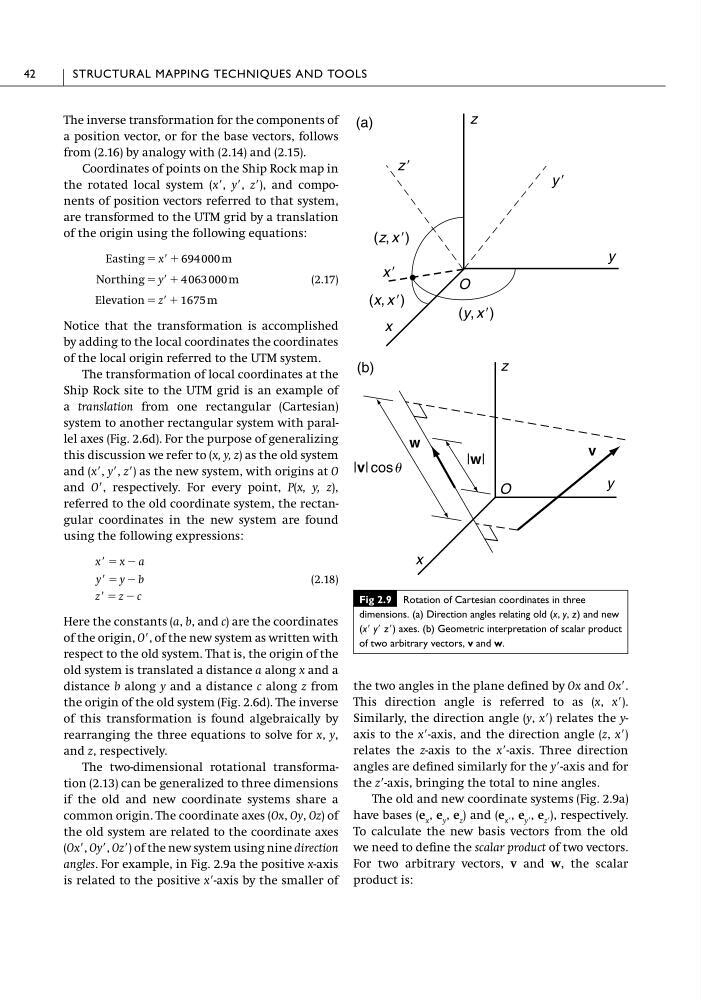
The two-dimensional rotational transformation (2.13) can be generalized to three dimensions
if the old and new coordinate systems share a
common origin. The coordinate axes (Ox, Oy, Oz) of
the old system are related to the coordinate axes
(OxЈ, OyЈ, OzЈ) of the new system using nine direction
angles. For example, in Fig. 2.9a the positive x-axis
is related to the positive xЈ-axis by the smaller of
zЈ ϭ z Ϫ c
yЈ ϭ y Ϫ b
xЈ ϭ x Ϫ a
Elevation ϭ zЈ ϩ 1675 m
Northing ϭ yЈ ϩ 4 063 000 m
Easting ϭ xЈ ϩ 694 000 m
the two angles in the plane defined by Ox and OxЈ.
This direction angle is referred to as (x, xЈ).
Similarly, the direction angle (y, xЈ) relates the yaxis to the xЈ-axis, and the direction angle (z, xЈ)
relates the z-axis to the xЈ-axis. Three direction
angles are defined similarly for the yЈ-axis and for
the zЈ-axis, bringing the total to nine angles.
The old and new coordinate systems (Fig. 2.9a)
have bases (e x , e y , e z ) and (e xЈ , e yЈ , e zЈ ), respectively.
To calculate the new basis vectors from the old
we need to define the scalar product of two vectors.
For two arbitrary vectors, v and w, the scalar
product is:
42
STRUCTURAL MAPPING TECHNIQUES AND TOOLS
yЈ
zЈ
xЈ
x
y
z
(a)
(x, xЈ)
(z, xЈ)
(y, xЈ)
(b)
O
x
y
z
O
v
w
|v| cos u
|w|
Fig 2.9 Rotation of Cartesian coordinates in three
dimensions. (a) Direction angles relating old (x, y, z) and new
(xЈ yЈ zЈ) axes. (b) Geometric interpretation of scalar product
of two arbitrary vectors, v and w.
a position vector, or for the base vectors, follows
from (2.16) by analogy with (2.14) and (2.15).
Coordinates of points on the Ship Rock map in
the rotated local system (xЈ, yЈ, zЈ), and components of position vectors referred to that system,
are transformed to the UTM grid by a translation
of the origin using the following equations:
(2.17)
Notice that the transformation is accomplished
by adding to the local coordinates the coordinates
of the local origin referred to the UTM system.
The transformation of local coordinates at the
Ship Rock site to the UTM grid is an example of
a translation from one rectangular (Cartesian)
system to another rectangular system with parallel axes (Fig. 2.6d). For the purpose of generalizing
this discussion we refer to (x, y, z) as the old system
and (xЈ, yЈ, zЈ) as the new system, with origins at O
and OЈ, respectively. For every point, P(x, y, z),
referred to the old coordinate system, the rectangular coordinates in the new system are found
using the following expressions:
(2.18)
Here the constants (a, b, and c) are the coordinates
of the origin, OЈ, of the new system as written with
respect to the old system. That is, the origin of the
old system is translated a distance a along x and a
distance b along y and a distance c along z from
the origin of the old system (Fig. 2.6d). The inverse
of this transformation is found algebraically by
rearranging the three equations to solve for x, y,
and z, respectively.
The two-dimensional rotational transformation (2.13) can be generalized to three dimensions
if the old and new coordinate systems share a
common origin. The coordinate axes (Ox, Oy, Oz) of
the old system are related to the coordinate axes
(OxЈ, OyЈ, OzЈ) of the new system using nine direction
angles. For example, in Fig. 2.9a the positive x-axis
is related to the positive xЈ-axis by the smaller of
zЈ ϭ z Ϫ c
yЈ ϭ y Ϫ b
xЈ ϭ x Ϫ a
Elevation ϭ zЈ ϩ 1675 m
Northing ϭ yЈ ϩ 4 063 000 m
Easting ϭ xЈ ϩ 694 000 m
the two angles in the plane defined by Ox and OxЈ.
This direction angle is referred to as (x, xЈ).
Similarly, the direction angle (y, xЈ) relates the yaxis to the xЈ-axis, and the direction angle (z, xЈ)
relates the z-axis to the xЈ-axis. Three direction
angles are defined similarly for the yЈ-axis and for
the zЈ-axis, bringing the total to nine angles.
The old and new coordinate systems (Fig. 2.9a)
have bases (e x , e y , e z ) and (e xЈ , e yЈ , e zЈ ), respectively.
To calculate the new basis vectors from the old
we need to define the scalar product of two vectors.
For two arbitrary vectors, v and w, the scalar
product is:
42
STRUCTURAL MAPPING TECHNIQUES AND TOOLS
yЈ
zЈ
xЈ
x
y
z
(a)
(x, xЈ)
(z, xЈ)
(y, xЈ)
(b)
O
x
y
z
O
v
w
|v| cos u
|w|
Fig 2.9 Rotation of Cartesian coordinates in three
dimensions. (a) Direction angles relating old (x, y, z) and new
(xЈ yЈ zЈ) axes. (b) Geometric interpretation of scalar product
of two arbitrary vectors, v and w.