

(11.120)
Because this set of equations is complete and selfcontained, it demonstrates that the component is
in fact linearly independent of all others. A perturbation that is not a single linearly independent
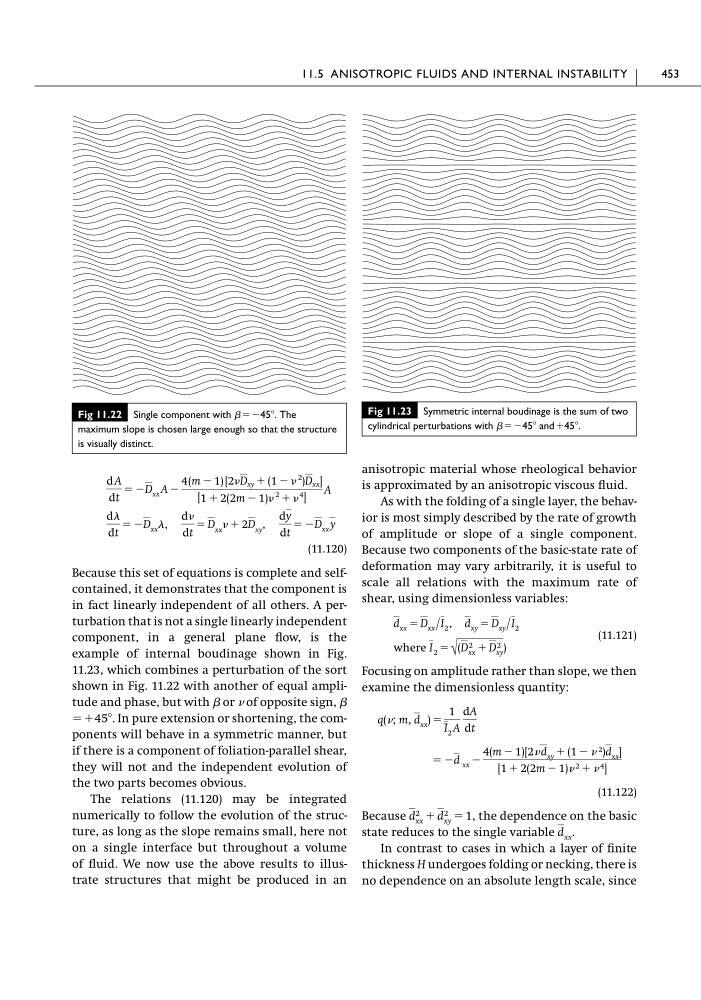
component, in a general plane flow, is the
example of internal boudinage shown in Fig.
11.23, which combines a perturbation of the sort
shown in Fig. 11.22 with another of equal amplitude and phase, but with  or of opposite sign, 
ϭϩ45Њ. In pure extension or shortening, the components will behave in a symmetric manner, but
if there is a component of foliation-parallel shear,
they will not and the independent evolution of
the two parts becomes obvious.
The relations (11.120) may be integrated
numerically to follow the evolution of the structure, as long as the slope remains small, here not
on a single interface but throughout a volume
of fluid. We now use the above results to illustrate structures that might be produced in an
d
dt
ϭ ϪD xx ,
d
dt
ϭ D xx ϩ 2D xy ,
dy
dt
ϭ ϪD xx y
d A
dt
ϭ ϪD xx A Ϫ
4(m Ϫ 1) [2D xy ϩ (1 Ϫ
2
)D xx ]
[1 ϩ 2(2m Ϫ 1)
2 ϩ
4 ]
A
anisotropic material whose rheological behavior
is approximated by an anisotropic viscous fluid.
As with the folding of a single layer, the behavior is most simply described by the rate of growth
of amplitude or slope of a single component.
Because two components of the basic-state rate of
deformation may vary arbitrarily, it is useful to
scale all relations with the maximum rate of
shear, using dimensionless variables:
(11.121)
Focusing on amplitude rather than slope, we then
examine the dimensionless quantity:
(11.122)
Because
the dependence on the basic
state reduces to the single variable
In contrast to cases in which a layer of finite
thickness H undergoes folding or necking, there is
no dependence on an absolute length scale, since
d xx .
d 2
xx ϩ d 2
xy ϭ 1,
ϭ Ϫd xx Ϫ
4(m Ϫ 1)[2 d xy ϩ (1 Ϫ 2 )d xx ]
[1 ϩ 2(2m Ϫ 1) 2 ϩ 4 ]
q(; m, d xx ) ϭ
1
I 2 A
dA
dt
where I 2 ϭ √ (D 2
xx ϩ D 2
xy )
d xx ϭ D xx ր I 2 , d xy ϭ D xy ր I 2
11.5 ANISOTROPIC FLUIDS AND INTERNAL INSTABILITY
453
Fig 11.22 Single component with ϭϪ45Њ. The
maximum slope is chosen large enough so that the structure
is visually distinct.
Fig 11.23 Symmetric internal boudinage is the sum of two
cylindrical perturbations with ϭϪ45Њ andϩ45Њ.
Because this set of equations is complete and selfcontained, it demonstrates that the component is
in fact linearly independent of all others. A perturbation that is not a single linearly independent
component, in a general plane flow, is the
example of internal boudinage shown in Fig.
11.23, which combines a perturbation of the sort
shown in Fig. 11.22 with another of equal amplitude and phase, but with  or of opposite sign, 
ϭϩ45Њ. In pure extension or shortening, the components will behave in a symmetric manner, but
if there is a component of foliation-parallel shear,
they will not and the independent evolution of
the two parts becomes obvious.
The relations (11.120) may be integrated
numerically to follow the evolution of the structure, as long as the slope remains small, here not
on a single interface but throughout a volume
of fluid. We now use the above results to illustrate structures that might be produced in an
d
dt
ϭ ϪD xx ,
d
dt
ϭ D xx ϩ 2D xy ,
dy
dt
ϭ ϪD xx y
d A
dt
ϭ ϪD xx A Ϫ
4(m Ϫ 1) [2D xy ϩ (1 Ϫ
2
)D xx ]
[1 ϩ 2(2m Ϫ 1)
2 ϩ
4 ]
A
anisotropic material whose rheological behavior
is approximated by an anisotropic viscous fluid.
As with the folding of a single layer, the behavior is most simply described by the rate of growth
of amplitude or slope of a single component.
Because two components of the basic-state rate of
deformation may vary arbitrarily, it is useful to
scale all relations with the maximum rate of
shear, using dimensionless variables:
(11.121)
Focusing on amplitude rather than slope, we then
examine the dimensionless quantity:
(11.122)
Because
the dependence on the basic
state reduces to the single variable
In contrast to cases in which a layer of finite
thickness H undergoes folding or necking, there is
no dependence on an absolute length scale, since
d xx .
d 2
xx ϩ d 2
xy ϭ 1,
ϭ Ϫd xx Ϫ
4(m Ϫ 1)[2 d xy ϩ (1 Ϫ 2 )d xx ]
[1 ϩ 2(2m Ϫ 1) 2 ϩ 4 ]
q(; m, d xx ) ϭ
1
I 2 A
dA
dt
where I 2 ϭ √ (D 2
xx ϩ D 2
xy )
d xx ϭ D xx ր I 2 , d xy ϭ D xy ր I 2
11.5 ANISOTROPIC FLUIDS AND INTERNAL INSTABILITY
453
Fig 11.22 Single component with ϭϪ45Њ. The
maximum slope is chosen large enough so that the structure
is visually distinct.
Fig 11.23 Symmetric internal boudinage is the sum of two
cylindrical perturbations with ϭϪ45Њ andϩ45Њ.