

none exists. That is, in principle, structures may
occur at any scale within the material. What is
selected for in the bulk deformation is the most
rapidly amplified band orientation, or, alternatively, that which has received the maximum
cumulative amplification. In reality, in a rock like
schist, the grain scale provides a lower limit on
the scale of coherent structures produced, but
often the schist will also exhibit a compositional
lamination, so that structures may occur in
response to several scales of microscopic structure
that give anisotropy. Indeed, the largest perturbations are often present at one or both of these
smallest scales at which coherent deformations
can take place. Hence, structures will commonly
occur at these scales, but, in principle, they may
also occur at larger scales as is often observed
(Price and Cosgrove, 1990).
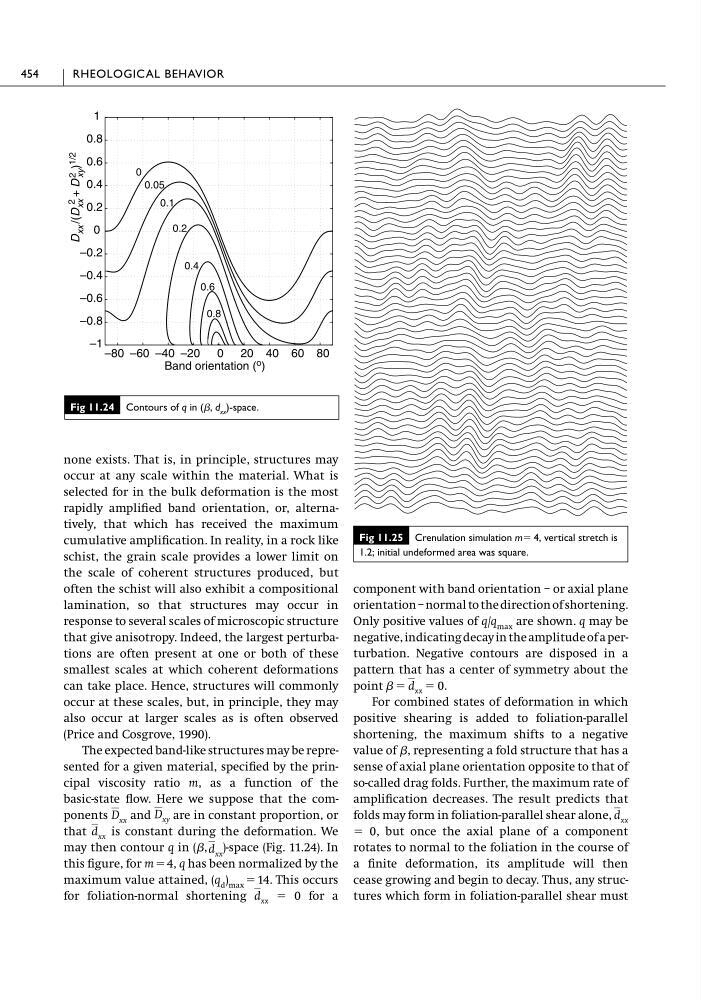
The expected band-like structures may be represented for a given material, specified by the principal viscosity ratio m, as a function of the
basic-state flow. Here we suppose that the components
and
are in constant proportion, or
that
is constant during the deformation. We
may then contour q in (, )-space (Fig. 11.24). In
this figure, for m ϭ 4, q has been normalized by the
maximum value attained, (q d ) max ϭ 14. This occurs
for foliation-normal shortening
ϭ 0 for a
d xx
d xx
d xx
D xy
D xx
component with band orientation – or axial plane
orientation – normal to the direction of shortening.
Only positive values of q/q max are shown. q may be
negative, indicating decay in the amplitude of a perturbation. Negative contours are disposed in a
pattern that has a center of symmetry about the
point  ϭ ϭ0.
For combined states of deformation in which
positive shearing is added to foliation-parallel
shortening, the maximum shifts to a negative
value of , representing a fold structure that has a
sense of axial plane orientation opposite to that of
so-called drag folds. Further, the maximum rate of
amplification decreases. The result predicts that
folds may form in foliation-parallel shear alone,
ϭ 0, but once the axial plane of a component
rotates to normal to the foliation in the course of
a finite deformation, its amplitude will then
cease growing and begin to decay. Thus, any structures which form in foliation-parallel shear must
d xx
d xx
454
RHEOLOGICAL BEHAVIOR
Fig 11.24 Contours of q in (, d xx )-space.
–80 –60 –40 –20 0 20 40 60 80
–1
–0.8
–0.6
–0.4
–0.2
0
0.2
0.4
0.6
0.8
1
0
0.05
0.1
Band orientation ( o )
D
xx /(D
xx +
D 2
xy ) 1/2
2
0.2
0.4
0.6
0.8
Fig 11.25 Crenulation simulation mϭ 4, vertical stretch is
1.2; initial undeformed area was square.
occur at any scale within the material. What is
selected for in the bulk deformation is the most
rapidly amplified band orientation, or, alternatively, that which has received the maximum
cumulative amplification. In reality, in a rock like
schist, the grain scale provides a lower limit on
the scale of coherent structures produced, but
often the schist will also exhibit a compositional
lamination, so that structures may occur in
response to several scales of microscopic structure
that give anisotropy. Indeed, the largest perturbations are often present at one or both of these
smallest scales at which coherent deformations
can take place. Hence, structures will commonly
occur at these scales, but, in principle, they may
also occur at larger scales as is often observed
(Price and Cosgrove, 1990).
The expected band-like structures may be represented for a given material, specified by the principal viscosity ratio m, as a function of the
basic-state flow. Here we suppose that the components
and
are in constant proportion, or
that
is constant during the deformation. We
may then contour q in (, )-space (Fig. 11.24). In
this figure, for m ϭ 4, q has been normalized by the
maximum value attained, (q d ) max ϭ 14. This occurs
for foliation-normal shortening
ϭ 0 for a
d xx
d xx
d xx
D xy
D xx
component with band orientation – or axial plane
orientation – normal to the direction of shortening.
Only positive values of q/q max are shown. q may be
negative, indicating decay in the amplitude of a perturbation. Negative contours are disposed in a
pattern that has a center of symmetry about the
point  ϭ ϭ0.
For combined states of deformation in which
positive shearing is added to foliation-parallel
shortening, the maximum shifts to a negative
value of , representing a fold structure that has a
sense of axial plane orientation opposite to that of
so-called drag folds. Further, the maximum rate of
amplification decreases. The result predicts that
folds may form in foliation-parallel shear alone,
ϭ 0, but once the axial plane of a component
rotates to normal to the foliation in the course of
a finite deformation, its amplitude will then
cease growing and begin to decay. Thus, any structures which form in foliation-parallel shear must
d xx
d xx
454
RHEOLOGICAL BEHAVIOR
Fig 11.24 Contours of q in (, d xx )-space.
–80 –60 –40 –20 0 20 40 60 80
–1
–0.8
–0.6
–0.4
–0.2
0
0.2
0.4
0.6
0.8
1
0
0.05
0.1
Band orientation ( o )
D
xx /(D
xx +
D 2
xy ) 1/2
2
0.2
0.4
0.6
0.8
Fig 11.25 Crenulation simulation mϭ 4, vertical stretch is
1.2; initial undeformed area was square.