

11.5.1 Deformation of an anisotropic
viscous fluid
Modeling of ductile deformation of a rock volume
is appropriately treated using the constitutive relations for a continuum that captures the bulk
rheological behavior at the scale of interest.
Understanding that this approximation applies to
a composite material, we realize that suitable constitutive relations may be needed to describe anisotropic behavior, as for a layered or foliated
material, a composite mass with a strong shape
fabric, or a polycrystalline material with lattice
preferred orientation, or a material in which all of
these elements contribute to rheological anisotropy. Further, all of these factors and others,
such as composition, will contribute to inhomogeneity. In some cases, such inhomogeneity as in a
volume of metamorphic or sedimentary rock may
be approximated by a set of a discrete layers or
bodies of other shape, e.g. inclusions, which are
themselves homogeneous. This is useful when the
contrast in mean properties of the discrete bodies
is much greater than that exhibited by internal
heterogeneity. Types of structures arising in this
case, such as folds and pinch-and-swell structures,
have been treated earlier in this chapter and in
Chapter 10. In the present case, we consider the
other alternative of a continuous variation in
properties at the scale of interest.
We consider a body in which the degree of heterogeneity is small, and may therefore be treated
as a perturbation on a homogeneous material. This
restriction has four anticipated consequences:
1. Analysis may be carried out by linearization
about a basic state and is therefore tractable.
2. Both in the analysis and in the physical interpretation of the results, any heterogeneous
current distribution of properties, the associated velocity field, and the relations describing
the evolving deformation and modification in
the distributions of properties may be broken
up into independent components, e.g. the
Fourier components whose linear superposition gives the distribution or field.
3. Physical intuition is most readily obtained by
focusing on the behavior of the individual components.
4. To interpret a naturally deformed rock mass,
we would initially explore the scales and patterns of the deformation and inferred constitutive behavior in terms of these components.
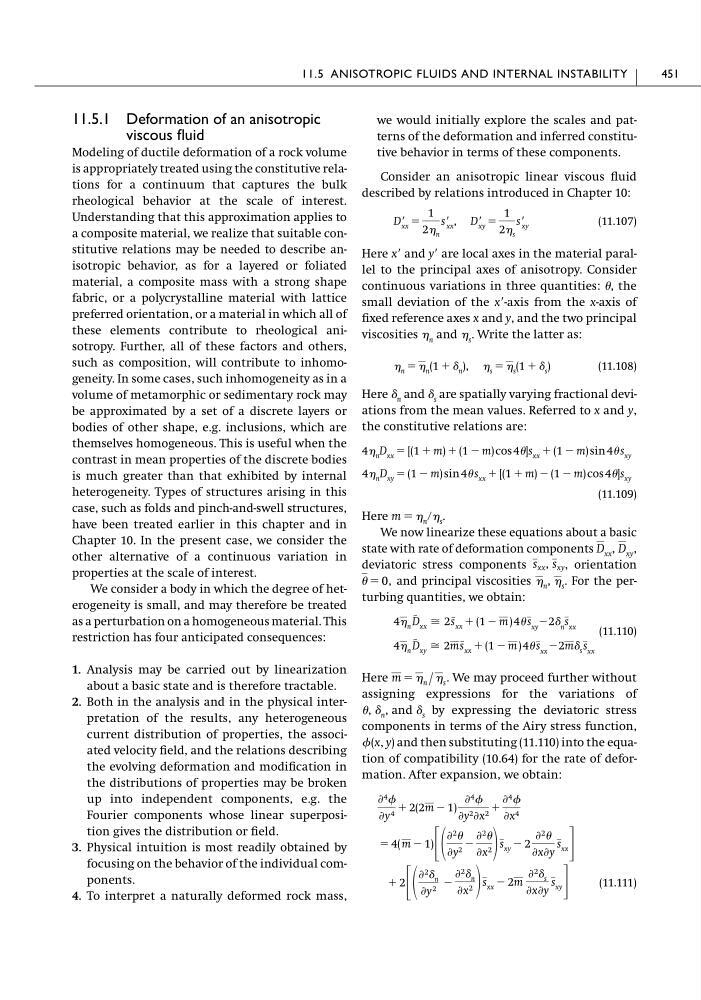
Consider an anisotropic linear viscous fluid
described by relations introduced in Chapter 10:
(11.107)
Here xЈ and yЈ are local axes in the material parallel to the principal axes of anisotropy. Consider
continuous variations in three quantities: , the
small deviation of the xЈ-axis from the x-axis of
fixed reference axes x and y, and the two principal
viscosities n and s . Write the latter as:
(11.108)
Here and are spatially varying fractional deviations from the mean values. Referred to x and y,
the constitutive relations are:
(11.109)
Here
We now linearize these equations about a basic
state with rate of deformation components
deviatoric stress components
, orientation
and principal viscosities
For the perturbing quantities, we obtain:
(11.110)
Here
We may proceed further without
assigning expressions for the variations of
by expressing the deviatoric stress
components in terms of the Airy stress function,
(x, y) and then substituting (11.110) into the equation of compatibility (10.64) for the rate of deformation. After expansion, we obtain:
(11.111)
ϩ 2
΄
Ѩ 2 ␦ n
Ѩy 2 Ϫ
Ѩ 2 ␦ n
Ѩx 2
s xx Ϫ 2m
Ѩ 2 ␦ s
ѨxѨy
s xy ΅
ϭ 4( m Ϫ 1) ΄
Ѩ 2
Ѩy 2 Ϫ
Ѩ 2
Ѩx 2 s xy Ϫ 2
Ѩ 2
ѨxѨy
s xx ΅
Ѩ 4
Ѩy 4 ϩ 2(2m Ϫ 1)
Ѩ 4
Ѩy 2 Ѩx 2 ϩ
Ѩ 4
Ѩx 4
, ␦ n , and ␦ s
m ϭ n ր s ˇ .
4 n D
~
xy Х 2ms ~
xx ϩ (1 Ϫ m ) 4 s xx Ϫ2m␦ s s xx
4 n D
~
xx Х 2s ~
xx ϩ (1 Ϫ m ) 4 s xy Ϫ2␦ n s xx
n , s .
ϭ 0,
s xx , s xy
D xx , D xy ,
m ϭ n ր s ˇ .
4 n D xy ϭ (1 Ϫ m) sin 4 s xx ϩ [(1 ϩ m) Ϫ (1 Ϫ m) cos 4]s xy
4 n D xx ϭ [(1 ϩ m) ϩ (1 Ϫ m) cos 4]s xx ϩ (1 Ϫ m) sin 4 s xy
␦ s
␦ n
n ϭ n (1 ϩ ␦ n ), s ϭ s (1 ϩ ␦ s )
DЈ xx ϭ
1
2 n
sЈ xx , DЈ xy ϭ
1
2 s
sЈ xy
11.5 ANISOTROPIC FLUIDS AND INTERNAL INSTABILITY
451
viscous fluid
Modeling of ductile deformation of a rock volume
is appropriately treated using the constitutive relations for a continuum that captures the bulk
rheological behavior at the scale of interest.
Understanding that this approximation applies to
a composite material, we realize that suitable constitutive relations may be needed to describe anisotropic behavior, as for a layered or foliated
material, a composite mass with a strong shape
fabric, or a polycrystalline material with lattice
preferred orientation, or a material in which all of
these elements contribute to rheological anisotropy. Further, all of these factors and others,
such as composition, will contribute to inhomogeneity. In some cases, such inhomogeneity as in a
volume of metamorphic or sedimentary rock may
be approximated by a set of a discrete layers or
bodies of other shape, e.g. inclusions, which are
themselves homogeneous. This is useful when the
contrast in mean properties of the discrete bodies
is much greater than that exhibited by internal
heterogeneity. Types of structures arising in this
case, such as folds and pinch-and-swell structures,
have been treated earlier in this chapter and in
Chapter 10. In the present case, we consider the
other alternative of a continuous variation in
properties at the scale of interest.
We consider a body in which the degree of heterogeneity is small, and may therefore be treated
as a perturbation on a homogeneous material. This
restriction has four anticipated consequences:
1. Analysis may be carried out by linearization
about a basic state and is therefore tractable.
2. Both in the analysis and in the physical interpretation of the results, any heterogeneous
current distribution of properties, the associated velocity field, and the relations describing
the evolving deformation and modification in
the distributions of properties may be broken
up into independent components, e.g. the
Fourier components whose linear superposition gives the distribution or field.
3. Physical intuition is most readily obtained by
focusing on the behavior of the individual components.
4. To interpret a naturally deformed rock mass,
we would initially explore the scales and patterns of the deformation and inferred constitutive behavior in terms of these components.
Consider an anisotropic linear viscous fluid
described by relations introduced in Chapter 10:
(11.107)
Here xЈ and yЈ are local axes in the material parallel to the principal axes of anisotropy. Consider
continuous variations in three quantities: , the
small deviation of the xЈ-axis from the x-axis of
fixed reference axes x and y, and the two principal
viscosities n and s . Write the latter as:
(11.108)
Here and are spatially varying fractional deviations from the mean values. Referred to x and y,
the constitutive relations are:
(11.109)
Here
We now linearize these equations about a basic
state with rate of deformation components
deviatoric stress components
, orientation
and principal viscosities
For the perturbing quantities, we obtain:
(11.110)
Here
We may proceed further without
assigning expressions for the variations of
by expressing the deviatoric stress
components in terms of the Airy stress function,
(x, y) and then substituting (11.110) into the equation of compatibility (10.64) for the rate of deformation. After expansion, we obtain:
(11.111)
ϩ 2
΄
Ѩ 2 ␦ n
Ѩy 2 Ϫ
Ѩ 2 ␦ n
Ѩx 2
s xx Ϫ 2m
Ѩ 2 ␦ s
ѨxѨy
s xy ΅
ϭ 4( m Ϫ 1) ΄
Ѩ 2
Ѩy 2 Ϫ
Ѩ 2
Ѩx 2 s xy Ϫ 2
Ѩ 2
ѨxѨy
s xx ΅
Ѩ 4
Ѩy 4 ϩ 2(2m Ϫ 1)
Ѩ 4
Ѩy 2 Ѩx 2 ϩ
Ѩ 4
Ѩx 4
, ␦ n , and ␦ s
m ϭ n ր s ˇ .
4 n D
~
xy Х 2ms ~
xx ϩ (1 Ϫ m ) 4 s xx Ϫ2m␦ s s xx
4 n D
~
xx Х 2s ~
xx ϩ (1 Ϫ m ) 4 s xy Ϫ2␦ n s xx
n , s .
ϭ 0,
s xx , s xy
D xx , D xy ,
m ϭ n ր s ˇ .
4 n D xy ϭ (1 Ϫ m) sin 4 s xx ϩ [(1 ϩ m) Ϫ (1 Ϫ m) cos 4]s xy
4 n D xx ϭ [(1 ϩ m) ϩ (1 Ϫ m) cos 4]s xx ϩ (1 Ϫ m) sin 4 s xy
␦ s
␦ n
n ϭ n (1 ϩ ␦ n ), s ϭ s (1 ϩ ␦ s )
DЈ xx ϭ
1
2 n
sЈ xx , DЈ xy ϭ
1
2 s
sЈ xy
11.5 ANISOTROPIC FLUIDS AND INTERNAL INSTABILITY
451