

randomly from a population with variable geometry but given volume fractions of the two components. The bounds provide information on the
possible range of variation.
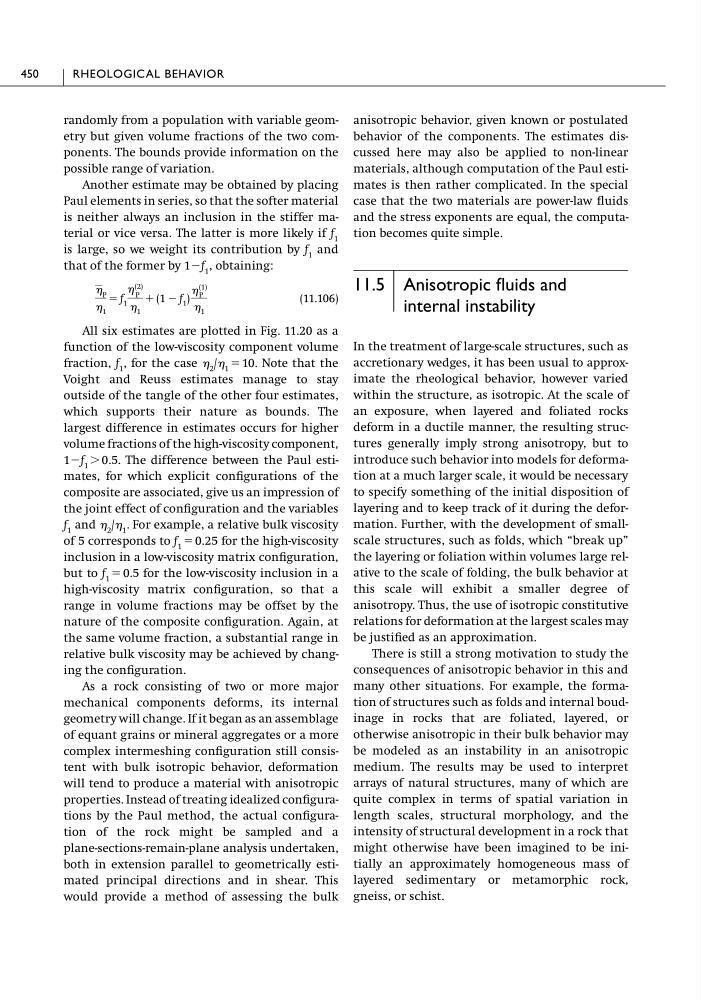
Another estimate may be obtained by placing
Paul elements in series, so that the softer material
is neither always an inclusion in the stiffer material or vice versa. The latter is more likely if f 1
is large, so we weight its contribution by f 1 and
that of the former by 1Ϫf 1 , obtaining:
(11.106)
All six estimates are plotted in Fig. 11.20 as a
function of the low-viscosity component volume
fraction, f 1 , for the case 2 / 1 ϭ 10. Note that the
Voight and Reuss estimates manage to stay
outside of the tangle of the other four estimates,
which supports their nature as bounds. The
largest difference in estimates occurs for higher
volume fractions of the high-viscosity component,
1Ϫf 1 Ͼ 0.5. The difference between the Paul estimates, for which explicit configurations of the
composite are associated, give us an impression of
the joint effect of configuration and the variables
f 1 and 2 / 1 . For example, a relative bulk viscosity
of 5 corresponds to f 1 ϭ 0.25 for the high-viscosity
inclusion in a low-viscosity matrix configuration,
but to f 1 ϭ 0.5 for the low-viscosity inclusion in a
high-viscosity matrix configuration, so that a
range in volume fractions may be offset by the
nature of the composite configuration. Again, at
the same volume fraction, a substantial range in
relative bulk viscosity may be achieved by changing the configuration.
As a rock consisting of two or more major
mechanical components deforms, its internal
geometry will change. If it began as an assemblage
of equant grains or mineral aggregates or a more
complex intermeshing configuration still consistent with bulk isotropic behavior, deformation
will tend to produce a material with anisotropic
properties. Instead of treating idealized configurations by the Paul method, the actual configuration of the rock might be sampled and a
plane-sections-remain-plane analysis undertaken,
both in extension parallel to geometrically estimated principal directions and in shear. This
would provide a method of assessing the bulk
P
1
ϭ f 1
(2)
P
1
ϩ (1 Ϫ f 1 )
(1)
P
1
anisotropic behavior, given known or postulated
behavior of the components. The estimates discussed here may also be applied to non-linear
materials, although computation of the Paul estimates is then rather complicated. In the special
case that the two materials are power-law fluids
and the stress exponents are equal, the computation becomes quite simple.
11.5 Anisotropic fluids and
internal instability
In the treatment of large-scale structures, such as
accretionary wedges, it has been usual to approximate the rheological behavior, however varied
within the structure, as isotropic. At the scale of
an exposure, when layered and foliated rocks
deform in a ductile manner, the resulting structures generally imply strong anisotropy, but to
introduce such behavior into models for deformation at a much larger scale, it would be necessary
to specify something of the initial disposition of
layering and to keep track of it during the deformation. Further, with the development of smallscale structures, such as folds, which “break up”
the layering or foliation within volumes large relative to the scale of folding, the bulk behavior at
this scale will exhibit a smaller degree of
anisotropy. Thus, the use of isotropic constitutive
relations for deformation at the largest scales may
be justified as an approximation.
There is still a strong motivation to study the
consequences of anisotropic behavior in this and
many other situations. For example, the formation of structures such as folds and internal boudinage in rocks that are foliated, layered, or
otherwise anisotropic in their bulk behavior may
be modeled as an instability in an anisotropic
medium. The results may be used to interpret
arrays of natural structures, many of which are
quite complex in terms of spatial variation in
length scales, structural morphology, and the
intensity of structural development in a rock that
might otherwise have been imagined to be initially an approximately homogeneous mass of
layered sedimentary or metamorphic rock,
gneiss, or schist.
450
RHEOLOGICAL BEHAVIOR
possible range of variation.
Another estimate may be obtained by placing
Paul elements in series, so that the softer material
is neither always an inclusion in the stiffer material or vice versa. The latter is more likely if f 1
is large, so we weight its contribution by f 1 and
that of the former by 1Ϫf 1 , obtaining:
(11.106)
All six estimates are plotted in Fig. 11.20 as a
function of the low-viscosity component volume
fraction, f 1 , for the case 2 / 1 ϭ 10. Note that the
Voight and Reuss estimates manage to stay
outside of the tangle of the other four estimates,
which supports their nature as bounds. The
largest difference in estimates occurs for higher
volume fractions of the high-viscosity component,
1Ϫf 1 Ͼ 0.5. The difference between the Paul estimates, for which explicit configurations of the
composite are associated, give us an impression of
the joint effect of configuration and the variables
f 1 and 2 / 1 . For example, a relative bulk viscosity
of 5 corresponds to f 1 ϭ 0.25 for the high-viscosity
inclusion in a low-viscosity matrix configuration,
but to f 1 ϭ 0.5 for the low-viscosity inclusion in a
high-viscosity matrix configuration, so that a
range in volume fractions may be offset by the
nature of the composite configuration. Again, at
the same volume fraction, a substantial range in
relative bulk viscosity may be achieved by changing the configuration.
As a rock consisting of two or more major
mechanical components deforms, its internal
geometry will change. If it began as an assemblage
of equant grains or mineral aggregates or a more
complex intermeshing configuration still consistent with bulk isotropic behavior, deformation
will tend to produce a material with anisotropic
properties. Instead of treating idealized configurations by the Paul method, the actual configuration of the rock might be sampled and a
plane-sections-remain-plane analysis undertaken,
both in extension parallel to geometrically estimated principal directions and in shear. This
would provide a method of assessing the bulk
P
1
ϭ f 1
(2)
P
1
ϩ (1 Ϫ f 1 )
(1)
P
1
anisotropic behavior, given known or postulated
behavior of the components. The estimates discussed here may also be applied to non-linear
materials, although computation of the Paul estimates is then rather complicated. In the special
case that the two materials are power-law fluids
and the stress exponents are equal, the computation becomes quite simple.
11.5 Anisotropic fluids and
internal instability
In the treatment of large-scale structures, such as
accretionary wedges, it has been usual to approximate the rheological behavior, however varied
within the structure, as isotropic. At the scale of
an exposure, when layered and foliated rocks
deform in a ductile manner, the resulting structures generally imply strong anisotropy, but to
introduce such behavior into models for deformation at a much larger scale, it would be necessary
to specify something of the initial disposition of
layering and to keep track of it during the deformation. Further, with the development of smallscale structures, such as folds, which “break up”
the layering or foliation within volumes large relative to the scale of folding, the bulk behavior at
this scale will exhibit a smaller degree of
anisotropy. Thus, the use of isotropic constitutive
relations for deformation at the largest scales may
be justified as an approximation.
There is still a strong motivation to study the
consequences of anisotropic behavior in this and
many other situations. For example, the formation of structures such as folds and internal boudinage in rocks that are foliated, layered, or
otherwise anisotropic in their bulk behavior may
be modeled as an instability in an anisotropic
medium. The results may be used to interpret
arrays of natural structures, many of which are
quite complex in terms of spatial variation in
length scales, structural morphology, and the
intensity of structural development in a rock that
might otherwise have been imagined to be initially an approximately homogeneous mass of
layered sedimentary or metamorphic rock,
gneiss, or schist.
450
RHEOLOGICAL BEHAVIOR