

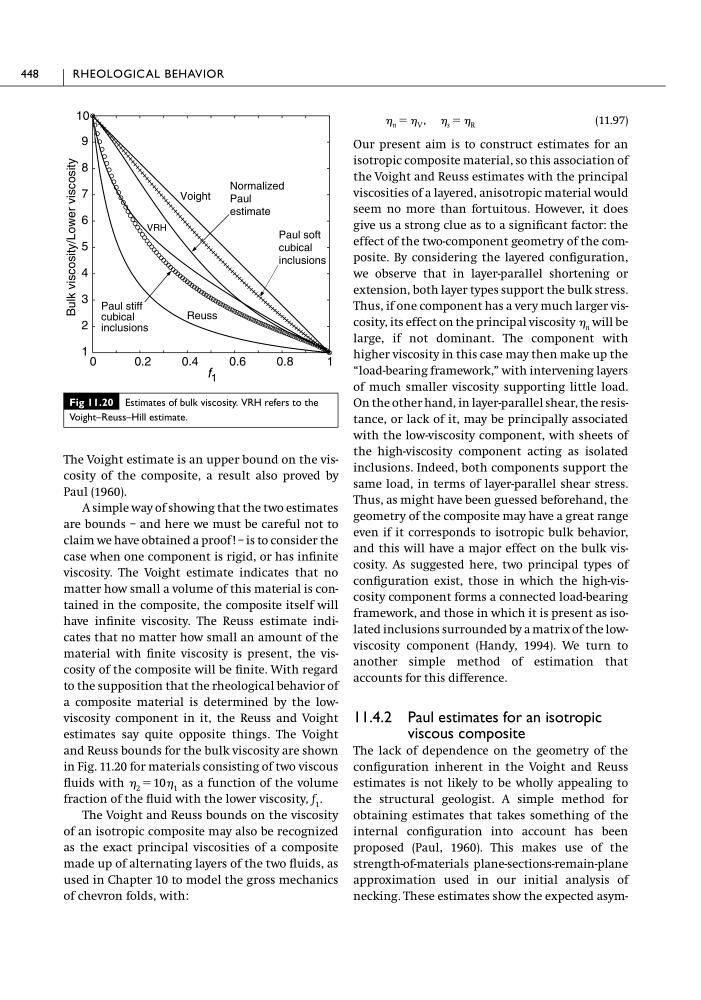
The Voight estimate is an upper bound on the viscosity of the composite, a result also proved by
Paul (1960).
A simple way of showing that the two estimates
are bounds – and here we must be careful not to
claim we have obtained a proof ! – is to consider the
case when one component is rigid, or has infinite
viscosity. The Voight estimate indicates that no
matter how small a volume of this material is contained in the composite, the composite itself will
have infinite viscosity. The Reuss estimate indicates that no matter how small an amount of the
material with finite viscosity is present, the viscosity of the composite will be finite. With regard
to the supposition that the rheological behavior of
a composite material is determined by the lowviscosity component in it, the Reuss and Voight
estimates say quite opposite things. The Voight
and Reuss bounds for the bulk viscosity are shown
in Fig. 11.20 for materials consisting of two viscous
fluids with 2 ϭ 10 1 as a function of the volume
fraction of the fluid with the lower viscosity, f 1 .
The Voight and Reuss bounds on the viscosity
of an isotropic composite may also be recognized
as the exact principal viscosities of a composite
made up of alternating layers of the two fluids, as
used in Chapter 10 to model the gross mechanics
of chevron folds, with:
(11.97)
Our present aim is to construct estimates for an
isotropic composite material, so this association of
the Voight and Reuss estimates with the principal
viscosities of a layered, anisotropic material would
seem no more than fortuitous. However, it does
give us a strong clue as to a significant factor: the
effect of the two-component geometry of the composite. By considering the layered configuration,
we observe that in layer-parallel shortening or
extension, both layer types support the bulk stress.
Thus, if one component has a very much larger viscosity, its effect on the principal viscosity n will be
large, if not dominant. The component with
higher viscosity in this case may then make up the
“load-bearing framework,” with intervening layers
of much smaller viscosity supporting little load.
On the other hand, in layer-parallel shear, the resistance, or lack of it, may be principally associated
with the low-viscosity component, with sheets of
the high-viscosity component acting as isolated
inclusions. Indeed, both components support the
same load, in terms of layer-parallel shear stress.
Thus, as might have been guessed beforehand, the
geometry of the composite may have a great range
even if it corresponds to isotropic bulk behavior,
and this will have a major effect on the bulk viscosity. As suggested here, two principal types of
configuration exist, those in which the high-viscosity component forms a connected load-bearing
framework, and those in which it is present as isolated inclusions surrounded by a matrix of the lowviscosity component (Handy, 1994). We turn to
another simple method of estimation that
accounts for this difference.
11.4.2 Paul estimates for an isotropic
viscous composite
The lack of dependence on the geometry of the
configuration inherent in the Voight and Reuss
estimates is not likely to be wholly appealing to
the structural geologist. A simple method for
obtaining estimates that takes something of the
internal configuration into account has been
proposed (Paul, 1960). This makes use of the
strength-of-materials plane-sections-remain-plane
approximation used in our initial analysis of
necking. These estimates show the expected asym n ϭ V , s ϭ R
448
RHEOLOGICAL BEHAVIOR
Fig 11.20 Estimates of bulk viscosity. VRH refers to the
Voight–Reuss–Hill estimate.
0
0.2
0.4
0.6
0.8
1
1
2
3
4
5
6
7
8
9
10
Bulk viscosity/Lower viscosity
Voight
VRH
f 1
Normalized
Paul
estimate
Paul soft
cubical
inclusions
Reuss
Paul stiff
cubical
inclusions
Paul (1960).
A simple way of showing that the two estimates
are bounds – and here we must be careful not to
claim we have obtained a proof ! – is to consider the
case when one component is rigid, or has infinite
viscosity. The Voight estimate indicates that no
matter how small a volume of this material is contained in the composite, the composite itself will
have infinite viscosity. The Reuss estimate indicates that no matter how small an amount of the
material with finite viscosity is present, the viscosity of the composite will be finite. With regard
to the supposition that the rheological behavior of
a composite material is determined by the lowviscosity component in it, the Reuss and Voight
estimates say quite opposite things. The Voight
and Reuss bounds for the bulk viscosity are shown
in Fig. 11.20 for materials consisting of two viscous
fluids with 2 ϭ 10 1 as a function of the volume
fraction of the fluid with the lower viscosity, f 1 .
The Voight and Reuss bounds on the viscosity
of an isotropic composite may also be recognized
as the exact principal viscosities of a composite
made up of alternating layers of the two fluids, as
used in Chapter 10 to model the gross mechanics
of chevron folds, with:
(11.97)
Our present aim is to construct estimates for an
isotropic composite material, so this association of
the Voight and Reuss estimates with the principal
viscosities of a layered, anisotropic material would
seem no more than fortuitous. However, it does
give us a strong clue as to a significant factor: the
effect of the two-component geometry of the composite. By considering the layered configuration,
we observe that in layer-parallel shortening or
extension, both layer types support the bulk stress.
Thus, if one component has a very much larger viscosity, its effect on the principal viscosity n will be
large, if not dominant. The component with
higher viscosity in this case may then make up the
“load-bearing framework,” with intervening layers
of much smaller viscosity supporting little load.
On the other hand, in layer-parallel shear, the resistance, or lack of it, may be principally associated
with the low-viscosity component, with sheets of
the high-viscosity component acting as isolated
inclusions. Indeed, both components support the
same load, in terms of layer-parallel shear stress.
Thus, as might have been guessed beforehand, the
geometry of the composite may have a great range
even if it corresponds to isotropic bulk behavior,
and this will have a major effect on the bulk viscosity. As suggested here, two principal types of
configuration exist, those in which the high-viscosity component forms a connected load-bearing
framework, and those in which it is present as isolated inclusions surrounded by a matrix of the lowviscosity component (Handy, 1994). We turn to
another simple method of estimation that
accounts for this difference.
11.4.2 Paul estimates for an isotropic
viscous composite
The lack of dependence on the geometry of the
configuration inherent in the Voight and Reuss
estimates is not likely to be wholly appealing to
the structural geologist. A simple method for
obtaining estimates that takes something of the
internal configuration into account has been
proposed (Paul, 1960). This makes use of the
strength-of-materials plane-sections-remain-plane
approximation used in our initial analysis of
necking. These estimates show the expected asym n ϭ V , s ϭ R
448
RHEOLOGICAL BEHAVIOR
Fig 11.20 Estimates of bulk viscosity. VRH refers to the
Voight–Reuss–Hill estimate.
0
0.2
0.4
0.6
0.8
1
1
2
3
4
5
6
7
8
9
10
Bulk viscosity/Lower viscosity
Voight
VRH
f 1
Normalized
Paul
estimate
Paul soft
cubical
inclusions
Reuss
Paul stiff
cubical
inclusions