

ponent rather than isolated masses surrounded
by the matrix component. The homogeneous
mechanical elements of the composite will then
consist of isolated bodies to rather complex interdigitated bodies consisting of amalgamations of
grains composed of one or the other component.
By our hypothesis, that each component may be
approximated by an isotropic viscous fluid, the
constitutive relations for the individual bodies
are given. Boundary conditions on continuity of
velocity or displacement and of traction at their
interfaces would then be specified. However, the
geometry of the composite body is so complex
that determining the stress and velocity distribution within it arising from a prescribed bulk
homogeneous stress or rate of deformation
would be difficult to obtain, even by numerical
means. Instead, we consider two simple means
of estimating the bulk behavior that avoid
difficulty.
In the Reuss estimate, the internal stress is
taken to be homogeneous and hence equal to the
macroscopic or applied stress. Here a point of view
espoused by J. N. Goodier is taken. We do not say
that the stress in the composite material is
assumed homogeneous because it is a priori known
not to be homogeneous, or highly unlikely to be
so. Rather, we postulate a behavior or condition
for the model, in this case, that the stress is homogeneous. We are free to postulate anything we like
about the model, as that is completely independent of the natural example. Later, we can hope to
understand to what extent the model corresponds
to nature. The equations of stress equilibrium will
be satisfied and the normal and shear stress components acting on interfaces within the composite will be continuous as required. However,
because the components of the rate of deformation in the separate constituents are homogeneous, the conditions of velocity continuity at
interfaces will generally not be satisfied, even in
approximation. Thus, the estimate does not represent an attempt to solve the boundary value
problem for the material of interest specified at
the microscopic scale.
The macroscopic or bulk components of
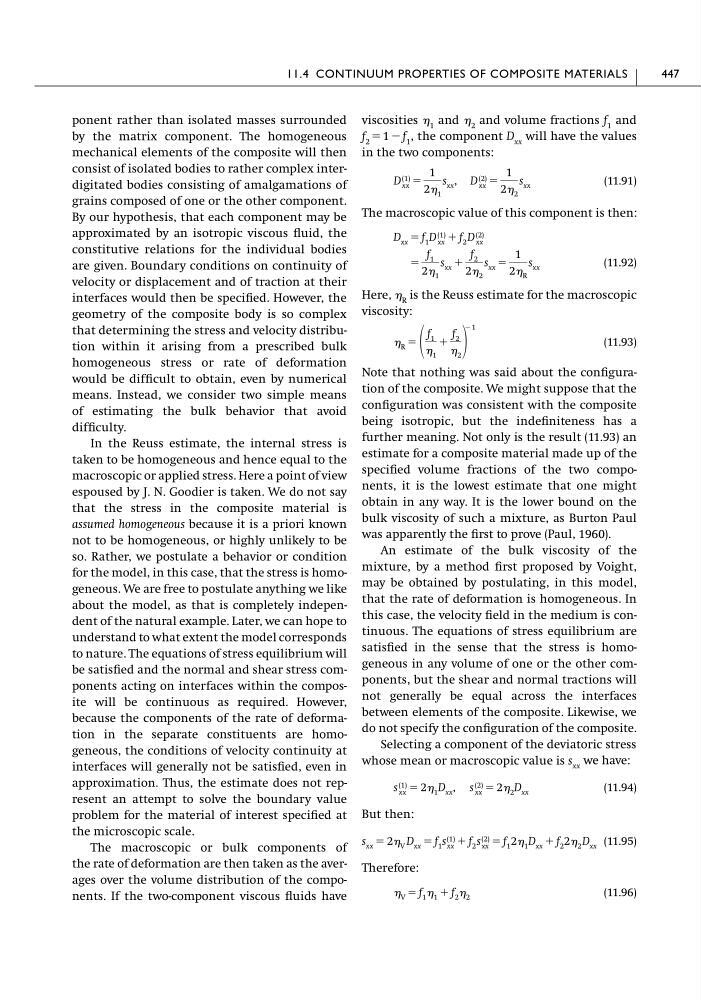
the rate of deformation are then taken as the averages over the volume distribution of the components. If the two-component viscous fluids have
viscosities 1 and 2 and volume fractions f 1 and
f 2 ϭ 1 Ϫ f 1 , the component D xx will have the values
in the two components:
(11.91)
The macroscopic value of this component is then:
(11.92)
Here, R is the Reuss estimate for the macroscopic
viscosity:
(11.93)
Note that nothing was said about the configuration of the composite. We might suppose that the
configuration was consistent with the composite
being isotropic, but the indefiniteness has a
further meaning. Not only is the result (11.93) an
estimate for a composite material made up of the
specified volume fractions of the two components, it is the lowest estimate that one might
obtain in any way. It is the lower bound on the
bulk viscosity of such a mixture, as Burton Paul
was apparently the first to prove (Paul, 1960).
An estimate of the bulk viscosity of the
mixture, by a method first proposed by Voight,
may be obtained by postulating, in this model,
that the rate of deformation is homogeneous. In
this case, the velocity field in the medium is continuous. The equations of stress equilibrium are
satisfied in the sense that the stress is homogeneous in any volume of one or the other components, but the shear and normal tractions will
not generally be equal across the interfaces
between elements of the composite. Likewise, we
do not specify the configuration of the composite.
Selecting a component of the deviatoric stress
whose mean or macroscopic value is s xx we have:
(11.94)
But then:
(11.95)
Therefore:
(11.96)
V ϭ f 1 1 ϩ f 2 2
s xx ϭ 2 V D xx ϭ f 1 s (1)
xx ϩ f 2 s (2)
xx ϭ f 1 2 1 D xx ϩ f 2 2 2 D xx
s (1)
xx ϭ 2 1 D xx , s (2)
xx ϭ 2 2 D xx
R ϭ
f 1
1
ϩ
f 2
2
Ϫ1
ϭ
f 1
2 1
s xx ϩ
f 2
2 2
s xx ϭ
1
2 R
s xx
D xx ϭ f 1 D (1)
xx ϩ f 2 D (2)
xx
D (1)
xx ϭ
1
2 1
s xx , D (2)
xx ϭ
1
2 2
s xx
11.4 CONTINUUM PROPERTIES OF COMPOSITE MATERIALS
447
by the matrix component. The homogeneous
mechanical elements of the composite will then
consist of isolated bodies to rather complex interdigitated bodies consisting of amalgamations of
grains composed of one or the other component.
By our hypothesis, that each component may be
approximated by an isotropic viscous fluid, the
constitutive relations for the individual bodies
are given. Boundary conditions on continuity of
velocity or displacement and of traction at their
interfaces would then be specified. However, the
geometry of the composite body is so complex
that determining the stress and velocity distribution within it arising from a prescribed bulk
homogeneous stress or rate of deformation
would be difficult to obtain, even by numerical
means. Instead, we consider two simple means
of estimating the bulk behavior that avoid
difficulty.
In the Reuss estimate, the internal stress is
taken to be homogeneous and hence equal to the
macroscopic or applied stress. Here a point of view
espoused by J. N. Goodier is taken. We do not say
that the stress in the composite material is
assumed homogeneous because it is a priori known
not to be homogeneous, or highly unlikely to be
so. Rather, we postulate a behavior or condition
for the model, in this case, that the stress is homogeneous. We are free to postulate anything we like
about the model, as that is completely independent of the natural example. Later, we can hope to
understand to what extent the model corresponds
to nature. The equations of stress equilibrium will
be satisfied and the normal and shear stress components acting on interfaces within the composite will be continuous as required. However,
because the components of the rate of deformation in the separate constituents are homogeneous, the conditions of velocity continuity at
interfaces will generally not be satisfied, even in
approximation. Thus, the estimate does not represent an attempt to solve the boundary value
problem for the material of interest specified at
the microscopic scale.
The macroscopic or bulk components of
the rate of deformation are then taken as the averages over the volume distribution of the components. If the two-component viscous fluids have
viscosities 1 and 2 and volume fractions f 1 and
f 2 ϭ 1 Ϫ f 1 , the component D xx will have the values
in the two components:
(11.91)
The macroscopic value of this component is then:
(11.92)
Here, R is the Reuss estimate for the macroscopic
viscosity:
(11.93)
Note that nothing was said about the configuration of the composite. We might suppose that the
configuration was consistent with the composite
being isotropic, but the indefiniteness has a
further meaning. Not only is the result (11.93) an
estimate for a composite material made up of the
specified volume fractions of the two components, it is the lowest estimate that one might
obtain in any way. It is the lower bound on the
bulk viscosity of such a mixture, as Burton Paul
was apparently the first to prove (Paul, 1960).
An estimate of the bulk viscosity of the
mixture, by a method first proposed by Voight,
may be obtained by postulating, in this model,
that the rate of deformation is homogeneous. In
this case, the velocity field in the medium is continuous. The equations of stress equilibrium are
satisfied in the sense that the stress is homogeneous in any volume of one or the other components, but the shear and normal tractions will
not generally be equal across the interfaces
between elements of the composite. Likewise, we
do not specify the configuration of the composite.
Selecting a component of the deviatoric stress
whose mean or macroscopic value is s xx we have:
(11.94)
But then:
(11.95)
Therefore:
(11.96)
V ϭ f 1 1 ϩ f 2 2
s xx ϭ 2 V D xx ϭ f 1 s (1)
xx ϩ f 2 s (2)
xx ϭ f 1 2 1 D xx ϩ f 2 2 2 D xx
s (1)
xx ϭ 2 1 D xx , s (2)
xx ϭ 2 2 D xx
R ϭ
f 1
1
ϩ
f 2
2
Ϫ1
ϭ
f 1
2 1
s xx ϩ
f 2
2 2
s xx ϭ
1
2 R
s xx
D xx ϭ f 1 D (1)
xx ϩ f 2 D (2)
xx
D (1)
xx ϭ
1
2 1
s xx , D (2)
xx ϭ
1
2 2
s xx
11.4 CONTINUUM PROPERTIES OF COMPOSITE MATERIALS
447