

re-precipitation, by the kinetics of dissolution and
precipitation, by rates of mechanical adjustment,
or by some combination of these. There is a dependence on grain size, with fine-grained rocks
deforming more rapidly than coarse-grained rocks
at the same stress. If both pressure solution and
crystal plasticity contribute significantly to deformation, a coarser-grained rock may deform chiefly
by the latter mechanism while a finer-grained rock
deforms chiefly by the former. A rock deforming by
pressure solution will behave approximately as a
linear viscous fluid.
The sandstone (frontispiece) comes from a
location in the internal part of the Cascades accretionary wedge, southeast of the topographic high
point at Mt. Olympus (Washington, USA). There,
the cleavage is nearly vertical and normal to the
direction of plate convergence. The thin section is
normal to the cleavage. The principal stretches for
the strain produced by pressure solution are 0.7
normal to cleavage, 1.17 parallel to cleavage in the
plane of the figure, and 0.98 in the direction
normal to these (Feehan and Brandon, 1999). The
product of the stretches is 0.80, which implies
that 20% of the initial volume has been removed
in the deformation. Since the observed deformation most likely took place after the rock was compacted to negligible porosity, volume loss must
come from loss of dissolved material, chiefly
quartz, from an initial volume of rock.
11.3.1 A model coupling deformation
and diffusion in a viscous fluid
The specific behavior to be considered here relates
to the segregation of material in sites such as
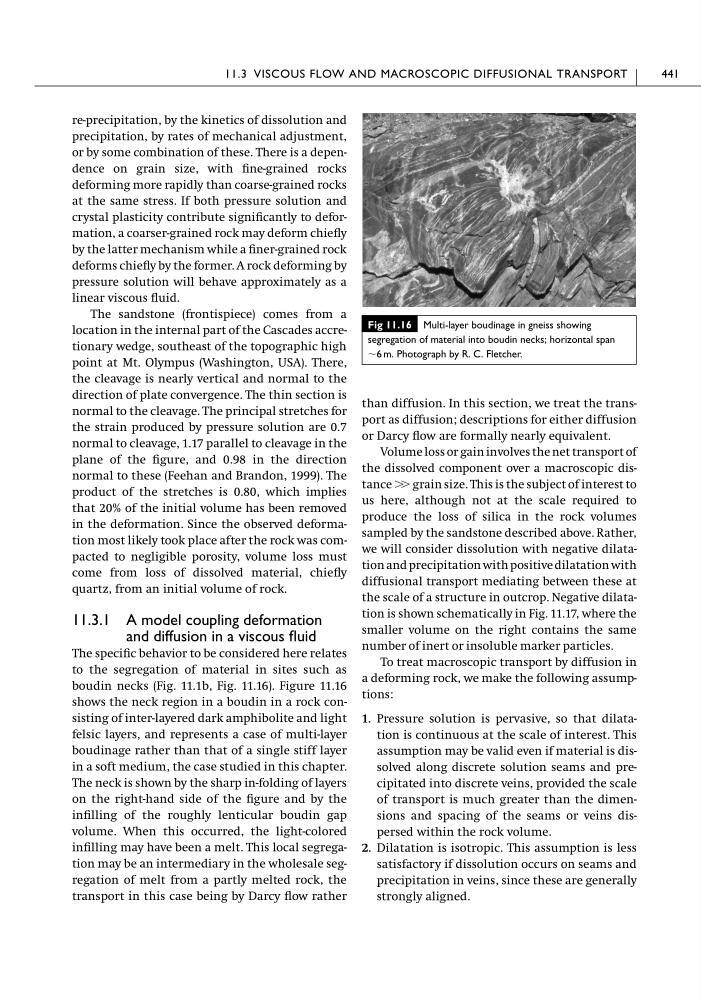
boudin necks (Fig. 11.1b, Fig. 11.16). Figure 11.16
shows the neck region in a boudin in a rock consisting of inter-layered dark amphibolite and light
felsic layers, and represents a case of multi-layer
boudinage rather than that of a single stiff layer
in a soft medium, the case studied in this chapter.
The neck is shown by the sharp in-folding of layers
on the right-hand side of the figure and by the
infilling of the roughly lenticular boudin gap
volume. When this occurred, the light-colored
infilling may have been a melt. This local segregation may be an intermediary in the wholesale segregation of melt from a partly melted rock, the
transport in this case being by Darcy flow rather
than diffusion. In this section, we treat the transport as diffusion; descriptions for either diffusion
or Darcy flow are formally nearly equivalent.
Volume loss or gain involves the net transport of
the dissolved component over a macroscopic distance Ͼ Ͼ grain size. This is the subject of interest to
us here, although not at the scale required to
produce the loss of silica in the rock volumes
sampled by the sandstone described above. Rather,
we will consider dissolution with negative dilatation and precipitation with positive dilatation with
diffusional transport mediating between these at
the scale of a structure in outcrop. Negative dilatation is shown schematically in Fig. 11.17, where the
smaller volume on the right contains the same
number of inert or insoluble marker particles.
To treat macroscopic transport by diffusion in
a deforming rock, we make the following assumptions:
1. Pressure solution is pervasive, so that dilatation is continuous at the scale of interest. This
assumption may be valid even if material is dissolved along discrete solution seams and precipitated into discrete veins, provided the scale
of transport is much greater than the dimensions and spacing of the seams or veins dispersed within the rock volume.
2. Dilatation is isotropic. This assumption is less
satisfactory if dissolution occurs on seams and
precipitation in veins, since these are generally
strongly aligned.
11.3 VISCOUS FLOW AND MACROSCOPIC DIFFUSIONAL TRANSPORT
441
Fig 11.16 Multi-layer boudinage in gneiss showing
segregation of material into boudin necks; horizontal span
ϳ6 m. Photograph by R. C. Fletcher.
precipitation, by rates of mechanical adjustment,
or by some combination of these. There is a dependence on grain size, with fine-grained rocks
deforming more rapidly than coarse-grained rocks
at the same stress. If both pressure solution and
crystal plasticity contribute significantly to deformation, a coarser-grained rock may deform chiefly
by the latter mechanism while a finer-grained rock
deforms chiefly by the former. A rock deforming by
pressure solution will behave approximately as a
linear viscous fluid.
The sandstone (frontispiece) comes from a
location in the internal part of the Cascades accretionary wedge, southeast of the topographic high
point at Mt. Olympus (Washington, USA). There,
the cleavage is nearly vertical and normal to the
direction of plate convergence. The thin section is
normal to the cleavage. The principal stretches for
the strain produced by pressure solution are 0.7
normal to cleavage, 1.17 parallel to cleavage in the
plane of the figure, and 0.98 in the direction
normal to these (Feehan and Brandon, 1999). The
product of the stretches is 0.80, which implies
that 20% of the initial volume has been removed
in the deformation. Since the observed deformation most likely took place after the rock was compacted to negligible porosity, volume loss must
come from loss of dissolved material, chiefly
quartz, from an initial volume of rock.
11.3.1 A model coupling deformation
and diffusion in a viscous fluid
The specific behavior to be considered here relates
to the segregation of material in sites such as
boudin necks (Fig. 11.1b, Fig. 11.16). Figure 11.16
shows the neck region in a boudin in a rock consisting of inter-layered dark amphibolite and light
felsic layers, and represents a case of multi-layer
boudinage rather than that of a single stiff layer
in a soft medium, the case studied in this chapter.
The neck is shown by the sharp in-folding of layers
on the right-hand side of the figure and by the
infilling of the roughly lenticular boudin gap
volume. When this occurred, the light-colored
infilling may have been a melt. This local segregation may be an intermediary in the wholesale segregation of melt from a partly melted rock, the
transport in this case being by Darcy flow rather
than diffusion. In this section, we treat the transport as diffusion; descriptions for either diffusion
or Darcy flow are formally nearly equivalent.
Volume loss or gain involves the net transport of
the dissolved component over a macroscopic distance Ͼ Ͼ grain size. This is the subject of interest to
us here, although not at the scale required to
produce the loss of silica in the rock volumes
sampled by the sandstone described above. Rather,
we will consider dissolution with negative dilatation and precipitation with positive dilatation with
diffusional transport mediating between these at
the scale of a structure in outcrop. Negative dilatation is shown schematically in Fig. 11.17, where the
smaller volume on the right contains the same
number of inert or insoluble marker particles.
To treat macroscopic transport by diffusion in
a deforming rock, we make the following assumptions:
1. Pressure solution is pervasive, so that dilatation is continuous at the scale of interest. This
assumption may be valid even if material is dissolved along discrete solution seams and precipitated into discrete veins, provided the scale
of transport is much greater than the dimensions and spacing of the seams or veins dispersed within the rock volume.
2. Dilatation is isotropic. This assumption is less
satisfactory if dissolution occurs on seams and
precipitation in veins, since these are generally
strongly aligned.
11.3 VISCOUS FLOW AND MACROSCOPIC DIFFUSIONAL TRANSPORT
441
Fig 11.16 Multi-layer boudinage in gneiss showing
segregation of material into boudin necks; horizontal span
ϳ6 m. Photograph by R. C. Fletcher.