

dominant wavelength is that maximizing the
eigenvalue q.
As with the necking of a single layer at n Ͼ Ͼ 1,
resonance leads to the excitation of multiple
peaks in rate of amplification at a sequence of
values of L/H Ͻ 1. Here, we shall consider only the
maximum value of L d /H. A question of principal
interest is how the existence of the necking instability and its length scale constrains the dimensionless groups S, R, and M. Alternatively, we may
ask which a priori estimates of these quantities, as
of M above, would be consistent with necking
at the basin-and-range scale ϳ30 km. Overlap
between these two sets of values would support
the model.
An estimate for mean strength of the brittle
crust in extension, using a friction angle of 30Њ and
no cohesion is K Ϸ gH/3. Including cohesion, K
will be larger than this by a multiple greater than
one and certainly less than two for H Ϸ 10 km.
Thus, we expect 3/2 Ն S Ն 3/4, and for 1 Ϸ 10
19 to
10
21 Pa s
Ϫ1 and
Ϸ 10
Ϫ15 s
Ϫ1 , R Ϸ 0.0002 to 0.02.
The latter values are remarkably small relative to
effective viscosity ratios obtained from interpretation of natural fold data; if
Ϸ 10
Ϫ14 s
Ϫ1 , R Ϸ
0.002–0.2. With these estimates in mind, we may
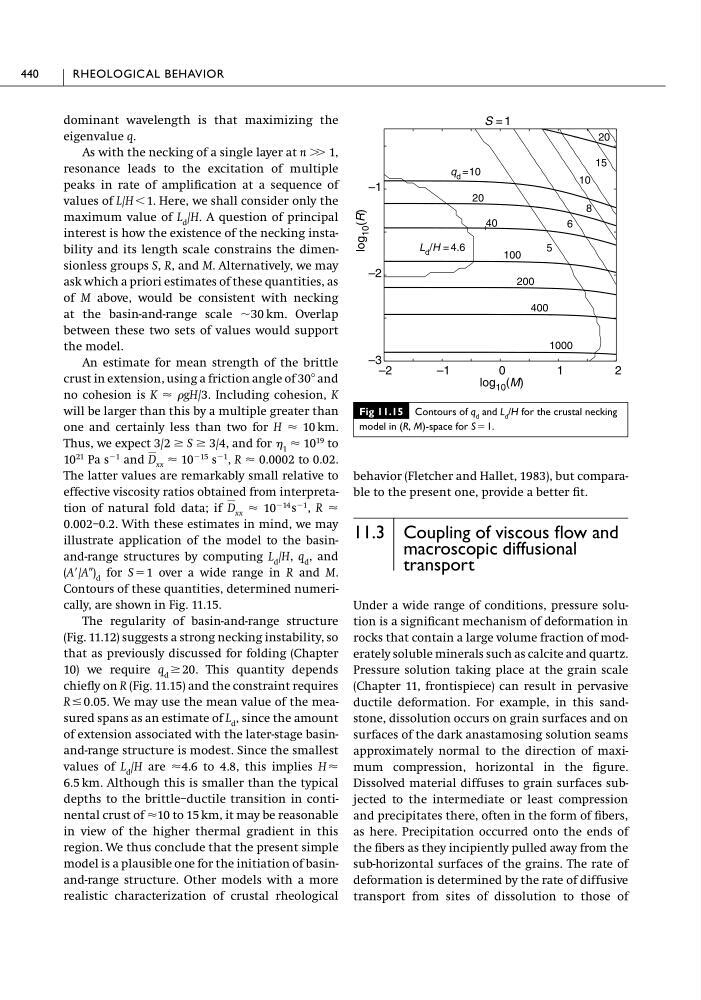
illustrate application of the model to the basinand-range structures by computing L d /H, q d , and
(AЈ/AЉ) d for S ϭ 1 over a wide range in R and M.
Contours of these quantities, determined numerically, are shown in Fig. 11.15.
The regularity of basin-and-range structure
(Fig. 11.12) suggests a strong necking instability, so
that as previously discussed for folding (Chapter
10) we require q d Ն 20. This quantity depends
chiefly on R (Fig. 11.15) and the constraint requires
R Յ 0.05. We may use the mean value of the measured spans as an estimate of L d , since the amount
of extension associated with the later-stage basinand-range structure is modest. Since the smallest
values of L d /H are Ϸ4.6 to 4.8, this implies H Ϸ
6.5 km. Although this is smaller than the typical
depths to the brittle–ductile transition in continental crust of Ϸ10 to 15 km, it may be reasonable
in view of the higher thermal gradient in this
region. We thus conclude that the present simple
model is a plausible one for the initiation of basinand-range structure. Other models with a more
realistic characterization of crustal rheological
D xx
D xx
behavior (Fletcher and Hallet, 1983), but comparable to the present one, provide a better fit.
11.3 Coupling of viscous flow and
macroscopic diffusional
transport
Under a wide range of conditions, pressure solution is a significant mechanism of deformation in
rocks that contain a large volume fraction of moderately soluble minerals such as calcite and quartz.
Pressure solution taking place at the grain scale
(Chapter 11, frontispiece) can result in pervasive
ductile deformation. For example, in this sandstone, dissolution occurs on grain surfaces and on
surfaces of the dark anastamosing solution seams
approximately normal to the direction of maximum compression, horizontal in the figure.
Dissolved material diffuses to grain surfaces subjected to the intermediate or least compression
and precipitates there, often in the form of fibers,
as here. Precipitation occurred onto the ends of
the fibers as they incipiently pulled away from the
sub-horizontal surfaces of the grains. The rate of
deformation is determined by the rate of diffusive
transport from sites of dissolution to those of
440
RHEOLOGICAL BEHAVIOR
Fig 11.15 Contours of q d and L d /H for the crustal necking
model in (R, M)-space for Sϭ1.
–2
–1
0
1
2
–3
–2
–1
20
40
100
200
400
1000
5
6
8
10
15
S = 1
log 10 (M)
log
10 (R)
q d =10
L d /H = 4.6
20
eigenvalue q.
As with the necking of a single layer at n Ͼ Ͼ 1,
resonance leads to the excitation of multiple
peaks in rate of amplification at a sequence of
values of L/H Ͻ 1. Here, we shall consider only the
maximum value of L d /H. A question of principal
interest is how the existence of the necking instability and its length scale constrains the dimensionless groups S, R, and M. Alternatively, we may
ask which a priori estimates of these quantities, as
of M above, would be consistent with necking
at the basin-and-range scale ϳ30 km. Overlap
between these two sets of values would support
the model.
An estimate for mean strength of the brittle
crust in extension, using a friction angle of 30Њ and
no cohesion is K Ϸ gH/3. Including cohesion, K
will be larger than this by a multiple greater than
one and certainly less than two for H Ϸ 10 km.
Thus, we expect 3/2 Ն S Ն 3/4, and for 1 Ϸ 10
19 to
10
21 Pa s
Ϫ1 and
Ϸ 10
Ϫ15 s
Ϫ1 , R Ϸ 0.0002 to 0.02.
The latter values are remarkably small relative to
effective viscosity ratios obtained from interpretation of natural fold data; if
Ϸ 10
Ϫ14 s
Ϫ1 , R Ϸ
0.002–0.2. With these estimates in mind, we may
illustrate application of the model to the basinand-range structures by computing L d /H, q d , and
(AЈ/AЉ) d for S ϭ 1 over a wide range in R and M.
Contours of these quantities, determined numerically, are shown in Fig. 11.15.
The regularity of basin-and-range structure
(Fig. 11.12) suggests a strong necking instability, so
that as previously discussed for folding (Chapter
10) we require q d Ն 20. This quantity depends
chiefly on R (Fig. 11.15) and the constraint requires
R Յ 0.05. We may use the mean value of the measured spans as an estimate of L d , since the amount
of extension associated with the later-stage basinand-range structure is modest. Since the smallest
values of L d /H are Ϸ4.6 to 4.8, this implies H Ϸ
6.5 km. Although this is smaller than the typical
depths to the brittle–ductile transition in continental crust of Ϸ10 to 15 km, it may be reasonable
in view of the higher thermal gradient in this
region. We thus conclude that the present simple
model is a plausible one for the initiation of basinand-range structure. Other models with a more
realistic characterization of crustal rheological
D xx
D xx
behavior (Fletcher and Hallet, 1983), but comparable to the present one, provide a better fit.
11.3 Coupling of viscous flow and
macroscopic diffusional
transport
Under a wide range of conditions, pressure solution is a significant mechanism of deformation in
rocks that contain a large volume fraction of moderately soluble minerals such as calcite and quartz.
Pressure solution taking place at the grain scale
(Chapter 11, frontispiece) can result in pervasive
ductile deformation. For example, in this sandstone, dissolution occurs on grain surfaces and on
surfaces of the dark anastamosing solution seams
approximately normal to the direction of maximum compression, horizontal in the figure.
Dissolved material diffuses to grain surfaces subjected to the intermediate or least compression
and precipitates there, often in the form of fibers,
as here. Precipitation occurred onto the ends of
the fibers as they incipiently pulled away from the
sub-horizontal surfaces of the grains. The rate of
deformation is determined by the rate of diffusive
transport from sites of dissolution to those of
440
RHEOLOGICAL BEHAVIOR
Fig 11.15 Contours of q d and L d /H for the crustal necking
model in (R, M)-space for Sϭ1.
–2
–1
0
1
2
–3
–2
–1
20
40
100
200
400
1000
5
6
8
10
15
S = 1
log 10 (M)
log
10 (R)
q d =10
L d /H = 4.6
20