

of shortening, since the shear strength K of the
brittle upper crust is independent of rate. At slow
rates of extension, R will be smaller, and the
degree of instability will be larger. The dimensionless group
is the ratio of a lithostatic stress to the stress difference at yield in the
plastic layer. A more realistic model for the
strength of the crust would introduce a mean
stress dependence on the strength. Effectively,
only a cohesion-like quantity is used here,
although its value may be assigned to account for
a mean value of the strength of the brittle crustal
layer that is dependent on the thickness H.
Further discussion of this issue may be found in
the papers cited earlier. The third dimensionless
group is k ϭ 2/(L/H).
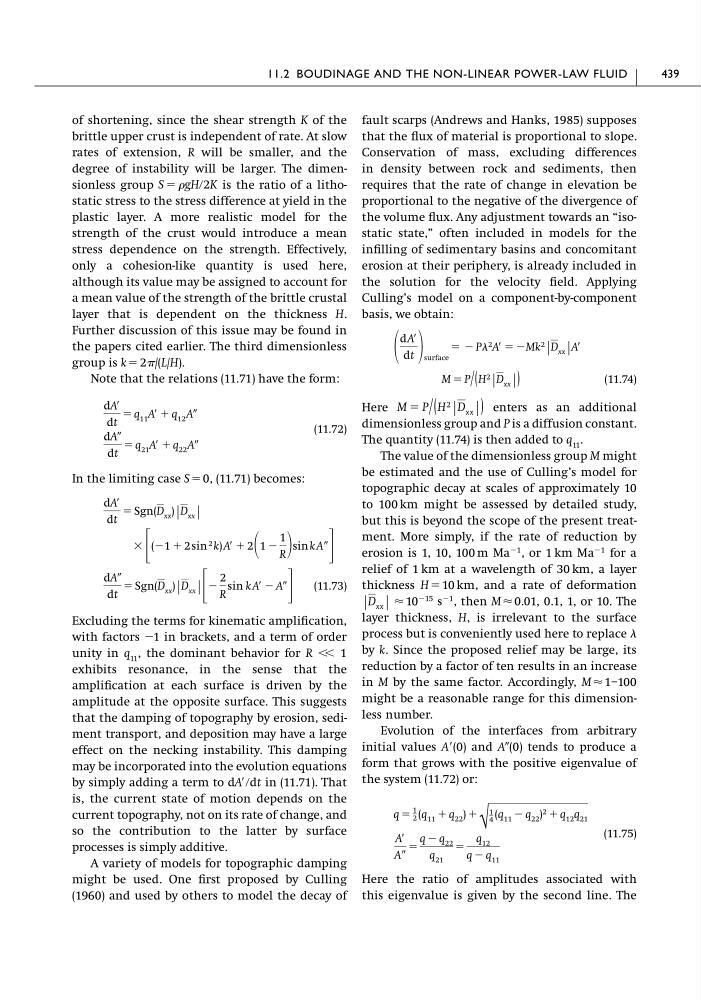
Note that the relations (11.71) have the form:
(11.72)
In the limiting case S ϭ 0, (11.71) becomes:
(11.73)
Excluding the terms for kinematic amplification,
with factors Ϫ1 in brackets, and a term of order
unity in q 11 , the dominant behavior for R Ͻ Ͻ 1
exhibits resonance, in the sense that the
amplification at each surface is driven by the
amplitude at the opposite surface. This suggests
that the damping of topography by erosion, sediment transport, and deposition may have a large
effect on the necking instability. This damping
may be incorporated into the evolution equations
by simply adding a term to
in (11.71). That
is, the current state of motion depends on the
current topography, not on its rate of change, and
so the contribution to the latter by surface
processes is simply additive.
A variety of models for topographic damping
might be used. One first proposed by Culling
(1960) and used by others to model the decay of
dAЈրdt
dAЉ
dt
ϭ Sgn(D xx ) |D xx | ΄ Ϫ
2
R
sin k AЈ Ϫ AЉ ΅
ϫ ΄ (Ϫ1 ϩ 2 sin 2
ˇ
k) AЈ ϩ 2 1 Ϫ
1
R sin k AЉ ΅
dAЈ
dt
ϭ Sgn(D xx ) |D xx |
dAЉ
dt
ϭ q 21 AЈ ϩ q 22 AЉ
dAЈ
dt
ϭ q 11 AЈ ϩ q 12 AЉ
S ϭ gHր2K
fault scarps (Andrews and Hanks, 1985) supposes
that the flux of material is proportional to slope.
Conservation of mass, excluding differences
in density between rock and sediments, then
requires that the rate of change in elevation be
proportional to the negative of the divergence of
the volume flux. Any adjustment towards an “isostatic state,” often included in models for the
infilling of sedimentary basins and concomitant
erosion at their periphery, is already included in
the solution for the velocity field. Applying
Culling’s model on a component-by-component
basis, we obtain:
(11.74)
Here
enters as an additional
dimensionless group and P is a diffusion constant.
The quantity (11.74) is then added to q 11 .
The value of the dimensionless group M might
be estimated and the use of Culling’s model for
topographic decay at scales of approximately 10
to 100 km might be assessed by detailed study,
but this is beyond the scope of the present treatment. More simply, if the rate of reduction by
erosion is 1, 10, 100 m Ma
Ϫ1 , or 1 km Ma
Ϫ1 for a
relief of 1 km at a wavelength of 30 km, a layer
thickness H ϭ 10 km, and a rate of deformation
Ϸ 10
Ϫ15 s
Ϫ1 , then M Ϸ 0.01, 0.1, 1, or 10. The
layer thickness, H, is irrelevant to the surface
process but is conveniently used here to replace
by k. Since the proposed relief may be large, its
reduction by a factor of ten results in an increase
in M by the same factor. Accordingly, M Ϸ 1–100
might be a reasonable range for this dimensionless number.
Evolution of the interfaces from arbitrary
initial values AЈ(0) and AЉ(0) tends to produce a
form that grows with the positive eigenvalue of
the system (11.72) or:
(11.75)
Here the ratio of amplitudes associated with
this eigenvalue is given by the second line. The
AЈ
AЉ
ϭ
q Ϫ q 22
q 21
ϭ
q 12
q Ϫ q 11
q ϭ
1
2 (q 11 ϩ q 22 ) ϩ
√
1
4
(q 11 Ϫ q 22 ) 2 ϩ q 12 q 21
|D xx |
M ϭ P ր (H 2 |D xx |)
M ϭ P ր (H 2 |D xx |)
dAЈ
dt surface
ϭ Ϫ P 2 AЈ ϭ ϪMk 2 |D xx |AЈ
11.2 BOUDINAGE AND THE NON-LINEAR POWER-LAW FLUID
439
brittle upper crust is independent of rate. At slow
rates of extension, R will be smaller, and the
degree of instability will be larger. The dimensionless group
is the ratio of a lithostatic stress to the stress difference at yield in the
plastic layer. A more realistic model for the
strength of the crust would introduce a mean
stress dependence on the strength. Effectively,
only a cohesion-like quantity is used here,
although its value may be assigned to account for
a mean value of the strength of the brittle crustal
layer that is dependent on the thickness H.
Further discussion of this issue may be found in
the papers cited earlier. The third dimensionless
group is k ϭ 2/(L/H).
Note that the relations (11.71) have the form:
(11.72)
In the limiting case S ϭ 0, (11.71) becomes:
(11.73)
Excluding the terms for kinematic amplification,
with factors Ϫ1 in brackets, and a term of order
unity in q 11 , the dominant behavior for R Ͻ Ͻ 1
exhibits resonance, in the sense that the
amplification at each surface is driven by the
amplitude at the opposite surface. This suggests
that the damping of topography by erosion, sediment transport, and deposition may have a large
effect on the necking instability. This damping
may be incorporated into the evolution equations
by simply adding a term to
in (11.71). That
is, the current state of motion depends on the
current topography, not on its rate of change, and
so the contribution to the latter by surface
processes is simply additive.
A variety of models for topographic damping
might be used. One first proposed by Culling
(1960) and used by others to model the decay of
dAЈրdt
dAЉ
dt
ϭ Sgn(D xx ) |D xx | ΄ Ϫ
2
R
sin k AЈ Ϫ AЉ ΅
ϫ ΄ (Ϫ1 ϩ 2 sin 2
ˇ
k) AЈ ϩ 2 1 Ϫ
1
R sin k AЉ ΅
dAЈ
dt
ϭ Sgn(D xx ) |D xx |
dAЉ
dt
ϭ q 21 AЈ ϩ q 22 AЉ
dAЈ
dt
ϭ q 11 AЈ ϩ q 12 AЉ
S ϭ gHր2K
fault scarps (Andrews and Hanks, 1985) supposes
that the flux of material is proportional to slope.
Conservation of mass, excluding differences
in density between rock and sediments, then
requires that the rate of change in elevation be
proportional to the negative of the divergence of
the volume flux. Any adjustment towards an “isostatic state,” often included in models for the
infilling of sedimentary basins and concomitant
erosion at their periphery, is already included in
the solution for the velocity field. Applying
Culling’s model on a component-by-component
basis, we obtain:
(11.74)
Here
enters as an additional
dimensionless group and P is a diffusion constant.
The quantity (11.74) is then added to q 11 .
The value of the dimensionless group M might
be estimated and the use of Culling’s model for
topographic decay at scales of approximately 10
to 100 km might be assessed by detailed study,
but this is beyond the scope of the present treatment. More simply, if the rate of reduction by
erosion is 1, 10, 100 m Ma
Ϫ1 , or 1 km Ma
Ϫ1 for a
relief of 1 km at a wavelength of 30 km, a layer
thickness H ϭ 10 km, and a rate of deformation
Ϸ 10
Ϫ15 s
Ϫ1 , then M Ϸ 0.01, 0.1, 1, or 10. The
layer thickness, H, is irrelevant to the surface
process but is conveniently used here to replace
by k. Since the proposed relief may be large, its
reduction by a factor of ten results in an increase
in M by the same factor. Accordingly, M Ϸ 1–100
might be a reasonable range for this dimensionless number.
Evolution of the interfaces from arbitrary
initial values AЈ(0) and AЉ(0) tends to produce a
form that grows with the positive eigenvalue of
the system (11.72) or:
(11.75)
Here the ratio of amplitudes associated with
this eigenvalue is given by the second line. The
AЈ
AЉ
ϭ
q Ϫ q 22
q 21
ϭ
q 12
q Ϫ q 11
q ϭ
1
2 (q 11 ϩ q 22 ) ϩ
√
1
4
(q 11 Ϫ q 22 ) 2 ϩ q 12 q 21
|D xx |
M ϭ P ր (H 2 |D xx |)
M ϭ P ր (H 2 |D xx |)
dAЈ
dt surface
ϭ Ϫ P 2 AЈ ϭ ϪMk 2 |D xx |AЈ
11.2 BOUDINAGE AND THE NON-LINEAR POWER-LAW FLUID
439