

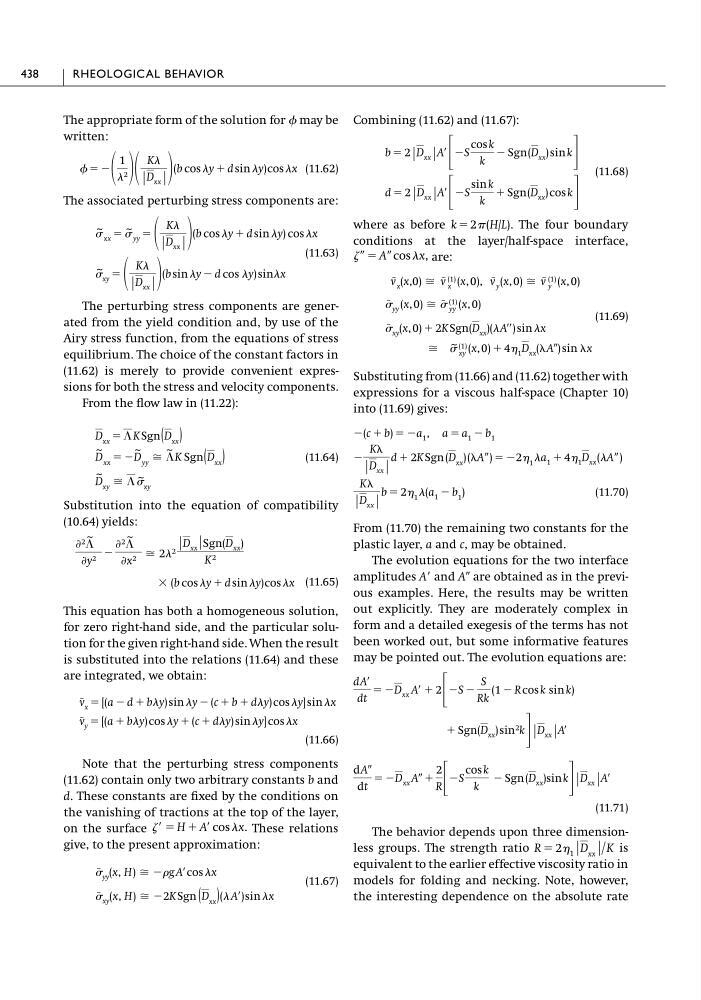
The appropriate form of the solution for � may be
written:
(11.62)
The associated perturbing stress components are:
(11.63)
The perturbing stress components are generated from the yield condition and, by use of the
Airy stress function, from the equations of stress
equilibrium. The choice of the constant factors in
(11.62) is merely to provide convenient expressions for both the stress and velocity components.
From the flow law in (11.22):
(11.64)
Substitution into the equation of compatibility
(10.64) yields:
(11.65)
This equation has both a homogeneous solution,
for zero right-hand side, and the particular solution for the given right-hand side. When the result
is substituted into the relations (11.64) and these
are integrated, we obtain:
(11.66)
Note that the perturbing stress components
(11.62) contain only two arbitrary constants b and
d. These constants are fixed by the conditions on
the vanishing of tractions at the top of the layer,
on the surface
These relations
give, to the present approximation:
(11.67)
� ~ xy (x, H) � �2K Sgn (D xx )(�A�)sin �x
� ~ yy (x, H) � ��gA�cos �x
�� � H � A� cos �x.
v
~ y � [(a � b�y) cos �y � (c � d�y) sin �y] cos �x
v
~ x � [(a � d � b�y) sin �y � (c � b � d�y) cos �y] sin �x
� (b cos �y � d sin �y)cos �x
� 2� 2
|D xx |Sgn(D xx )
K 2
� 2 � ~
�y 2 �
� 2 � ~
�x 2
D ~
xy
� � � ~ xy
D ~
xx
� �D ~
yy
� � ~ K Sgn(D xx )
D xx � � K Sgn(D xx )
� ~ xy � �
K�
|D xx | �
(b sin �y � d cos �y) sin�x
� ~ xx � � ~ yy � �
K�
|D xx | �
(b cos �y � d sin �y) cos �x
� � � �
1
� 2� �
K�
|D xx | � (b cos �y � d sin �y)cos �x
Combining (11.62) and (11.67):
(11.68)
where as before k � 2� (H/L). The four boundary
conditions at the layer/half-space interface,
are:
(11.69)
Substituting from (11.66) and (11.62) together with
expressions for a viscous half-space (Chapter 10)
into (11.69) gives:
(11.70)
From (11.70) the remaining two constants for the
plastic layer, a and c, may be obtained.
The evolution equations for the two interface
amplitudes A� and A� are obtained as in the previous examples. Here, the results may be written
out explicitly. They are moderately complex in
form and a detailed exegesis of the terms has not
been worked out, but some informative features
may be pointed out. The evolution equations are:
(11.71)
The behavior depends upon three dimensionless groups. The strength ratio
is
equivalent to the earlier effective viscosity ratio in
models for folding and necking. Note, however,
the interesting dependence on the absolute rate
R � 2� 1 |D xx | � K
dA�
dt
� �D xx A� �
2
R � �S
cos k
k
� Sgn (D xx )sin k � |D xx |A�
� Sgn(D xx ) sin 2 k � |D xx |A�
dA�
dt
� �D xx A� � 2
�
�S �
S
Rk
(1 � R cos k sin k)
K�
|D xx |
b � 2� 1 �(a 1 � b 1 )
�
K�
|D xx |
d � 2K Sgn (D xx ) (�A�) � �2� 1 �a 1 � 4� 1 D xx (�A�)
�(c � b) � �a 1 , a � a 1 � b 1
� ~
� (1)
xy (x, 0) � 4� 1 D xx (�A�) sin �x
� ~ xy (x, 0) � 2K Sgn(D xx )(�A��) sin �x
� ~ yy (x, 0) � � ~ (1)
yy (x, 0)
v ~ x (x,0) � v ~ (1)
x (x, 0), v ~ y (x, 0) � v ~ (1)
y (x, 0)
� � � A� cos �x,
d � 2 |D xx |A� �
�S
sin k
k
� Sgn(D xx ) cos k
�
b � 2|D xx |A� �
�S
cos k
k
� Sgn(D xx ) sin k
�
438
RHEOLOGICAL BEHAVIOR
written:
(11.62)
The associated perturbing stress components are:
(11.63)
The perturbing stress components are generated from the yield condition and, by use of the
Airy stress function, from the equations of stress
equilibrium. The choice of the constant factors in
(11.62) is merely to provide convenient expressions for both the stress and velocity components.
From the flow law in (11.22):
(11.64)
Substitution into the equation of compatibility
(10.64) yields:
(11.65)
This equation has both a homogeneous solution,
for zero right-hand side, and the particular solution for the given right-hand side. When the result
is substituted into the relations (11.64) and these
are integrated, we obtain:
(11.66)
Note that the perturbing stress components
(11.62) contain only two arbitrary constants b and
d. These constants are fixed by the conditions on
the vanishing of tractions at the top of the layer,
on the surface
These relations
give, to the present approximation:
(11.67)
� ~ xy (x, H) � �2K Sgn (D xx )(�A�)sin �x
� ~ yy (x, H) � ��gA�cos �x
�� � H � A� cos �x.
v
~ y � [(a � b�y) cos �y � (c � d�y) sin �y] cos �x
v
~ x � [(a � d � b�y) sin �y � (c � b � d�y) cos �y] sin �x
� (b cos �y � d sin �y)cos �x
� 2� 2
|D xx |Sgn(D xx )
K 2
� 2 � ~
�y 2 �
� 2 � ~
�x 2
D ~
xy
� � � ~ xy
D ~
xx
� �D ~
yy
� � ~ K Sgn(D xx )
D xx � � K Sgn(D xx )
� ~ xy � �
K�
|D xx | �
(b sin �y � d cos �y) sin�x
� ~ xx � � ~ yy � �
K�
|D xx | �
(b cos �y � d sin �y) cos �x
� � � �
1
� 2� �
K�
|D xx | � (b cos �y � d sin �y)cos �x
Combining (11.62) and (11.67):
(11.68)
where as before k � 2� (H/L). The four boundary
conditions at the layer/half-space interface,
are:
(11.69)
Substituting from (11.66) and (11.62) together with
expressions for a viscous half-space (Chapter 10)
into (11.69) gives:
(11.70)
From (11.70) the remaining two constants for the
plastic layer, a and c, may be obtained.
The evolution equations for the two interface
amplitudes A� and A� are obtained as in the previous examples. Here, the results may be written
out explicitly. They are moderately complex in
form and a detailed exegesis of the terms has not
been worked out, but some informative features
may be pointed out. The evolution equations are:
(11.71)
The behavior depends upon three dimensionless groups. The strength ratio
is
equivalent to the earlier effective viscosity ratio in
models for folding and necking. Note, however,
the interesting dependence on the absolute rate
R � 2� 1 |D xx | � K
dA�
dt
� �D xx A� �
2
R � �S
cos k
k
� Sgn (D xx )sin k � |D xx |A�
� Sgn(D xx ) sin 2 k � |D xx |A�
dA�
dt
� �D xx A� � 2
�
�S �
S
Rk
(1 � R cos k sin k)
K�
|D xx |
b � 2� 1 �(a 1 � b 1 )
�
K�
|D xx |
d � 2K Sgn (D xx ) (�A�) � �2� 1 �a 1 � 4� 1 D xx (�A�)
�(c � b) � �a 1 , a � a 1 � b 1
� ~
� (1)
xy (x, 0) � 4� 1 D xx (�A�) sin �x
� ~ xy (x, 0) � 2K Sgn(D xx )(�A��) sin �x
� ~ yy (x, 0) � � ~ (1)
yy (x, 0)
v ~ x (x,0) � v ~ (1)
x (x, 0), v ~ y (x, 0) � v ~ (1)
y (x, 0)
� � � A� cos �x,
d � 2 |D xx |A� �
�S
sin k
k
� Sgn(D xx ) cos k
�
b � 2|D xx |A� �
�S
cos k
k
� Sgn(D xx ) sin k
�
438
RHEOLOGICAL BEHAVIOR