

(11.56)
For folding:
(11.57)
We may use these results to compute the rates
of growth for the amplitudes of the upper and
lower interfaces, AЈ and AЉ, where:
(11.58)
Using the approximations for R Ͻ Ͻ 0:
(11.59)
To re-confirm the sense of these relations, in
folding
and both AЈ and AЉ are positive: the perturbation grows if sin k Ͼ 0. In
necking in extension,
and AЉ is
negative, AЈ is positive: again, the perturbation
grows if sin k Ͼ 0.
The discrepancy from the approximations in
(11.59) is due to the difference between the discarded terms in the denominators of (11.56) and
(11.57), which are small if
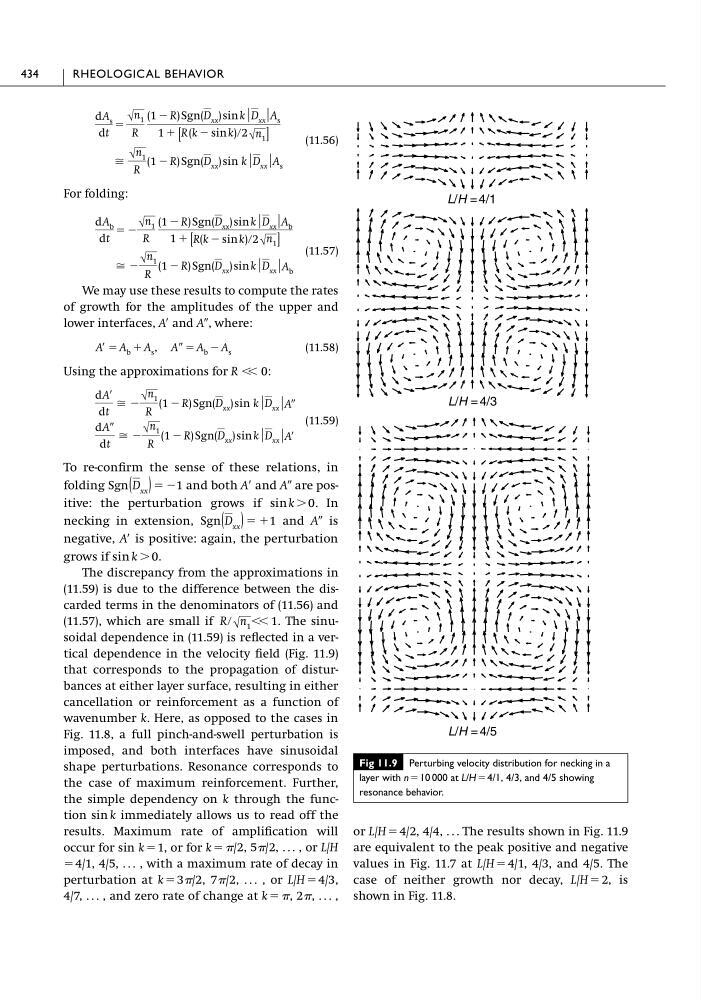
The sinusoidal dependence in (11.59) is reflected in a vertical dependence in the velocity field (Fig. 11.9)
that corresponds to the propagation of disturbances at either layer surface, resulting in either
cancellation or reinforcement as a function of
wavenumber k. Here, as opposed to the cases in
Fig. 11.8, a full pinch-and-swell perturbation is
imposed, and both interfaces have sinusoidal
shape perturbations. Resonance corresponds to
the case of maximum reinforcement. Further,
the simple dependency on k through the function sin k immediately allows us to read off the
results. Maximum rate of amplification will
occur for sin k ϭ 1, or for k ϭ /2, 5/2, . . . , or L/H
ϭ 4/1, 4/5, . . . , with a maximum rate of decay in
perturbation at k ϭ 3/2, 7/2, . . . , or L/H ϭ 4/3,
4/7, . . . , and zero rate of change at k ϭ , 2, . . . ,
Rր √ n 1 ϽϽ 1.
Sgn(D xx ) ϭ ϩ1
Sgn(D xx ) ϭ Ϫ1
dAЈЈ
dt
Х Ϫ
√ n 1
R
(1 Ϫ R) Sgn(D xx ) sin k |D xx |AЈ
dAЈ
dt
Х Ϫ
√ n 1
R
(1 Ϫ R) Sgn(D xx ) sin k |D xx |AЈЈ
AЈ ϭ A b ϩ A s , AЉ ϭ A b Ϫ A s
Х Ϫ
√ n 1
R
(1 Ϫ R) Sgn(D xx ) sin k |D xx |A b
dA b
dt
ϭ Ϫ
√ n 1
R
(1 Ϫ R) Sgn(D xx ) sin k |D xx |A b
1 ϩ [R(k Ϫ sin k)ր2 √ n 1 ]
Х
√ n 1
R
(1 Ϫ R) Sgn(D xx ) sin k |D xx |A s
dA s
dt
ϭ
√ n 1
R
(1 Ϫ R) Sgn(D xx ) sin k |D xx |A s
1 ϩ [ R (k Ϫ sin k)ր2 √ n 1 ]
or L/H ϭ 4/2, 4/4, . . . The results shown in Fig. 11.9
are equivalent to the peak positive and negative
values in Fig. 11.7 at L/H ϭ 4/1, 4/3, and 4/5. The
case of neither growth nor decay, L/H ϭ 2, is
shown in Fig. 11.8.
434
RHEOLOGICAL BEHAVIOR
Fig 11.9 Perturbing velocity distribution for necking in a
layer with nϭ10 000 at L/Hϭ4/1, 4/3, and 4/5 showing
resonance behavior.
L/H = 4/1
L/H = 4/3
L/H = 4/5
For folding:
(11.57)
We may use these results to compute the rates
of growth for the amplitudes of the upper and
lower interfaces, AЈ and AЉ, where:
(11.58)
Using the approximations for R Ͻ Ͻ 0:
(11.59)
To re-confirm the sense of these relations, in
folding
and both AЈ and AЉ are positive: the perturbation grows if sin k Ͼ 0. In
necking in extension,
and AЉ is
negative, AЈ is positive: again, the perturbation
grows if sin k Ͼ 0.
The discrepancy from the approximations in
(11.59) is due to the difference between the discarded terms in the denominators of (11.56) and
(11.57), which are small if
The sinusoidal dependence in (11.59) is reflected in a vertical dependence in the velocity field (Fig. 11.9)
that corresponds to the propagation of disturbances at either layer surface, resulting in either
cancellation or reinforcement as a function of
wavenumber k. Here, as opposed to the cases in
Fig. 11.8, a full pinch-and-swell perturbation is
imposed, and both interfaces have sinusoidal
shape perturbations. Resonance corresponds to
the case of maximum reinforcement. Further,
the simple dependency on k through the function sin k immediately allows us to read off the
results. Maximum rate of amplification will
occur for sin k ϭ 1, or for k ϭ /2, 5/2, . . . , or L/H
ϭ 4/1, 4/5, . . . , with a maximum rate of decay in
perturbation at k ϭ 3/2, 7/2, . . . , or L/H ϭ 4/3,
4/7, . . . , and zero rate of change at k ϭ , 2, . . . ,
Rր √ n 1 ϽϽ 1.
Sgn(D xx ) ϭ ϩ1
Sgn(D xx ) ϭ Ϫ1
dAЈЈ
dt
Х Ϫ
√ n 1
R
(1 Ϫ R) Sgn(D xx ) sin k |D xx |AЈ
dAЈ
dt
Х Ϫ
√ n 1
R
(1 Ϫ R) Sgn(D xx ) sin k |D xx |AЈЈ
AЈ ϭ A b ϩ A s , AЉ ϭ A b Ϫ A s
Х Ϫ
√ n 1
R
(1 Ϫ R) Sgn(D xx ) sin k |D xx |A b
dA b
dt
ϭ Ϫ
√ n 1
R
(1 Ϫ R) Sgn(D xx ) sin k |D xx |A b
1 ϩ [R(k Ϫ sin k)ր2 √ n 1 ]
Х
√ n 1
R
(1 Ϫ R) Sgn(D xx ) sin k |D xx |A s
dA s
dt
ϭ
√ n 1
R
(1 Ϫ R) Sgn(D xx ) sin k |D xx |A s
1 ϩ [ R (k Ϫ sin k)ր2 √ n 1 ]
or L/H ϭ 4/2, 4/4, . . . The results shown in Fig. 11.9
are equivalent to the peak positive and negative
values in Fig. 11.7 at L/H ϭ 4/1, 4/3, and 4/5. The
case of neither growth nor decay, L/H ϭ 2, is
shown in Fig. 11.8.
434
RHEOLOGICAL BEHAVIOR
Fig 11.9 Perturbing velocity distribution for necking in a
layer with nϭ10 000 at L/Hϭ4/1, 4/3, and 4/5 showing
resonance behavior.
L/H = 4/1
L/H = 4/3
L/H = 4/5