

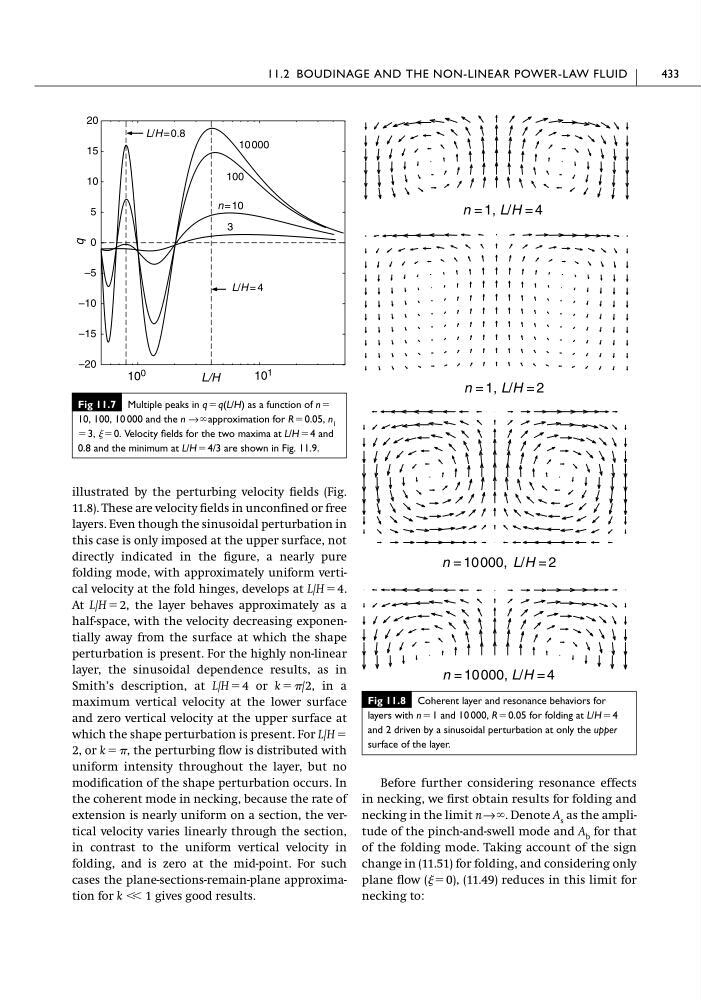
illustrated by the perturbing velocity fields (Fig.
11.8). These are velocity fields in unconfined or free
layers. Even though the sinusoidal perturbation in
this case is only imposed at the upper surface, not
directly indicated in the figure, a nearly pure
folding mode, with approximately uniform vertical velocity at the fold hinges, develops at L/H ϭ 4.
At L/H ϭ 2, the layer behaves approximately as a
half-space, with the velocity decreasing exponentially away from the surface at which the shape
perturbation is present. For the highly non-linear
layer, the sinusoidal dependence results, as in
Smith’s description, at L/H ϭ 4 or k ϭ /2, in a
maximum vertical velocity at the lower surface
and zero vertical velocity at the upper surface at
which the shape perturbation is present. For L/H ϭ
2, or k ϭ , the perturbing flow is distributed with
uniform intensity throughout the layer, but no
modification of the shape perturbation occurs. In
the coherent mode in necking, because the rate of
extension is nearly uniform on a section, the vertical velocity varies linearly through the section,
in contrast to the uniform vertical velocity in
folding, and is zero at the mid-point. For such
cases the plane-sections-remain-plane approximation for k Ͻ Ͻ 1 gives good results.
Before further considering resonance effects
in necking, we first obtain results for folding and
necking in the limit n→ ϱ. Denote A s as the amplitude of the pinch-and-swell mode and A b for that
of the folding mode. Taking account of the sign
change in (11.51) for folding, and considering only
plane flow ( ϭ 0), (11.49) reduces in this limit for
necking to:
11.2 BOUDINAGE AND THE NON-LINEAR POWER-LAW FLUID
433
Fig 11.7 Multiple peaks in qϭq(L/H) as a function of nϭ
10, 100, 10 000 and the n →ϱ approximation for Rϭ0.05, n 1
ϭ 3, ϭ0. Velocity fields for the two maxima at L/Hϭ4 and
0.8 and the minimum at L/Hϭ4/3 are shown in Fig. 11.9.
10 1
–20
–15
–10
–5
0
5
10
15
20
q
n=10
3
100
10000
L/H = 4
L/H=0.8
L/H
10 0
Fig 11.8 Coherent layer and resonance behaviors for
layers with nϭ1 and 10 000, R ϭ0.05 for folding at L/Hϭ4
and 2 driven by a sinusoidal perturbation at only the upper
surface of the layer.
n = 1, L/H = 4
n = 10 000, L/H = 2
n = 1, L/H = 2
n = 10 000, L/H = 4
11.8). These are velocity fields in unconfined or free
layers. Even though the sinusoidal perturbation in
this case is only imposed at the upper surface, not
directly indicated in the figure, a nearly pure
folding mode, with approximately uniform vertical velocity at the fold hinges, develops at L/H ϭ 4.
At L/H ϭ 2, the layer behaves approximately as a
half-space, with the velocity decreasing exponentially away from the surface at which the shape
perturbation is present. For the highly non-linear
layer, the sinusoidal dependence results, as in
Smith’s description, at L/H ϭ 4 or k ϭ /2, in a
maximum vertical velocity at the lower surface
and zero vertical velocity at the upper surface at
which the shape perturbation is present. For L/H ϭ
2, or k ϭ , the perturbing flow is distributed with
uniform intensity throughout the layer, but no
modification of the shape perturbation occurs. In
the coherent mode in necking, because the rate of
extension is nearly uniform on a section, the vertical velocity varies linearly through the section,
in contrast to the uniform vertical velocity in
folding, and is zero at the mid-point. For such
cases the plane-sections-remain-plane approximation for k Ͻ Ͻ 1 gives good results.
Before further considering resonance effects
in necking, we first obtain results for folding and
necking in the limit n→ ϱ. Denote A s as the amplitude of the pinch-and-swell mode and A b for that
of the folding mode. Taking account of the sign
change in (11.51) for folding, and considering only
plane flow ( ϭ 0), (11.49) reduces in this limit for
necking to:
11.2 BOUDINAGE AND THE NON-LINEAR POWER-LAW FLUID
433
Fig 11.7 Multiple peaks in qϭq(L/H) as a function of nϭ
10, 100, 10 000 and the n →ϱ approximation for Rϭ0.05, n 1
ϭ 3, ϭ0. Velocity fields for the two maxima at L/Hϭ4 and
0.8 and the minimum at L/Hϭ4/3 are shown in Fig. 11.9.
10 1
–20
–15
–10
–5
0
5
10
15
20
q
n=10
3
100
10000
L/H = 4
L/H=0.8
L/H
10 0
Fig 11.8 Coherent layer and resonance behaviors for
layers with nϭ1 and 10 000, R ϭ0.05 for folding at L/Hϭ4
and 2 driven by a sinusoidal perturbation at only the upper
surface of the layer.
n = 1, L/H = 4
n = 10 000, L/H = 2
n = 1, L/H = 2
n = 10 000, L/H = 4