

pressure are not used in solving for the velocity
field for necking or folding, and are not given
here.
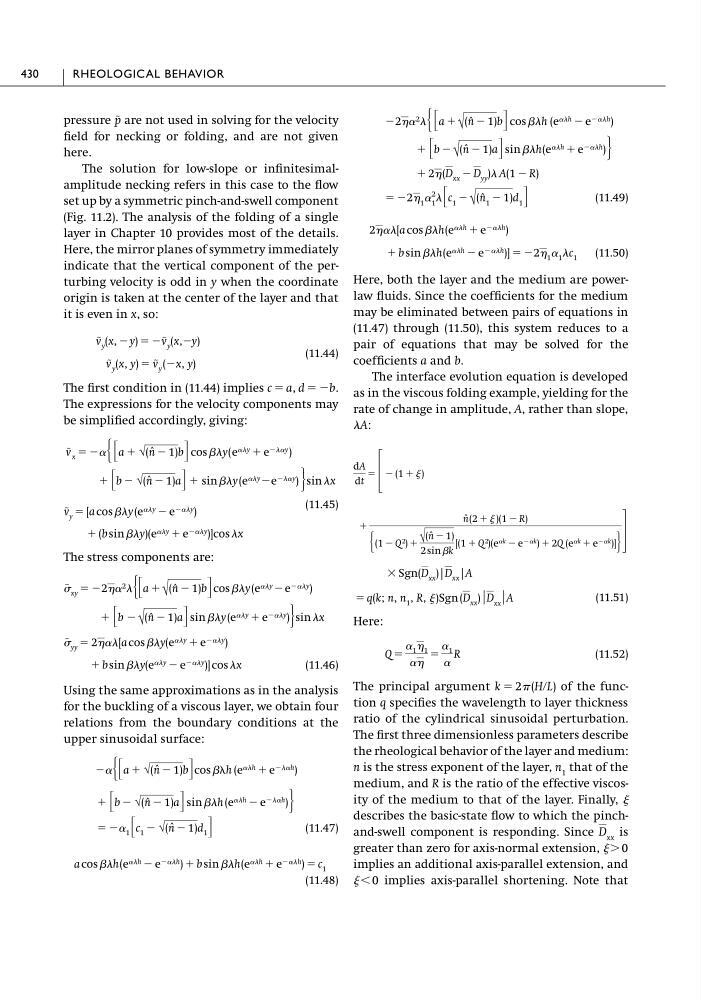
The solution for low-slope or infinitesimalamplitude necking refers in this case to the flow
set up by a symmetric pinch-and-swell component
(Fig. 11.2). The analysis of the folding of a single
layer in Chapter 10 provides most of the details.
Here, the mirror planes of symmetry immediately
indicate that the vertical component of the perturbing velocity is odd in y when the coordinate
origin is taken at the center of the layer and that
it is even in x, so:
(11.44)
The first condition in (11.44) implies
The expressions for the velocity components may
be simplified accordingly, giving:
(11.45)
The stress components are:
(11.46)
Using the same approximations as in the analysis
for the buckling of a viscous layer, we obtain four
relations from the boundary conditions at the
upper sinusoidal surface:
(11.47)
(11.48)
a cos h(e ␣h Ϫ e Ϫ␣h ) ϩ b sin h(e ␣h ϩ e Ϫ␣h ) ϭ c 1
ϭ Ϫ␣ 1 ΄c 1 Ϫ √(n ˆ Ϫ 1)d 1 ΅
ϩ ΄bϪ √(n ˆ Ϫ 1)a΅ sin h (e ␣h Ϫ e Ϫ␣h ) ·
Ϫ␣ Ά΄ a ϩ √(n ˆ Ϫ 1)b΅cos h (e ␣h ϩ e Ϫ␣h )
ϩ b sin y(e ␣y Ϫ e Ϫ␣y )] cos x
~ yy ϭ 2␣[a cos y(e ␣y ϩ e Ϫ␣y )
ϩ ΄b Ϫ √ (n ˆ Ϫ 1)a΅ sin y (e ␣y ϩ e Ϫ␣y ) · sin x
~ xy ϭ Ϫ2␣ 2 Ά΄ a ϩ √ (n ˆ Ϫ 1)b΅ cos y (e ␣y Ϫe Ϫ␣y )
ϩ (b sin y)(e ␣y ϩ e Ϫ␣y )]cos x
v ~ y ϭ [a cos y (e ␣y Ϫ e Ϫ␣y )
ϩ ΄bϪ √(n ˆ Ϫ 1)a΅ ϩ sin y (e ␣y Ϫe Ϫ␣y ) · sin x
v ~ x ϭ Ϫ␣ Ά΄ a ϩ √(n ˆ Ϫ 1)b΅ cos y(e ␣y ϩ e Ϫ␣y )
c ϭ a, d ϭ Ϫb.
v ~ y (x, y) ϭ v ~ y (Ϫx, y)
v ~ y (x, Ϫy) ϭ Ϫv ~ y (x,Ϫy)
p ~
(11.49)
(11.50)
Here, both the layer and the medium are powerlaw fluids. Since the coefficients for the medium
may be eliminated between pairs of equations in
(11.47) through (11.50), this system reduces to a
pair of equations that may be solved for the
coefficients a and b.
The interface evolution equation is developed
as in the viscous folding example, yielding for the
rate of change in amplitude, A, rather than slope,
A:
(11.51)
Here:
(11.52)
The principal argument
of the function q specifies the wavelength to layer thickness
ratio of the cylindrical sinusoidal perturbation.
The first three dimensionless parameters describe
the rheological behavior of the layer and medium:
n is the stress exponent of the layer, n 1 that of the
medium, and R is the ratio of the effective viscosity of the medium to that of the layer. Finally,
describes the basic-state flow to which the pinchand-swell component is responding. Since
is
greater than zero for axis-normal extension, Ͼ 0
implies an additional axis-parallel extension, and
Ͻ 0 implies axis-parallel shortening. Note that
D xx
k ϭ 2 (HրL)
Q ϭ
␣ 1 1
␣
ϭ
␣ 1
␣
R
ϭ q(k; n, n 1 , R, )Sgn (D xx ) |D xx |A
ϫ Sgn(D xx )|D xx |A
ϩ
n ˆ(2 ϩ )(1 Ϫ R)
Ά (1 Ϫ Q 2 ) ϩ √ (n ˆ Ϫ 1)
2 sin k
[(1 ϩ Q 2 )(e ␣k Ϫ e Ϫ␣k ) ϩ 2Q (e ␣k ϩ e Ϫ␣k )] · ΅
dA
dt
ϭ
΄
Ϫ (1 ϩ )
ϩ b sin h(e ␣h Ϫ e Ϫ␣h )] ϭ Ϫ2 1 ␣ 1 c 1
2␣[a cos h(e ␣h ϩ e Ϫ␣h )
ϭ Ϫ2 1 ␣
2
1
΄c 1 Ϫ √ (n ˆ 1 Ϫ 1)d 1 ΅
ϩ 2(D xx Ϫ D yy ) A(1 Ϫ R)
ϩ ΄bϪ √ (n ˆ Ϫ 1)a΅ sin h(e ␣h ϩ e Ϫ␣h ) ·
Ϫ2␣ 2 Ά΄ a ϩ √ (n ˆ Ϫ 1)b΅ cos h (e ␣h Ϫ e Ϫ␣h )
430
RHEOLOGICAL BEHAVIOR
field for necking or folding, and are not given
here.
The solution for low-slope or infinitesimalamplitude necking refers in this case to the flow
set up by a symmetric pinch-and-swell component
(Fig. 11.2). The analysis of the folding of a single
layer in Chapter 10 provides most of the details.
Here, the mirror planes of symmetry immediately
indicate that the vertical component of the perturbing velocity is odd in y when the coordinate
origin is taken at the center of the layer and that
it is even in x, so:
(11.44)
The first condition in (11.44) implies
The expressions for the velocity components may
be simplified accordingly, giving:
(11.45)
The stress components are:
(11.46)
Using the same approximations as in the analysis
for the buckling of a viscous layer, we obtain four
relations from the boundary conditions at the
upper sinusoidal surface:
(11.47)
(11.48)
a cos h(e ␣h Ϫ e Ϫ␣h ) ϩ b sin h(e ␣h ϩ e Ϫ␣h ) ϭ c 1
ϭ Ϫ␣ 1 ΄c 1 Ϫ √(n ˆ Ϫ 1)d 1 ΅
ϩ ΄bϪ √(n ˆ Ϫ 1)a΅ sin h (e ␣h Ϫ e Ϫ␣h ) ·
Ϫ␣ Ά΄ a ϩ √(n ˆ Ϫ 1)b΅cos h (e ␣h ϩ e Ϫ␣h )
ϩ b sin y(e ␣y Ϫ e Ϫ␣y )] cos x
~ yy ϭ 2␣[a cos y(e ␣y ϩ e Ϫ␣y )
ϩ ΄b Ϫ √ (n ˆ Ϫ 1)a΅ sin y (e ␣y ϩ e Ϫ␣y ) · sin x
~ xy ϭ Ϫ2␣ 2 Ά΄ a ϩ √ (n ˆ Ϫ 1)b΅ cos y (e ␣y Ϫe Ϫ␣y )
ϩ (b sin y)(e ␣y ϩ e Ϫ␣y )]cos x
v ~ y ϭ [a cos y (e ␣y Ϫ e Ϫ␣y )
ϩ ΄bϪ √(n ˆ Ϫ 1)a΅ ϩ sin y (e ␣y Ϫe Ϫ␣y ) · sin x
v ~ x ϭ Ϫ␣ Ά΄ a ϩ √(n ˆ Ϫ 1)b΅ cos y(e ␣y ϩ e Ϫ␣y )
c ϭ a, d ϭ Ϫb.
v ~ y (x, y) ϭ v ~ y (Ϫx, y)
v ~ y (x, Ϫy) ϭ Ϫv ~ y (x,Ϫy)
p ~
(11.49)
(11.50)
Here, both the layer and the medium are powerlaw fluids. Since the coefficients for the medium
may be eliminated between pairs of equations in
(11.47) through (11.50), this system reduces to a
pair of equations that may be solved for the
coefficients a and b.
The interface evolution equation is developed
as in the viscous folding example, yielding for the
rate of change in amplitude, A, rather than slope,
A:
(11.51)
Here:
(11.52)
The principal argument
of the function q specifies the wavelength to layer thickness
ratio of the cylindrical sinusoidal perturbation.
The first three dimensionless parameters describe
the rheological behavior of the layer and medium:
n is the stress exponent of the layer, n 1 that of the
medium, and R is the ratio of the effective viscosity of the medium to that of the layer. Finally,
describes the basic-state flow to which the pinchand-swell component is responding. Since
is
greater than zero for axis-normal extension, Ͼ 0
implies an additional axis-parallel extension, and
Ͻ 0 implies axis-parallel shortening. Note that
D xx
k ϭ 2 (HրL)
Q ϭ
␣ 1 1
␣
ϭ
␣ 1
␣
R
ϭ q(k; n, n 1 , R, )Sgn (D xx ) |D xx |A
ϫ Sgn(D xx )|D xx |A
ϩ
n ˆ(2 ϩ )(1 Ϫ R)
Ά (1 Ϫ Q 2 ) ϩ √ (n ˆ Ϫ 1)
2 sin k
[(1 ϩ Q 2 )(e ␣k Ϫ e Ϫ␣k ) ϩ 2Q (e ␣k ϩ e Ϫ␣k )] · ΅
dA
dt
ϭ
΄
Ϫ (1 ϩ )
ϩ b sin h(e ␣h Ϫ e Ϫ␣h )] ϭ Ϫ2 1 ␣ 1 c 1
2␣[a cos h(e ␣h ϩ e Ϫ␣h )
ϭ Ϫ2 1 ␣
2
1
΄c 1 Ϫ √ (n ˆ 1 Ϫ 1)d 1 ΅
ϩ 2(D xx Ϫ D yy ) A(1 Ϫ R)
ϩ ΄bϪ √ (n ˆ Ϫ 1)a΅ sin h(e ␣h ϩ e Ϫ␣h ) ·
Ϫ2␣ 2 Ά΄ a ϩ √ (n ˆ Ϫ 1)b΅ cos h (e ␣h Ϫ e Ϫ␣h )
430
RHEOLOGICAL BEHAVIOR