

random waviness. Selective amplification may
then only occur when the constitutive relations of a non-linear material can be linearized
about a basic state of flow, since only then do the
wavelength components in the perturbing flow
not interact. Linear independence also requires
that linearization of the boundary conditions,
when only terms proportional to A are retained, is accurate, as in our analysis of viscous
folding.
Here, the basic state is taken as uniform layerparallel extension or shortening, which simply
changes the sign of
To emphasize this, we
write:
(11.24)
Since we have not studied folding in layer-parallel
shortening for a non-linear fluid layer, we also
consider that here. We shall see that other types
of instability in the shortening or extension of a
layer occur; for example shortening of a soft layer
between stiff media produces mullions (Smith,
1975).
To add interest to the analysis, consider a basicstate flow in which the principal rates of deformation,
are all non-zero, with axes x
and z in the plane of the layer and y normal to it.
The perturbing flow is restricted to a plane flow
associated with a cylindrical component in the
shape perturbation whose axis lies parallel to the
principal axis of the basic state, .
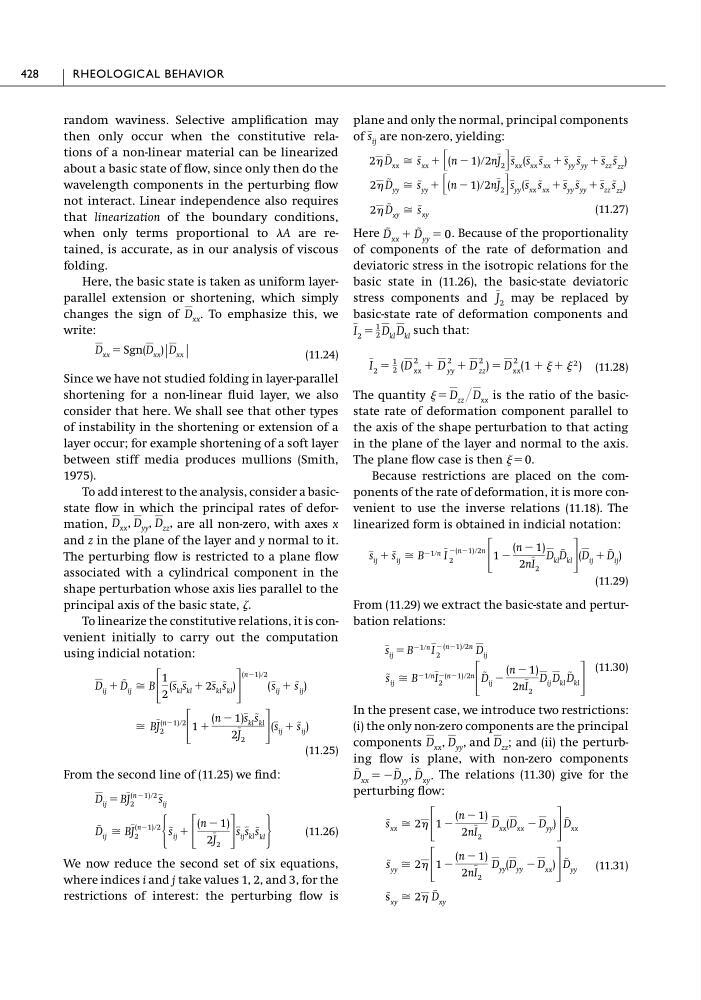
To linearize the constitutive relations, it is convenient initially to carry out the computation
using indicial notation:
(11.25)
From the second line of (11.25) we find:
(11.26)
We now reduce the second set of six equations,
where indices i and j take values 1, 2, and 3, for the
restrictions of interest: the perturbing flow is
D
~
ij Х BJ
(nϪ1)ր2
2
Ά
s ~
ij ϩ
΄
(n Ϫ 1)
2J 2 ΅
s ij s kl s ~
kl ·
D ij ϭ BJ
(nϪ1)ր2
2
s ij
Х BJ
(nϪ1)ր2
2
΄ 1 ϩ
(n Ϫ 1)s kl s ~
kl
2J 2
΅ (s ij ϩ s ~ ij )
D ij ϩ D
~
ij Х B ΄
1
2
(s kl s kl ϩ 2s kl s ~
kl ) ΅
(nϪ1)ր2
(s ij ϩ s ~
ij )
D xx , D yy , D zz ,
D xx ϭ Sgn(D xx )|D xx |
D xx .
plane and only the normal, principal components
of are non-zero, yielding:
(11.27)
Here
. Because of the proportionality
of components of the rate of deformation and
deviatoric stress in the isotropic relations for the
basic state in (11.26), the basic-state deviatoric
stress components and
may be replaced by
basic-state rate of deformation components and
such that:
(11.28)
The quantity
is the ratio of the basicstate rate of deformation component parallel to
the axis of the shape perturbation to that acting
in the plane of the layer and normal to the axis.
The plane flow case is then ϭ 0.
Because restrictions are placed on the components of the rate of deformation, it is more convenient to use the inverse relations (11.18). The
linearized form is obtained in indicial notation:
(11.29)
From (11.29) we extract the basic-state and perturbation relations:
(11.30)
In the present case, we introduce two restrictions:
(i) the only non-zero components are the principal
components
and (ii) the perturbing flow is plane, with non-zero components
The relations (11.30) give for the
perturbing flow:
(11.31)
s ~
xy
Х 2 D
~
xy
s ~
yy
Х 2 ΄ 1 Ϫ
(n Ϫ 1)
2nI 2
D yy (D yy Ϫ D xx ) ΅ D
~
yy
s ~
xx Х 2 ΄ 1 Ϫ
(n Ϫ 1)
2nI 2
D xx (D xx Ϫ D yy ) ΅ D
~
xx
D
~
xx ϭ ϪD
~
yy , D
~
xy .
D xx , D yy , and D zz ;
s ~
ij Х B Ϫ1րn I 2
Ϫ(nϪ1) ր2n
΄
D ij
~ Ϫ
(n Ϫ 1)
2nI 2
D ij D kl D
~
kl ΅
s ij ϭ B
Ϫ1րn I
Ϫ(nϪ1)ր2n
2
D ij
s ij ϩ s ~
ij Х B Ϫ1րn I 2
Ϫ(nϪ1) ր2n
΄
1 Ϫ
(n Ϫ 1)
2nI 2
D kl D
~
kl ΅
(D ij ϩ D
~
ij )
ϭ D zz D xx
I 2 ϭ
1
2 (D
2
xx ϩ D
2
yy ϩ D
2
zz ) ϭ D
2
xx (1 ϩ ϩ 2 )
I 2 ϭ
1
2 D kl D kl
J 2
D
~
xx ϩ D
~
yy ϭ 0
2 D
~
xy
Х s ~
xy
2 D
~
yy Х s ~
yy ϩ ΄(n Ϫ 1)ր2nJ 2 ΅s yy (s xx s ~ xx ϩ s yy s ~ yy ϩ s zz s ~
zz
)
2 D
~
xx Х s ~
xx ϩ ΄(n Ϫ 1)ր2nJ 2 ΅s xx (s xx s ~ xx ϩ s yy s ~ yy ϩ s zz s ~
zz
)
s ij
428
RHEOLOGICAL BEHAVIOR
then only occur when the constitutive relations of a non-linear material can be linearized
about a basic state of flow, since only then do the
wavelength components in the perturbing flow
not interact. Linear independence also requires
that linearization of the boundary conditions,
when only terms proportional to A are retained, is accurate, as in our analysis of viscous
folding.
Here, the basic state is taken as uniform layerparallel extension or shortening, which simply
changes the sign of
To emphasize this, we
write:
(11.24)
Since we have not studied folding in layer-parallel
shortening for a non-linear fluid layer, we also
consider that here. We shall see that other types
of instability in the shortening or extension of a
layer occur; for example shortening of a soft layer
between stiff media produces mullions (Smith,
1975).
To add interest to the analysis, consider a basicstate flow in which the principal rates of deformation,
are all non-zero, with axes x
and z in the plane of the layer and y normal to it.
The perturbing flow is restricted to a plane flow
associated with a cylindrical component in the
shape perturbation whose axis lies parallel to the
principal axis of the basic state, .
To linearize the constitutive relations, it is convenient initially to carry out the computation
using indicial notation:
(11.25)
From the second line of (11.25) we find:
(11.26)
We now reduce the second set of six equations,
where indices i and j take values 1, 2, and 3, for the
restrictions of interest: the perturbing flow is
D
~
ij Х BJ
(nϪ1)ր2
2
Ά
s ~
ij ϩ
΄
(n Ϫ 1)
2J 2 ΅
s ij s kl s ~
kl ·
D ij ϭ BJ
(nϪ1)ր2
2
s ij
Х BJ
(nϪ1)ր2
2
΄ 1 ϩ
(n Ϫ 1)s kl s ~
kl
2J 2
΅ (s ij ϩ s ~ ij )
D ij ϩ D
~
ij Х B ΄
1
2
(s kl s kl ϩ 2s kl s ~
kl ) ΅
(nϪ1)ր2
(s ij ϩ s ~
ij )
D xx , D yy , D zz ,
D xx ϭ Sgn(D xx )|D xx |
D xx .
plane and only the normal, principal components
of are non-zero, yielding:
(11.27)
Here
. Because of the proportionality
of components of the rate of deformation and
deviatoric stress in the isotropic relations for the
basic state in (11.26), the basic-state deviatoric
stress components and
may be replaced by
basic-state rate of deformation components and
such that:
(11.28)
The quantity
is the ratio of the basicstate rate of deformation component parallel to
the axis of the shape perturbation to that acting
in the plane of the layer and normal to the axis.
The plane flow case is then ϭ 0.
Because restrictions are placed on the components of the rate of deformation, it is more convenient to use the inverse relations (11.18). The
linearized form is obtained in indicial notation:
(11.29)
From (11.29) we extract the basic-state and perturbation relations:
(11.30)
In the present case, we introduce two restrictions:
(i) the only non-zero components are the principal
components
and (ii) the perturbing flow is plane, with non-zero components
The relations (11.30) give for the
perturbing flow:
(11.31)
s ~
xy
Х 2 D
~
xy
s ~
yy
Х 2 ΄ 1 Ϫ
(n Ϫ 1)
2nI 2
D yy (D yy Ϫ D xx ) ΅ D
~
yy
s ~
xx Х 2 ΄ 1 Ϫ
(n Ϫ 1)
2nI 2
D xx (D xx Ϫ D yy ) ΅ D
~
xx
D
~
xx ϭ ϪD
~
yy , D
~
xy .
D xx , D yy , and D zz ;
s ~
ij Х B Ϫ1րn I 2
Ϫ(nϪ1) ր2n
΄
D ij
~ Ϫ
(n Ϫ 1)
2nI 2
D ij D kl D
~
kl ΅
s ij ϭ B
Ϫ1րn I
Ϫ(nϪ1)ր2n
2
D ij
s ij ϩ s ~
ij Х B Ϫ1րn I 2
Ϫ(nϪ1) ր2n
΄
1 Ϫ
(n Ϫ 1)
2nI 2
D kl D
~
kl ΅
(D ij ϩ D
~
ij )
ϭ D zz D xx
I 2 ϭ
1
2 (D
2
xx ϩ D
2
yy ϩ D
2
zz ) ϭ D
2
xx (1 ϩ ϩ 2 )
I 2 ϭ
1
2 D kl D kl
J 2
D
~
xx ϩ D
~
yy ϭ 0
2 D
~
xy
Х s ~
xy
2 D
~
yy Х s ~
yy ϩ ΄(n Ϫ 1)ր2nJ 2 ΅s yy (s xx s ~ xx ϩ s yy s ~ yy ϩ s zz s ~
zz
)
2 D
~
xx Х s ~
xx ϩ ΄(n Ϫ 1)ր2nJ 2 ΅s xx (s xx s ~ xx ϩ s yy s ~ yy ϩ s zz s ~
zz
)
s ij
428
RHEOLOGICAL BEHAVIOR