

(11.17)
Using (11.17) in (11.13) we have:
(11.18)
It is useful to make a comparison between the
relations for the Newtonian viscous fluid, the
power-law fluid, and a third material, the
rigid, perfectly plastic solid. For simplicity, the
results for plane flow are given, for which
All materials are
incompressible so the rates of deformation are
related as:
(11.19)
The constitutive relations for the viscous fluid are:
(11.20)
The constitutive relations for the power-law fluid
are:
(11.21)
The constitutive relations for the rigid, perfectly
plastic solid at yield are:
(11.22)
K is the maximum shear stress attained at yielding of the material. Here ⌳ϭ⌳(x, y) is not a material constant but is a function of position. The
first pair of conditions in (11.22) is a statement
of isotropy alone: the principal axes of the rate of
deformation tensor coincide with the principal
axes of the stress tensor or the deviatoric stress
tensor. To complement the addition of a new
unknown, an additional equation in the stress
components, the yield condition is specified. For
stresses below this condition, the material is rigid
and, further, the stress state cannot lie outside the
yield condition, which is a circle in ( ( xx Ϫ yy ),
xy )-space. All three materials satisfy the governing equations of stress equilibrium and the kinematic relations.
1
2
where J 2 ϭ
1
4 ( xx Ϫ yy ) 2 ϩ 2
xy ϭ K 2
D xx ϭ ⌳
1
2 ( xx Ϫ yy ), D xy ϭ ⌳ xy
where J 2 ϭ
1
4 ( xx Ϫ yy ) 2 ϩ 2
xy
D xx ϭ BJ (nϪ1) ր2
2
1
2 ( xx Ϫ yy ), D xy ϭ BJ (nϪ1)ր2
2
xy
D xy ϭ xy ր4
D xx ϭ ( xx Ϫ yy ) ր4
D xx ϩ D yy ϭ 0
s xx ϭ Ϫs yy ϭ
1
2 ( xx Ϫ yy ), s xy ϭ xy .
s ij ϭ B Ϫ1րn I Ϫ(nϪ1) ր 2n
2
D ij
J 2 ϭ (I 2 րB 2 ) 1րn
I 2 ϭ
1
2 D ij D ij ϭ B 2 J (nϪ1)
2
1
2 s ij s ij ϭ B 2 J n
2
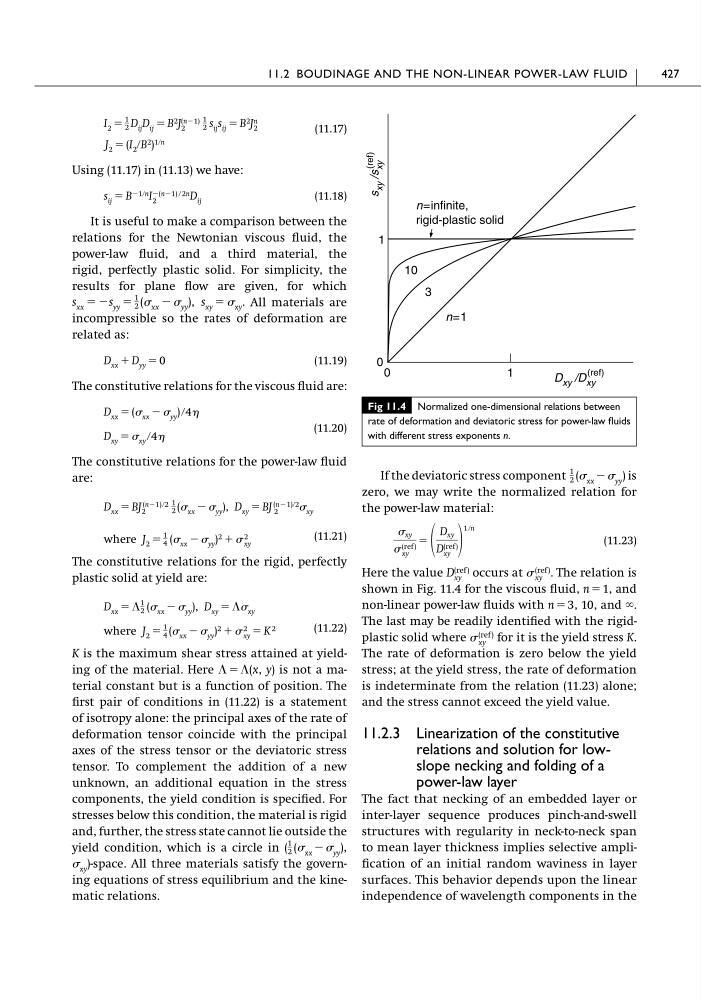
If the deviatoric stress component ( xx Ϫ yy ) is
zero, we may write the normalized relation for
the power-law material:
(11.23)
Here the value
occurs at
The relation is
shown in Fig. 11.4 for the viscous fluid, n ϭ 1, and
non-linear power-law fluids with n ϭ 3, 10, and ϱ.
The last may be readily identified with the rigidplastic solid where
for it is the yield stress K.
The rate of deformation is zero below the yield
stress; at the yield stress, the rate of deformation
is indeterminate from the relation (11.23) alone;
and the stress cannot exceed the yield value.
11.2.3 Linearization of the constitutive
relations and solution for lowslope necking and folding of a
power-law layer
The fact that necking of an embedded layer or
inter-layer sequence produces pinch-and-swell
structures with regularity in neck-to-neck span
to mean layer thickness implies selective amplification of an initial random waviness in layer
surfaces. This behavior depends upon the linear
independence of wavelength components in the
(ref )
xy
(ref )
xy .
D (ref )
xy
xy
(ref )
xy
ϭ
D xy
D (ref )
xy
ˇ
1րn
1
2
11.2 BOUDINAGE AND THE NON-LINEAR POWER-LAW FLUID
427
Fig 11.4 Normalized one-dimensional relations between
rate of deformation and deviatoric stress for power-law fluids
with different stress exponents n.
0
1
1
n=infinite,
rigid-plastic solid
n=1
3
10
D xy /D xy
(ref)
s
xy /s
xy
(ref)
0
Using (11.17) in (11.13) we have:
(11.18)
It is useful to make a comparison between the
relations for the Newtonian viscous fluid, the
power-law fluid, and a third material, the
rigid, perfectly plastic solid. For simplicity, the
results for plane flow are given, for which
All materials are
incompressible so the rates of deformation are
related as:
(11.19)
The constitutive relations for the viscous fluid are:
(11.20)
The constitutive relations for the power-law fluid
are:
(11.21)
The constitutive relations for the rigid, perfectly
plastic solid at yield are:
(11.22)
K is the maximum shear stress attained at yielding of the material. Here ⌳ϭ⌳(x, y) is not a material constant but is a function of position. The
first pair of conditions in (11.22) is a statement
of isotropy alone: the principal axes of the rate of
deformation tensor coincide with the principal
axes of the stress tensor or the deviatoric stress
tensor. To complement the addition of a new
unknown, an additional equation in the stress
components, the yield condition is specified. For
stresses below this condition, the material is rigid
and, further, the stress state cannot lie outside the
yield condition, which is a circle in ( ( xx Ϫ yy ),
xy )-space. All three materials satisfy the governing equations of stress equilibrium and the kinematic relations.
1
2
where J 2 ϭ
1
4 ( xx Ϫ yy ) 2 ϩ 2
xy ϭ K 2
D xx ϭ ⌳
1
2 ( xx Ϫ yy ), D xy ϭ ⌳ xy
where J 2 ϭ
1
4 ( xx Ϫ yy ) 2 ϩ 2
xy
D xx ϭ BJ (nϪ1) ր2
2
1
2 ( xx Ϫ yy ), D xy ϭ BJ (nϪ1)ր2
2
xy
D xy ϭ xy ր4
D xx ϭ ( xx Ϫ yy ) ր4
D xx ϩ D yy ϭ 0
s xx ϭ Ϫs yy ϭ
1
2 ( xx Ϫ yy ), s xy ϭ xy .
s ij ϭ B Ϫ1րn I Ϫ(nϪ1) ր 2n
2
D ij
J 2 ϭ (I 2 րB 2 ) 1րn
I 2 ϭ
1
2 D ij D ij ϭ B 2 J (nϪ1)
2
1
2 s ij s ij ϭ B 2 J n
2
If the deviatoric stress component ( xx Ϫ yy ) is
zero, we may write the normalized relation for
the power-law material:
(11.23)
Here the value
occurs at
The relation is
shown in Fig. 11.4 for the viscous fluid, n ϭ 1, and
non-linear power-law fluids with n ϭ 3, 10, and ϱ.
The last may be readily identified with the rigidplastic solid where
for it is the yield stress K.
The rate of deformation is zero below the yield
stress; at the yield stress, the rate of deformation
is indeterminate from the relation (11.23) alone;
and the stress cannot exceed the yield value.
11.2.3 Linearization of the constitutive
relations and solution for lowslope necking and folding of a
power-law layer
The fact that necking of an embedded layer or
inter-layer sequence produces pinch-and-swell
structures with regularity in neck-to-neck span
to mean layer thickness implies selective amplification of an initial random waviness in layer
surfaces. This behavior depends upon the linear
independence of wavelength components in the
(ref )
xy
(ref )
xy .
D (ref )
xy
xy
(ref )
xy
ϭ
D xy
D (ref )
xy
ˇ
1րn
1
2
11.2 BOUDINAGE AND THE NON-LINEAR POWER-LAW FLUID
427
Fig 11.4 Normalized one-dimensional relations between
rate of deformation and deviatoric stress for power-law fluids
with different stress exponents n.
0
1
1
n=infinite,
rigid-plastic solid
n=1
3
10
D xy /D xy
(ref)
s
xy /s
xy
(ref)
0