

The expectation for a layer embedded in a
medium is that the degree or strength of instability will be less than that for the mechanically
unconstrained layer. In part to study this aspect,
we formulate a complete tensor characterization
of a power-law fluid and use it to analyze necking
and folding in the manner of the treatment given
in Chapter 10.
11.2.2 Constitutive relations for an
isotropic power-law fluid and a
plastic solid
A general tensor relationship between the components of the rate of deformation and those of the
deviatoric stress is needed to treat arbitrary deformations of the power-law fluid. In experiments
(Evans and Kohlstedt, 1995) on right-circular cylinders of rock under axial stress, � 1 , generally compressive, and uniform radial or circumferential
stress, � 3 , acting on the surface of the cylinder,
results are usually given in the form:
(11.12)
Here
is the axial strain rate. Because
experiments are conducted in compression, the
experimentalists treat a rate of shortening and a
compressive stress as positive. The constant preceding the power of the difference between axial
and circumferential normal stress components is
written as the product of a pre-exponential constant, A 0 , and a term expressing temperature
dependence, where Q� is an activation energy, R� is
the gas constant, and T� is the absolute temperature. Primes are introduced since the symbols Q ,
R, and T will be used for other quantities. In our
development, we retain the convention of taking
compressive stress as negative.
d� 1 �dt � �
.
1
d� 1
dt
� A 0 exp �
Q�
R� T� (� 1 � � 3 ) n
A convenient isotropic non-linear form for the
constitutive relations (Nye, 1953; Calladine and
Drucker, 1962) is:
(11.13)
Here the scalar J 2 is the second isotropic invariant
of the deviatoric stress. Thus, all quantities in
(11.13) are independent of the orientation of the
coordinate axes with respect to the material, and
the relations are those for an isotropic material.
We may write, in analogy with a Newtonian
viscous fluid:
(11.14)
Here
is an effective viscosity that is generally
position dependent through the local value of the
stress. A comparison of the form (11.13) with the
experimental relationship (11.12), reversing the
usual sign convention used for experiments, is
obtained as follows. Taking x 1 for the direction
along the cylindrical sample axis, we have:
(11.15)
Then:
(11.16)
The coefficient B is expressed in units (MPa)
�n s
�1
in terms of constants given in the literature.
Constants for several polycrystalline quartzites
and marbles are given in Table 11.1 (Evans and
Kohlstedt, 1995). Values of effective viscosity
(11.14) at a temperature of 400� C and a maximum
shear stress of 10 MPa were computed from these
quantities and are also given.
In later analysis, the inverse of (11.13) is used.
To derive this, first we form:
B � [(3) (n�1)�2 (3�2)] A 0 exp(�Q��R�T�)
� A 0 exp (�Q��R�T�)(� 1 �� 3 ) n
D 1 � B΄
1
3 (� 1 � � 3 ) 2 ΅
(n�1) �2
2
3 (� 1 � � 3 )
J 2 �
1
2 (s 2
1 � s 2
2 � s 2
3 ) �
1
3 (� 1 � � 3 ) 2
s 2 � s 3 � �
1
3 (� 1 � � 3 )
s 1 � � 1 �
1
3 (� 1 � � 2 � � 3 ) �
2
3 (� 1 � � 3 )
� eff
2� eff � [BJ (n�1) � 2
2
] �1
D ij �
1
2� eff
s ij
s ij � � ij �
1
3 � kk � ij
D ij � BJ
(n�1)� 2
2
s ij , J 2 �
1
2 s kl s kl ,
426
RHEOLOGICAL BEHAVIOR
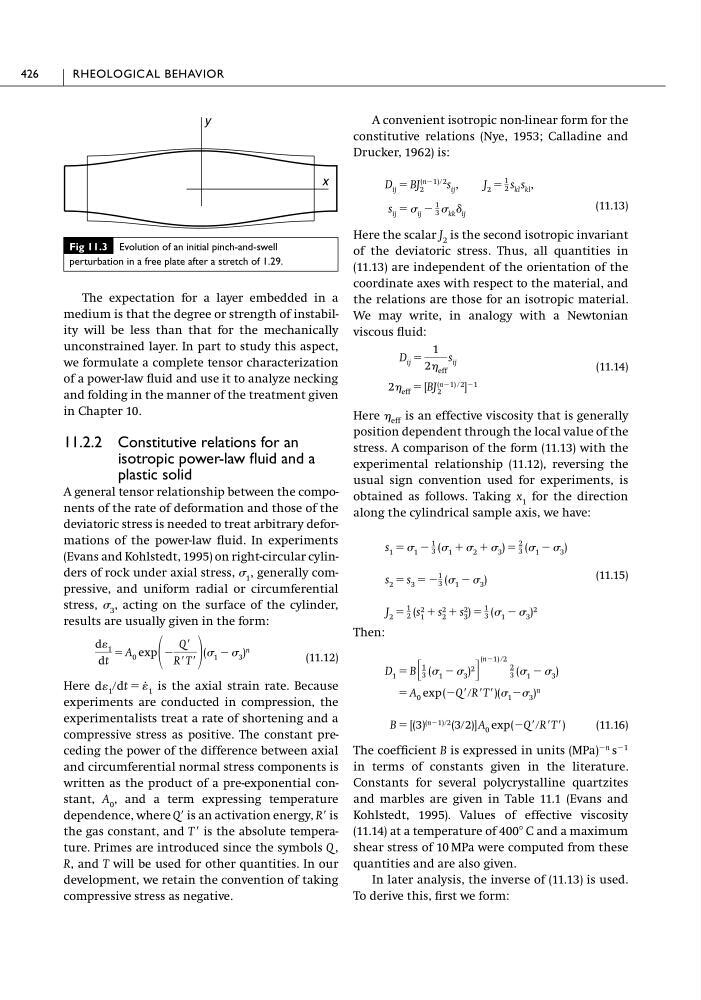
Fig 11.3 Evolution of an initial pinch-and-swell
perturbation in a free plate after a stretch of 1.29.
y
x
medium is that the degree or strength of instability will be less than that for the mechanically
unconstrained layer. In part to study this aspect,
we formulate a complete tensor characterization
of a power-law fluid and use it to analyze necking
and folding in the manner of the treatment given
in Chapter 10.
11.2.2 Constitutive relations for an
isotropic power-law fluid and a
plastic solid
A general tensor relationship between the components of the rate of deformation and those of the
deviatoric stress is needed to treat arbitrary deformations of the power-law fluid. In experiments
(Evans and Kohlstedt, 1995) on right-circular cylinders of rock under axial stress, � 1 , generally compressive, and uniform radial or circumferential
stress, � 3 , acting on the surface of the cylinder,
results are usually given in the form:
(11.12)
Here
is the axial strain rate. Because
experiments are conducted in compression, the
experimentalists treat a rate of shortening and a
compressive stress as positive. The constant preceding the power of the difference between axial
and circumferential normal stress components is
written as the product of a pre-exponential constant, A 0 , and a term expressing temperature
dependence, where Q� is an activation energy, R� is
the gas constant, and T� is the absolute temperature. Primes are introduced since the symbols Q ,
R, and T will be used for other quantities. In our
development, we retain the convention of taking
compressive stress as negative.
d� 1 �dt � �
.
1
d� 1
dt
� A 0 exp �
Q�
R� T� (� 1 � � 3 ) n
A convenient isotropic non-linear form for the
constitutive relations (Nye, 1953; Calladine and
Drucker, 1962) is:
(11.13)
Here the scalar J 2 is the second isotropic invariant
of the deviatoric stress. Thus, all quantities in
(11.13) are independent of the orientation of the
coordinate axes with respect to the material, and
the relations are those for an isotropic material.
We may write, in analogy with a Newtonian
viscous fluid:
(11.14)
Here
is an effective viscosity that is generally
position dependent through the local value of the
stress. A comparison of the form (11.13) with the
experimental relationship (11.12), reversing the
usual sign convention used for experiments, is
obtained as follows. Taking x 1 for the direction
along the cylindrical sample axis, we have:
(11.15)
Then:
(11.16)
The coefficient B is expressed in units (MPa)
�n s
�1
in terms of constants given in the literature.
Constants for several polycrystalline quartzites
and marbles are given in Table 11.1 (Evans and
Kohlstedt, 1995). Values of effective viscosity
(11.14) at a temperature of 400� C and a maximum
shear stress of 10 MPa were computed from these
quantities and are also given.
In later analysis, the inverse of (11.13) is used.
To derive this, first we form:
B � [(3) (n�1)�2 (3�2)] A 0 exp(�Q��R�T�)
� A 0 exp (�Q��R�T�)(� 1 �� 3 ) n
D 1 � B΄
1
3 (� 1 � � 3 ) 2 ΅
(n�1) �2
2
3 (� 1 � � 3 )
J 2 �
1
2 (s 2
1 � s 2
2 � s 2
3 ) �
1
3 (� 1 � � 3 ) 2
s 2 � s 3 � �
1
3 (� 1 � � 3 )
s 1 � � 1 �
1
3 (� 1 � � 2 � � 3 ) �
2
3 (� 1 � � 3 )
� eff
2� eff � [BJ (n�1) � 2
2
] �1
D ij �
1
2� eff
s ij
s ij � � ij �
1
3 � kk � ij
D ij � BJ
(n�1)� 2
2
s ij , J 2 �
1
2 s kl s kl ,
426
RHEOLOGICAL BEHAVIOR
Fig 11.3 Evolution of an initial pinch-and-swell
perturbation in a free plate after a stretch of 1.29.
y
x