

As a second related approximation, we adopt
the familiar plane-sections-remain-plane approximation used in engineering (Timoshenko and
Young, 1968) – or perhaps formerly used when
numerical codes were not readily available. Each
vertical section of the plate thus is treated as
undergoing homogeneous extension:
(11.4)
The applicable single-component relation for a
power-law fluid relates D xx and the deviatoric
stress component, s xx , which for plane flow is:
(11.5)
The constitutive relation is:
(11.6)
Substituting (11.4) and (11.5) into (11.6) we have:
(11.7)
This is the relation for change in vertical dimension of an infinitesimal material element of crosssectional area dA ϭ Hdx and thus the derivative is
a material time derivative. We could use the constancy of area dA, expressing conservation of mass
for an incompressible material in plane flow, to
establish the relative positions of sections along
the layer, but this problem is set aside.
so, ϪH nϪ1 dH
dt
ϭ C
D xx ϭ Ϫ
1
H
dH
dt
ϭ BЈ ΄
1
2
F x
H ΅
n
ϭ
C
H n
D xx ϭ BЈ(s 2
xx ) (nϪ1)ր 2 s xx
s xx ϭ
1
2
xx ϭ
1
2
F x
H
D xx Х Ϫ
1
H
ѨH
Ѩt
Linearizing the relation (11.7) for a perturbation in thickness about a mean value yields:
(11.8)
Expansion and separation of mean and perturbing parts gives:
(11.9)
The last relation indeed shows that the perturbation does not grow for a viscous layer, n ϭ 1, and
grows only slowly unless n is large. Values of n
obtained in the laboratory for high-temperature
steady-state creep of rock tend to be modest, typically ranging from 3 to 5 (Table 11.1), so that only
a weak necking instability arises from the nonlinear relation between the rate of deformation
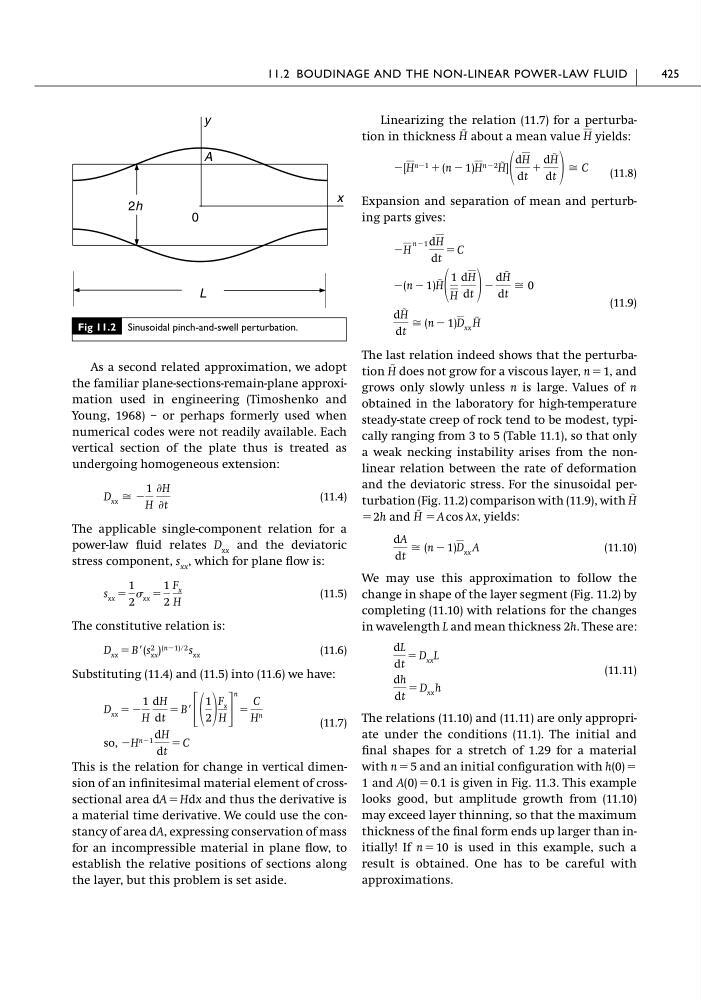
and the deviatoric stress. For the sinusoidal perturbation (Fig. 11.2) comparison with (11.9), with
ϭ2h and ϭ A cos x, yields:
(11.10)
We may use this approximation to follow the
change in shape of the layer segment (Fig. 11.2) by
completing (11.10) with relations for the changes
in wavelength L and mean thickness 2h. These are:
(11.11)
The relations (11.10) and (11.11) are only appropriate under the conditions (11.1). The initial and
final shapes for a stretch of 1.29 for a material
with n ϭ 5 and an initial configuration with h(0) ϭ
1 and A(0) ϭ 0.1 is given in Fig. 11.3. This example
looks good, but amplitude growth from (11.10)
may exceed layer thinning, so that the maximum
thickness of the final form ends up larger than initially! If n ϭ 10 is used in this example, such a
result is obtained. One has to be careful with
approximations.
dh
dt
ϭ D xx h
dL
dt
ϭ D xx L
dA
dt
Х (n Ϫ 1)D xx A
H
~
H
~
H
~
dH
~
dt
Х (n Ϫ 1)D xx H
~
Ϫ(n Ϫ 1)H
~
1
H
dH
dt
Ϫ
dH
~
dt
Х 0
ϪH
nϪ1 dH
dt
ϭ C
Ϫ[H nϪ1 ϩ (n Ϫ 1)H nϪ2 H
~ ]
dH
dt
ϩ
dH
~
dt Х C
H
H
~
11.2 BOUDINAGE AND THE NON-LINEAR POWER-LAW FLUID
425
Fig 11.2 Sinusoidal pinch-and-swell perturbation.
0
y
x
A
2h
L
the familiar plane-sections-remain-plane approximation used in engineering (Timoshenko and
Young, 1968) – or perhaps formerly used when
numerical codes were not readily available. Each
vertical section of the plate thus is treated as
undergoing homogeneous extension:
(11.4)
The applicable single-component relation for a
power-law fluid relates D xx and the deviatoric
stress component, s xx , which for plane flow is:
(11.5)
The constitutive relation is:
(11.6)
Substituting (11.4) and (11.5) into (11.6) we have:
(11.7)
This is the relation for change in vertical dimension of an infinitesimal material element of crosssectional area dA ϭ Hdx and thus the derivative is
a material time derivative. We could use the constancy of area dA, expressing conservation of mass
for an incompressible material in plane flow, to
establish the relative positions of sections along
the layer, but this problem is set aside.
so, ϪH nϪ1 dH
dt
ϭ C
D xx ϭ Ϫ
1
H
dH
dt
ϭ BЈ ΄
1
2
F x
H ΅
n
ϭ
C
H n
D xx ϭ BЈ(s 2
xx ) (nϪ1)ր 2 s xx
s xx ϭ
1
2
xx ϭ
1
2
F x
H
D xx Х Ϫ
1
H
ѨH
Ѩt
Linearizing the relation (11.7) for a perturbation in thickness about a mean value yields:
(11.8)
Expansion and separation of mean and perturbing parts gives:
(11.9)
The last relation indeed shows that the perturbation does not grow for a viscous layer, n ϭ 1, and
grows only slowly unless n is large. Values of n
obtained in the laboratory for high-temperature
steady-state creep of rock tend to be modest, typically ranging from 3 to 5 (Table 11.1), so that only
a weak necking instability arises from the nonlinear relation between the rate of deformation
and the deviatoric stress. For the sinusoidal perturbation (Fig. 11.2) comparison with (11.9), with
ϭ2h and ϭ A cos x, yields:
(11.10)
We may use this approximation to follow the
change in shape of the layer segment (Fig. 11.2) by
completing (11.10) with relations for the changes
in wavelength L and mean thickness 2h. These are:
(11.11)
The relations (11.10) and (11.11) are only appropriate under the conditions (11.1). The initial and
final shapes for a stretch of 1.29 for a material
with n ϭ 5 and an initial configuration with h(0) ϭ
1 and A(0) ϭ 0.1 is given in Fig. 11.3. This example
looks good, but amplitude growth from (11.10)
may exceed layer thinning, so that the maximum
thickness of the final form ends up larger than initially! If n ϭ 10 is used in this example, such a
result is obtained. One has to be careful with
approximations.
dh
dt
ϭ D xx h
dL
dt
ϭ D xx L
dA
dt
Х (n Ϫ 1)D xx A
H
~
H
~
H
~
dH
~
dt
Х (n Ϫ 1)D xx H
~
Ϫ(n Ϫ 1)H
~
1
H
dH
dt
Ϫ
dH
~
dt
Х 0
ϪH
nϪ1 dH
dt
ϭ C
Ϫ[H nϪ1 ϩ (n Ϫ 1)H nϪ2 H
~ ]
dH
dt
ϩ
dH
~
dt Х C
H
H
~
11.2 BOUDINAGE AND THE NON-LINEAR POWER-LAW FLUID
425
Fig 11.2 Sinusoidal pinch-and-swell perturbation.
0
y
x
A
2h
L