

simple analysis of necking of a free plate, or
unconfined layer. We then show how selective
amplification occurs in layer extension, giving
necking, and, in layer-parallel shortening, giving
folding, in a layer of homogeneous and isotropic
power-law fluid embedded in a weaker medium.
A model for large-scale crustal necking is presented to illustrate the roles of gravity and
surficial processes acting on topography.
11.2.1 Plane-sections-remain-plane
analysis for a free plate
Let the material be the isotropic incompressible
power-law fluid already treated in the glacier-like
flow of Chapter 10. Consider a free plate of cylindrical form whose thickness varies as in Fig. 11.2.
It is not necessary to assume such a restricted
form, but we do suppose in the present case that
layer thickness varies slowly with length and that
the thickness variation is small relative to the
mean thickness. For this periodic shape, these
requirements are:
(11.1)
Here ϭ 2/L is the wavenumber and A is the
amplitude of the sinusoidal perturbation. We
later use this configuration to study initiation of
necking in an embedded layer. Here, though, we
more generally consider the deformation of a
layer of thickness H(x, t) that satisfies the equivalent conditions:
(11.2)
Here is the mean thickness and is the deviation from it. The thickness variation of the plate
is also cylindrical with a constant profile in the
layer direction normal to x. The plate undergoes
plane deformation when subjected to an axial
force per unit depth of constant magnitude F x Ͼ 0.
As here, the use of H for the full thickness of a
layer, but also h for the half-thickness, is done to
avoid having to write H/2 in boundary conditions
when the coordinate origin is taken at the center
of a layer to exploit symmetry.
The mean axial normal stress on a vertical
surface through the plate is:
(11.3)
This stress is taken to be uniform on a vertical
surface across the plate. We only treat the case of
a free plate with zero traction on its surface.
xx (x, t) ϭ
F x
H(x, t)
H
~
H
Ѩ(H
~ )
Ѩx
Ͻ Ͻ 1 and
H
~
H
Ͻ Ͻ 1
H(x, t) ϭ H(t) ϩ H
~ (x, t)
A Ͻ Ͻ 1 and A րh Ͻ Ͻ 1
424
RHEOLOGICAL BEHAVIOR
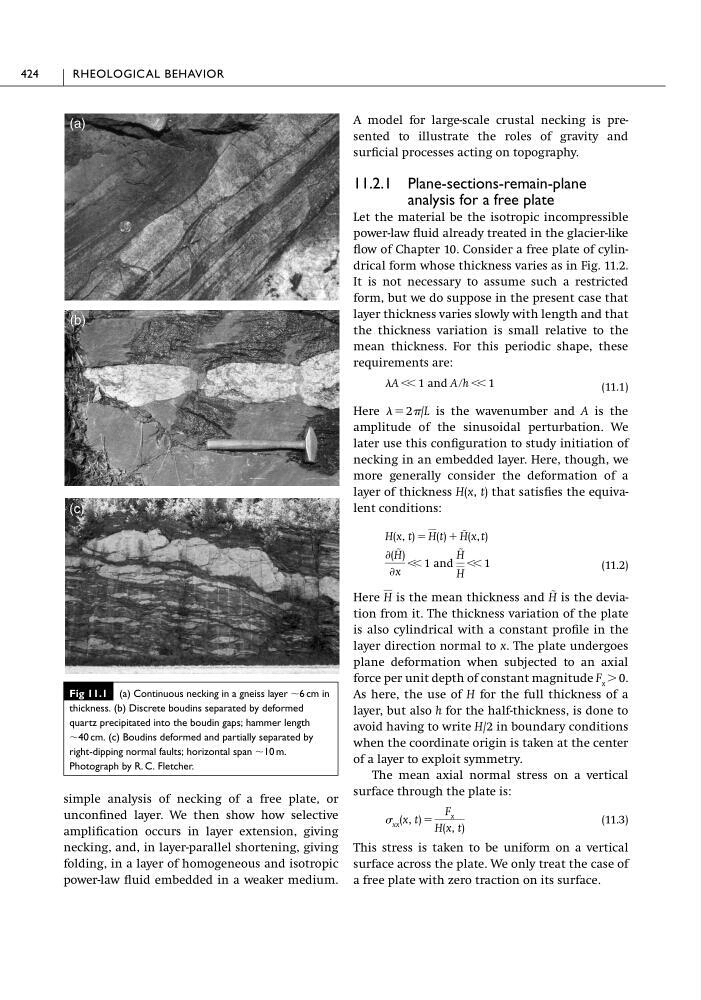
Fig 11.1 (a) Continuous necking in a gneiss layer ϳ6 cm in
thickness. (b) Discrete boudins separated by deformed
quartz precipitated into the boudin gaps; hammer length
ϳ40 cm. (c) Boudins deformed and partially separated by
right-dipping normal faults; horizontal span ϳ10 m.
Photograph by R. C. Fletcher.
(a)
(b)
(c)
unconfined layer. We then show how selective
amplification occurs in layer extension, giving
necking, and, in layer-parallel shortening, giving
folding, in a layer of homogeneous and isotropic
power-law fluid embedded in a weaker medium.
A model for large-scale crustal necking is presented to illustrate the roles of gravity and
surficial processes acting on topography.
11.2.1 Plane-sections-remain-plane
analysis for a free plate
Let the material be the isotropic incompressible
power-law fluid already treated in the glacier-like
flow of Chapter 10. Consider a free plate of cylindrical form whose thickness varies as in Fig. 11.2.
It is not necessary to assume such a restricted
form, but we do suppose in the present case that
layer thickness varies slowly with length and that
the thickness variation is small relative to the
mean thickness. For this periodic shape, these
requirements are:
(11.1)
Here ϭ 2/L is the wavenumber and A is the
amplitude of the sinusoidal perturbation. We
later use this configuration to study initiation of
necking in an embedded layer. Here, though, we
more generally consider the deformation of a
layer of thickness H(x, t) that satisfies the equivalent conditions:
(11.2)
Here is the mean thickness and is the deviation from it. The thickness variation of the plate
is also cylindrical with a constant profile in the
layer direction normal to x. The plate undergoes
plane deformation when subjected to an axial
force per unit depth of constant magnitude F x Ͼ 0.
As here, the use of H for the full thickness of a
layer, but also h for the half-thickness, is done to
avoid having to write H/2 in boundary conditions
when the coordinate origin is taken at the center
of a layer to exploit symmetry.
The mean axial normal stress on a vertical
surface through the plate is:
(11.3)
This stress is taken to be uniform on a vertical
surface across the plate. We only treat the case of
a free plate with zero traction on its surface.
xx (x, t) ϭ
F x
H(x, t)
H
~
H
Ѩ(H
~ )
Ѩx
Ͻ Ͻ 1 and
H
~
H
Ͻ Ͻ 1
H(x, t) ϭ H(t) ϩ H
~ (x, t)
A Ͻ Ͻ 1 and A րh Ͻ Ͻ 1
424
RHEOLOGICAL BEHAVIOR
Fig 11.1 (a) Continuous necking in a gneiss layer ϳ6 cm in
thickness. (b) Discrete boudins separated by deformed
quartz precipitated into the boudin gaps; hammer length
ϳ40 cm. (c) Boudins deformed and partially separated by
right-dipping normal faults; horizontal span ϳ10 m.
Photograph by R. C. Fletcher.
(a)
(b)
(c)