

Deformation of a rock mass containing small
random perturbations in the orientation of the
principal axes may give rise to their strong selective amplification leading to folding, internal
boudinage, or other structures (Cobbold et al.,
1971). Here, we examine the internal instability in
plane flow of an anisotropic viscous fluid.
A third deviation from the Newtonian fluid is
through compressibility that is mediated by the
transport by intergranular diffusion or by Darcy
flow of a mobile component – one that is soluble
in an intergranular pore fluid or acts as a weak
fluid in a much stiffer “solid” framework, as in a
partly melted rock. In this chapter, we consider
the former alternative, and model some of the
effects that arise from it in folding and necking
when the medium containing a stiff layer exhibits
this kind of behavior in combination with
Newtonian viscosity.
All deviations from the homogeneous Newtonian viscous fluid lead to effects that produce
observable features in the structures and internal
fabrics of deformed rocks, and they are of substantial interest in application to the interpretation of field data.
11.2 Boudinage and the non-linear
power-law fluid
Confusion with regards to the significance of the term
boudin has undoubtedly arisen in some countries
because of the different ways in which sausages are displayed in shops. On the continent of Europe, large
boudins are found lying side-by-side on grocers’ slabs;
in Britain and America, the smaller type of sausage is
more common, and these are seen hanging in strings,
end to end. Transverse sections of non-equidimensional
boudins remind the unwary of the latter. This misinterpretation of Lohest’s original description has unfortunately been made in at least two papers (Wilson and
Cosgrove, 1982).
Necking as exhibited in pinch-and-swell structures
in stiff layers (Fig. 11.1a) is an example indicating
rheological non-linearity in natural rock deformation. The ability to work molten glass to produce
sheets of uniform thickness depends on the
absence of a necking instability in a linear viscous
fluid. In structural geology, boudinage includes
the continuous necking that produces pinch-andswell structures (Fig. 11.1a) and the processes that
produce discretely segmented boudins (Fig. 11.1b,
c). While discretely segmented in cross section,
they may coalesce in the axial direction. Discrete
boudins may often have undergone an initial
episode of continuous necking. Two mechanisms
of segmentation occur: mode I cracks that contemporaneously fill with precipitated minerals
(Fig. 11.1b), and mode II faults or shear bands (Fig
11.1c). After separation, boudins tend to undergo
further deformation that results in a variety of
striking forms. The modeling of boudinage presented here is restricted to continuous necking.
It is not clear whether examples of necking of
rock layers are chiefly a consequence of nonlinearity derived from strain rate thinning, in which
the rate of deformation increases more rapidly
than linearly with the deviatoric stress, or that
derived from strain softening, in which an element
weakens as it deforms, since both contribute to
necking (Neurath and Smith, 1982). We first give a
11.2 BOUDINAGE AND THE NON-LINEAR POWER-LAW FLUID
423
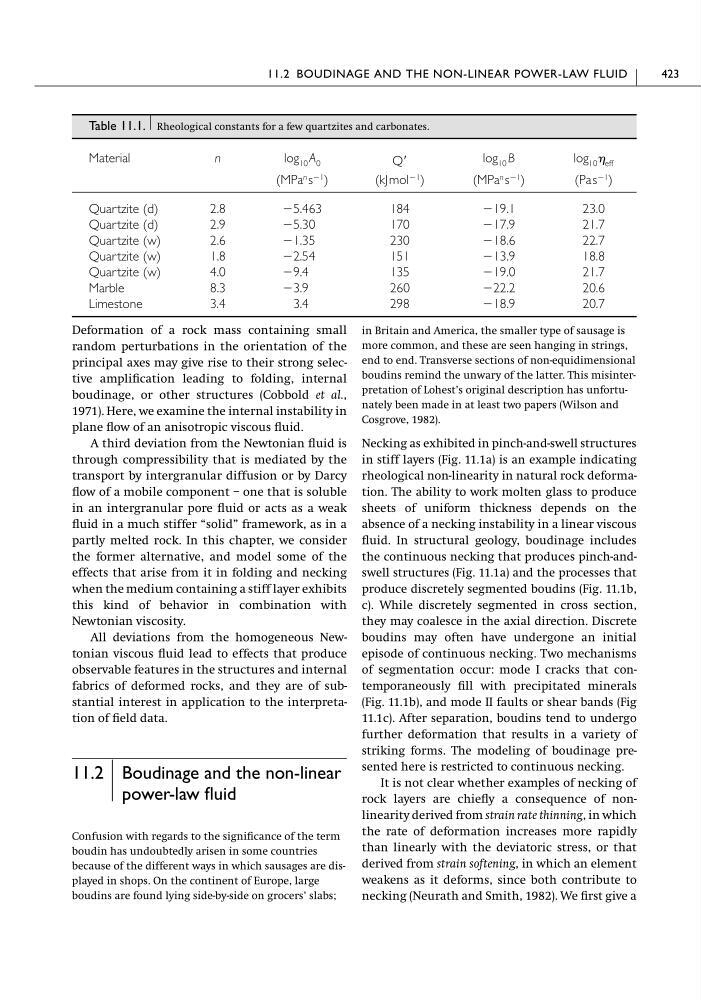
Table 11.1. Rheological constants for a few quartzites and carbonates.
Material
n
QЈ
Quartzite (d)
2.8
Ϫ5.463
184
Ϫ19.1
23.0
Quartzite (d)
2.9
Ϫ5.30
170
Ϫ17.9
21.7
Quartzite (w)
2.6
Ϫ1.35
230
Ϫ18.6
22.7
Quartzite (w)
1.8
Ϫ2.54
151
Ϫ13.9
18.8
Quartzite (w)
4.0
Ϫ9.4
135
Ϫ19.0
21.7
Marble
8.3
Ϫ3.9
260
Ϫ22.2
20.6
Limestone
3.4
3.4
298
Ϫ18.9
20.7
(Pa s Ϫ1 )
(MPa n s Ϫ1 )
(kJ mol Ϫ1 )
(MPa n s Ϫ1 )
log 10 eff
log 10 B
log 10 A 0
random perturbations in the orientation of the
principal axes may give rise to their strong selective amplification leading to folding, internal
boudinage, or other structures (Cobbold et al.,
1971). Here, we examine the internal instability in
plane flow of an anisotropic viscous fluid.
A third deviation from the Newtonian fluid is
through compressibility that is mediated by the
transport by intergranular diffusion or by Darcy
flow of a mobile component – one that is soluble
in an intergranular pore fluid or acts as a weak
fluid in a much stiffer “solid” framework, as in a
partly melted rock. In this chapter, we consider
the former alternative, and model some of the
effects that arise from it in folding and necking
when the medium containing a stiff layer exhibits
this kind of behavior in combination with
Newtonian viscosity.
All deviations from the homogeneous Newtonian viscous fluid lead to effects that produce
observable features in the structures and internal
fabrics of deformed rocks, and they are of substantial interest in application to the interpretation of field data.
11.2 Boudinage and the non-linear
power-law fluid
Confusion with regards to the significance of the term
boudin has undoubtedly arisen in some countries
because of the different ways in which sausages are displayed in shops. On the continent of Europe, large
boudins are found lying side-by-side on grocers’ slabs;
in Britain and America, the smaller type of sausage is
more common, and these are seen hanging in strings,
end to end. Transverse sections of non-equidimensional
boudins remind the unwary of the latter. This misinterpretation of Lohest’s original description has unfortunately been made in at least two papers (Wilson and
Cosgrove, 1982).
Necking as exhibited in pinch-and-swell structures
in stiff layers (Fig. 11.1a) is an example indicating
rheological non-linearity in natural rock deformation. The ability to work molten glass to produce
sheets of uniform thickness depends on the
absence of a necking instability in a linear viscous
fluid. In structural geology, boudinage includes
the continuous necking that produces pinch-andswell structures (Fig. 11.1a) and the processes that
produce discretely segmented boudins (Fig. 11.1b,
c). While discretely segmented in cross section,
they may coalesce in the axial direction. Discrete
boudins may often have undergone an initial
episode of continuous necking. Two mechanisms
of segmentation occur: mode I cracks that contemporaneously fill with precipitated minerals
(Fig. 11.1b), and mode II faults or shear bands (Fig
11.1c). After separation, boudins tend to undergo
further deformation that results in a variety of
striking forms. The modeling of boudinage presented here is restricted to continuous necking.
It is not clear whether examples of necking of
rock layers are chiefly a consequence of nonlinearity derived from strain rate thinning, in which
the rate of deformation increases more rapidly
than linearly with the deviatoric stress, or that
derived from strain softening, in which an element
weakens as it deforms, since both contribute to
necking (Neurath and Smith, 1982). We first give a
11.2 BOUDINAGE AND THE NON-LINEAR POWER-LAW FLUID
423
Table 11.1. Rheological constants for a few quartzites and carbonates.
Material
n
QЈ
Quartzite (d)
2.8
Ϫ5.463
184
Ϫ19.1
23.0
Quartzite (d)
2.9
Ϫ5.30
170
Ϫ17.9
21.7
Quartzite (w)
2.6
Ϫ1.35
230
Ϫ18.6
22.7
Quartzite (w)
1.8
Ϫ2.54
151
Ϫ13.9
18.8
Quartzite (w)
4.0
Ϫ9.4
135
Ϫ19.0
21.7
Marble
8.3
Ϫ3.9
260
Ϫ22.2
20.6
Limestone
3.4
3.4
298
Ϫ18.9
20.7
(Pa s Ϫ1 )
(MPa n s Ϫ1 )
(kJ mol Ϫ1 )
(MPa n s Ϫ1 )
log 10 eff
log 10 B
log 10 A 0