

constitutive equations for a transversely isotropic
anisotropic viscous fluid are given in (10.157). We
also showed how these could be identified as the
bulk constitutive relations for a layered material
consisting of alternating stiff and soft isotropic
viscous layers. Now let xЈ and yЈ denote the principal axes of anisotropy as in (10.157) and take the
x-axis fixed in the direction of bulk shortening
normal to the fold axial plane. The constitutive
relations for the homogeneous material in the
left-dipping fold limb are then, by transformation
of coordinates:
(10.168)
Here the stress components are the deviatoric
stress components defined as:
ϩ [(1 ϩ m) Ϫ (1 Ϫ m) cos 4]s xy
4 n D xy ϭ (1Ϫm) sin 4s xx
ϩ (1 Ϫ m) sin 4s xy
4 n D xx ϭ [(1 ϩ m) ϩ (1 Ϫ m) cos 4 ]s xx
(10.169)
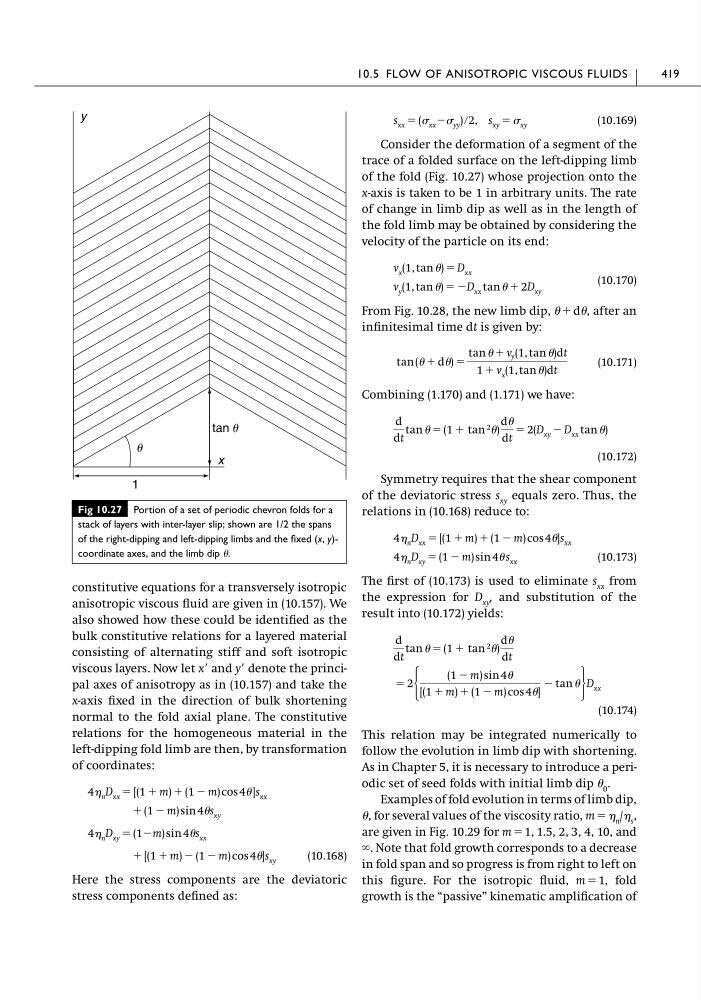
Consider the deformation of a segment of the
trace of a folded surface on the left-dipping limb
of the fold (Fig. 10.27) whose projection onto the
x-axis is taken to be 1 in arbitrary units. The rate
of change in limb dip as well as in the length of
the fold limb may be obtained by considering the
velocity of the particle on its end:
(10.170)
From Fig. 10.28, the new limb dip, ϩ d, after an
infinitesimal time dt is given by:
(10.171)
Combining (1.170) and (1.171) we have:
(10.172)
Symmetry requires that the shear component
of the deviatoric stress s xy equals zero. Thus, the
relations in (10.168) reduce to:
(10.173)
The first of (10.173) is used to eliminate s xx from
the expression for D xy , and substitution of the
result into (10.172) yields:
(10.174)
This relation may be integrated numerically to
follow the evolution in limb dip with shortening.
As in Chapter 5, it is necessary to introduce a periodic set of seed folds with initial limb dip 0 .
Examples of fold evolution in terms of limb dip,
, for several values of the viscosity ratio, m ϭ n / s ,
are given in Fig. 10.29 for m ϭ 1, 1.5, 2, 3, 4, 10, and
ϱ. Note that fold growth corresponds to a decrease
in fold span and so progress is from right to left on
this figure. For the isotropic fluid, m ϭ 1, fold
growth is the “passive” kinematic amplification of
ϭ 2
Ά
(1 Ϫ m) sin 4
[(1 ϩ m) ϩ (1 Ϫ m) cos 4]
Ϫ tan ·
D xx
d
dt
tan ϭ (1 ϩ tan 2 )
d
dt
4 n D xy ϭ (1 Ϫ m) sin 4 s xx
4 n D xx ϭ [(1 ϩ m) ϩ (1 Ϫ m) cos 4]s xx
d
dt
tan ϭ (1 ϩ tan 2 )
d
dt
ϭ 2(D xy Ϫ D xx tan )
tan ( ϩ d) ϭ
tan ϩ v y (1, tan )dt
1 ϩ v x (1, tan )dt
v y (1, tan ) ϭ ϪD xx tan ϩ 2D xy
v x (1, tan ) ϭ D xx
s xx ϭ ( xx Ϫ yy ) ր2, s xy ϭ xy
10.5 FLOW OF ANISOTROPIC VISCOUS FLUIDS
419
Fig 10.27 Portion of a set of periodic chevron folds for a
stack of layers with inter-layer slip; shown are 1/2 the spans
of the right-dipping and left-dipping limbs and the fixed (x, y)coordinate axes, and the limb dip .
x
y
1
tan u
u
anisotropic viscous fluid are given in (10.157). We
also showed how these could be identified as the
bulk constitutive relations for a layered material
consisting of alternating stiff and soft isotropic
viscous layers. Now let xЈ and yЈ denote the principal axes of anisotropy as in (10.157) and take the
x-axis fixed in the direction of bulk shortening
normal to the fold axial plane. The constitutive
relations for the homogeneous material in the
left-dipping fold limb are then, by transformation
of coordinates:
(10.168)
Here the stress components are the deviatoric
stress components defined as:
ϩ [(1 ϩ m) Ϫ (1 Ϫ m) cos 4]s xy
4 n D xy ϭ (1Ϫm) sin 4s xx
ϩ (1 Ϫ m) sin 4s xy
4 n D xx ϭ [(1 ϩ m) ϩ (1 Ϫ m) cos 4 ]s xx
(10.169)
Consider the deformation of a segment of the
trace of a folded surface on the left-dipping limb
of the fold (Fig. 10.27) whose projection onto the
x-axis is taken to be 1 in arbitrary units. The rate
of change in limb dip as well as in the length of
the fold limb may be obtained by considering the
velocity of the particle on its end:
(10.170)
From Fig. 10.28, the new limb dip, ϩ d, after an
infinitesimal time dt is given by:
(10.171)
Combining (1.170) and (1.171) we have:
(10.172)
Symmetry requires that the shear component
of the deviatoric stress s xy equals zero. Thus, the
relations in (10.168) reduce to:
(10.173)
The first of (10.173) is used to eliminate s xx from
the expression for D xy , and substitution of the
result into (10.172) yields:
(10.174)
This relation may be integrated numerically to
follow the evolution in limb dip with shortening.
As in Chapter 5, it is necessary to introduce a periodic set of seed folds with initial limb dip 0 .
Examples of fold evolution in terms of limb dip,
, for several values of the viscosity ratio, m ϭ n / s ,
are given in Fig. 10.29 for m ϭ 1, 1.5, 2, 3, 4, 10, and
ϱ. Note that fold growth corresponds to a decrease
in fold span and so progress is from right to left on
this figure. For the isotropic fluid, m ϭ 1, fold
growth is the “passive” kinematic amplification of
ϭ 2
Ά
(1 Ϫ m) sin 4
[(1 ϩ m) ϩ (1 Ϫ m) cos 4]
Ϫ tan ·
D xx
d
dt
tan ϭ (1 ϩ tan 2 )
d
dt
4 n D xy ϭ (1 Ϫ m) sin 4 s xx
4 n D xx ϭ [(1 ϩ m) ϩ (1 Ϫ m) cos 4]s xx
d
dt
tan ϭ (1 ϩ tan 2 )
d
dt
ϭ 2(D xy Ϫ D xx tan )
tan ( ϩ d) ϭ
tan ϩ v y (1, tan )dt
1 ϩ v x (1, tan )dt
v y (1, tan ) ϭ ϪD xx tan ϩ 2D xy
v x (1, tan ) ϭ D xx
s xx ϭ ( xx Ϫ yy ) ր2, s xy ϭ xy
10.5 FLOW OF ANISOTROPIC VISCOUS FLUIDS
419
Fig 10.27 Portion of a set of periodic chevron folds for a
stack of layers with inter-layer slip; shown are 1/2 the spans
of the right-dipping and left-dipping limbs and the fixed (x, y)coordinate axes, and the limb dip .
x
y
1
tan u
u