

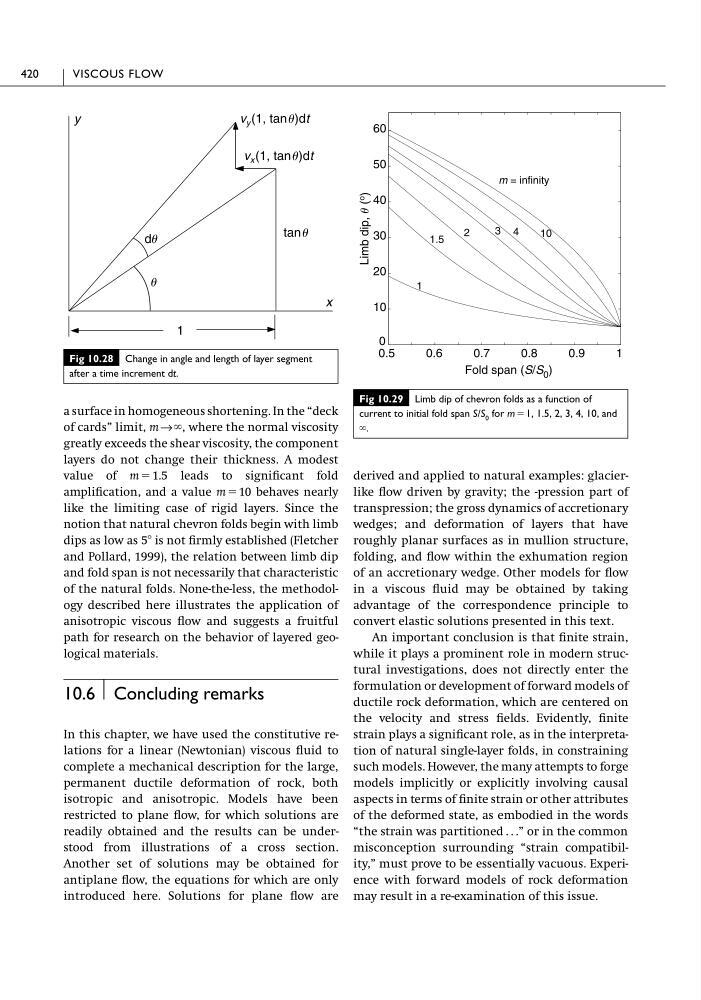
a surface in homogeneous shortening. In the “deck
of cards” limit, m → ϱ, where the normal viscosity
greatly exceeds the shear viscosity, the component
layers do not change their thickness. A modest
value of m ϭ 1.5 leads to significant fold
amplification, and a value m ϭ 10 behaves nearly
like the limiting case of rigid layers. Since the
notion that natural chevron folds begin with limb
dips as low as 5Њ is not firmly established (Fletcher
and Pollard, 1999), the relation between limb dip
and fold span is not necessarily that characteristic
of the natural folds. None-the-less, the methodology described here illustrates the application of
anisotropic viscous flow and suggests a fruitful
path for research on the behavior of layered geological materials.
10.6 Concluding remarks
In this chapter, we have used the constitutive relations for a linear (Newtonian) viscous fluid to
complete a mechanical description for the large,
permanent ductile deformation of rock, both
isotropic and anisotropic. Models have been
restricted to plane flow, for which solutions are
readily obtained and the results can be understood from illustrations of a cross section.
Another set of solutions may be obtained for
antiplane flow, the equations for which are only
introduced here. Solutions for plane flow are
derived and applied to natural examples: glacierlike flow driven by gravity; the -pression part of
transpression; the gross dynamics of accretionary
wedges; and deformation of layers that have
roughly planar surfaces as in mullion structure,
folding, and flow within the exhumation region
of an accretionary wedge. Other models for flow
in a viscous fluid may be obtained by taking
advantage of the correspondence principle to
convert elastic solutions presented in this text.
An important conclusion is that finite strain,
while it plays a prominent role in modern structural investigations, does not directly enter the
formulation or development of forward models of
ductile rock deformation, which are centered on
the velocity and stress fields. Evidently, finite
strain plays a significant role, as in the interpretation of natural single-layer folds, in constraining
such models. However, the many attempts to forge
models implicitly or explicitly involving causal
aspects in terms of finite strain or other attributes
of the deformed state, as embodied in the words
“the strain was partitioned . . .” or in the common
misconception surrounding “strain compatibility,” must prove to be essentially vacuous. Experience with forward models of rock deformation
may result in a re-examination of this issue.
420
VISCOUS FLOW
Fig 10.28 Change in angle and length of layer segment
after a time increment dt.
u
du
tan u
1
y
x
v y (1, tan u)dt
v x (1, tan u)dt
Fig 10.29 Limb dip of chevron folds as a function of
current to initial fold span S/S 0 for m ϭ1, 1.5, 2, 3, 4, 10, and
ϱ.
0.5
0.6
0.7
0.8
0.9
1
0
10
20
30
40
50
60
Fold span (S/S 0 )
Limb dip, u
( o
)
m = infinity
1
1.5
2
3 4
10
of cards” limit, m → ϱ, where the normal viscosity
greatly exceeds the shear viscosity, the component
layers do not change their thickness. A modest
value of m ϭ 1.5 leads to significant fold
amplification, and a value m ϭ 10 behaves nearly
like the limiting case of rigid layers. Since the
notion that natural chevron folds begin with limb
dips as low as 5Њ is not firmly established (Fletcher
and Pollard, 1999), the relation between limb dip
and fold span is not necessarily that characteristic
of the natural folds. None-the-less, the methodology described here illustrates the application of
anisotropic viscous flow and suggests a fruitful
path for research on the behavior of layered geological materials.
10.6 Concluding remarks
In this chapter, we have used the constitutive relations for a linear (Newtonian) viscous fluid to
complete a mechanical description for the large,
permanent ductile deformation of rock, both
isotropic and anisotropic. Models have been
restricted to plane flow, for which solutions are
readily obtained and the results can be understood from illustrations of a cross section.
Another set of solutions may be obtained for
antiplane flow, the equations for which are only
introduced here. Solutions for plane flow are
derived and applied to natural examples: glacierlike flow driven by gravity; the -pression part of
transpression; the gross dynamics of accretionary
wedges; and deformation of layers that have
roughly planar surfaces as in mullion structure,
folding, and flow within the exhumation region
of an accretionary wedge. Other models for flow
in a viscous fluid may be obtained by taking
advantage of the correspondence principle to
convert elastic solutions presented in this text.
An important conclusion is that finite strain,
while it plays a prominent role in modern structural investigations, does not directly enter the
formulation or development of forward models of
ductile rock deformation, which are centered on
the velocity and stress fields. Evidently, finite
strain plays a significant role, as in the interpretation of natural single-layer folds, in constraining
such models. However, the many attempts to forge
models implicitly or explicitly involving causal
aspects in terms of finite strain or other attributes
of the deformed state, as embodied in the words
“the strain was partitioned . . .” or in the common
misconception surrounding “strain compatibility,” must prove to be essentially vacuous. Experience with forward models of rock deformation
may result in a re-examination of this issue.
420
VISCOUS FLOW
Fig 10.28 Change in angle and length of layer segment
after a time increment dt.
u
du
tan u
1
y
x
v y (1, tan u)dt
v x (1, tan u)dt
Fig 10.29 Limb dip of chevron folds as a function of
current to initial fold span S/S 0 for m ϭ1, 1.5, 2, 3, 4, 10, and
ϱ.
0.5
0.6
0.7
0.8
0.9
1
0
10
20
30
40
50
60
Fold span (S/S 0 )
Limb dip, u
( o
)
m = infinity
1
1.5
2
3 4
10