

(10.153)
The number of independent coefficients for a
general anisotropic viscous fluid is reduced from
21 to 15.
Following the discussion of anisotropic elastic
materials with certain symmetry restrictions, we
write for an orthorhombic material with three
mutually perpendicular mirror planes of symmetry, initially setting aside the conditions (10.153):
(10.154)
This simpler form of the constitutive relations
only applies when the axes x, y, and z are principal
axes of anisotropy, fixed in material directions
coinciding with the intersections of pairs of
mirror planes in this case.
We will investigate a plane flow problem for an
incompressible anisotropic viscous fluid. One
requirement for plane flow is that the plane of
2D xy ϭ a 66 xy
2D zx ϭ a 55 zx
2D yz ϭ a 44 yz
D zz ϭ a 13 xx ϩ a 23 yy ϩ a 33 zz
D yy ϭ a 12 xx ϩ a 22 yy ϩ a 23 zz
D xx ϭ a 11 xx ϩ a 12 yy ϩ a 13 zz
a i1 ϩ a i2 ϩ a i3 ϭ 0, i ϭ 1, 2, 3, 4, 5, 6
flow is a mirror plane of symmetry. Let plane flow
take place in the (x, y)-plane for the orthorhombic
material of (10.154). We may then eliminate the
normal component of stress zz by the condition
that D zz ϭ 0, or from (10.154):
(10.155)
Using this in the equations from (10.154) for D xx
and D yy , and retaining the relation for D xy , we have:
(10.156)
Here b 11 ϭ a 11 Ϫ a
2
13
/ a 33 and b 12 ϭ a 12 Ϫ a 13 a 23 / a 33 . Evoking incompressibility, we obtain b 11 ϩ b 12 ϭ 0 and
b 12 ϩ b 22 ϭ 0, so b 22 ϭ b 12 ϭ b 11 . Substituting for the
two independent constants in (10.156) the constitutive relations for plane flow are:
(10.157)
Here n and s are the principal viscosities for
plane flow in the (x, y)-plane (10.154). For plane
flow in other symmetry planes, the numerical
values of these quantities would change.
We may further suppose that the material of
interest is transversely isotropic, with equivalent
directions x and z, so that only the y-axis is a
unique direction within the material. The
coefficients in (10.154) then have the additional
restrictions:
(10.158)
The last condition arises from isotropy in the (x, z)plane, i.e. that the constants do not change for
such a material when the coordinate axes are
changed by an arbitrary rotation about the y-axis.
An incompressible, transversely isotropic anisotropic viscous fluid is then described by only two
parameters, the principal viscosities n and s of
(10.157).
Such a material may be thought of as an
a 23 ϭ a 12 , a 33 ϭ a 11 , a 44 ϭ a 66 , a 55 ϭ 2(a 11 Ϫa 13 )
D xy ϭ xy ր2 s
D yy ϭ Ϫ( xx Ϫ yy ) ր4 n
D xx ϭ ( xx Ϫ yy ) ր4 n
2D xy ϭ a 66 xy
D yy ϭ b 12 xx ϩ b 22 yy
D xx ϭ b 11 xx ϩ b 12 yy
zz ϭ Ϫ
a 13
a 33
xx Ϫ
a 23
a 33
yy
10.5 FLOW OF ANISOTROPIC VISCOUS FLUIDS
417
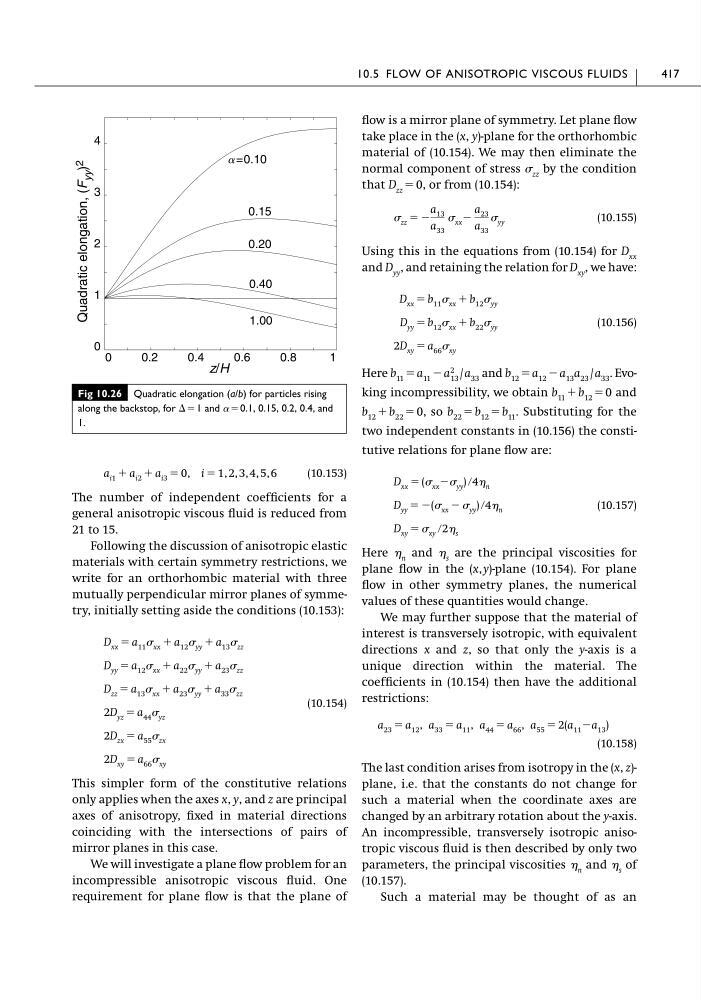
Fig 10.26 Quadratic elongation (a/b) for particles rising
along the backstop, for ⌬ϭ1 and ␣ϭ0.1, 0.15, 0.2, 0.4, and
1.
Quadratic elongation, (F
yy ) 2
0
0.2
0.4
0.6
0.8
1
z/H
4
3
2
1
0
a=0.10
0.15
0.20
0.40
1.00
The number of independent coefficients for a
general anisotropic viscous fluid is reduced from
21 to 15.
Following the discussion of anisotropic elastic
materials with certain symmetry restrictions, we
write for an orthorhombic material with three
mutually perpendicular mirror planes of symmetry, initially setting aside the conditions (10.153):
(10.154)
This simpler form of the constitutive relations
only applies when the axes x, y, and z are principal
axes of anisotropy, fixed in material directions
coinciding with the intersections of pairs of
mirror planes in this case.
We will investigate a plane flow problem for an
incompressible anisotropic viscous fluid. One
requirement for plane flow is that the plane of
2D xy ϭ a 66 xy
2D zx ϭ a 55 zx
2D yz ϭ a 44 yz
D zz ϭ a 13 xx ϩ a 23 yy ϩ a 33 zz
D yy ϭ a 12 xx ϩ a 22 yy ϩ a 23 zz
D xx ϭ a 11 xx ϩ a 12 yy ϩ a 13 zz
a i1 ϩ a i2 ϩ a i3 ϭ 0, i ϭ 1, 2, 3, 4, 5, 6
flow is a mirror plane of symmetry. Let plane flow
take place in the (x, y)-plane for the orthorhombic
material of (10.154). We may then eliminate the
normal component of stress zz by the condition
that D zz ϭ 0, or from (10.154):
(10.155)
Using this in the equations from (10.154) for D xx
and D yy , and retaining the relation for D xy , we have:
(10.156)
Here b 11 ϭ a 11 Ϫ a
2
13
/ a 33 and b 12 ϭ a 12 Ϫ a 13 a 23 / a 33 . Evoking incompressibility, we obtain b 11 ϩ b 12 ϭ 0 and
b 12 ϩ b 22 ϭ 0, so b 22 ϭ b 12 ϭ b 11 . Substituting for the
two independent constants in (10.156) the constitutive relations for plane flow are:
(10.157)
Here n and s are the principal viscosities for
plane flow in the (x, y)-plane (10.154). For plane
flow in other symmetry planes, the numerical
values of these quantities would change.
We may further suppose that the material of
interest is transversely isotropic, with equivalent
directions x and z, so that only the y-axis is a
unique direction within the material. The
coefficients in (10.154) then have the additional
restrictions:
(10.158)
The last condition arises from isotropy in the (x, z)plane, i.e. that the constants do not change for
such a material when the coordinate axes are
changed by an arbitrary rotation about the y-axis.
An incompressible, transversely isotropic anisotropic viscous fluid is then described by only two
parameters, the principal viscosities n and s of
(10.157).
Such a material may be thought of as an
a 23 ϭ a 12 , a 33 ϭ a 11 , a 44 ϭ a 66 , a 55 ϭ 2(a 11 Ϫa 13 )
D xy ϭ xy ր2 s
D yy ϭ Ϫ( xx Ϫ yy ) ր4 n
D xx ϭ ( xx Ϫ yy ) ր4 n
2D xy ϭ a 66 xy
D yy ϭ b 12 xx ϩ b 22 yy
D xx ϭ b 11 xx ϩ b 12 yy
zz ϭ Ϫ
a 13
a 33
xx Ϫ
a 23
a 33
yy
10.5 FLOW OF ANISOTROPIC VISCOUS FLUIDS
417
Fig 10.26 Quadratic elongation (a/b) for particles rising
along the backstop, for ⌬ϭ1 and ␣ϭ0.1, 0.15, 0.2, 0.4, and
1.
Quadratic elongation, (F
yy ) 2
0
0.2
0.4
0.6
0.8
1
z/H
4
3
2
1
0
a=0.10
0.15
0.20
0.40
1.00