

10.5 Flow of anisotropic viscous
fluids
Rocks composed of layers, such as sedimentary
and metasedimentary rocks, those made up of
less-continuous layers or of lenticular bodies,
such as gneisses and some sedimentary rocks, and
those with a strong foliation, compositional
banding, and alignment of mineral grains, will
exhibit anisotropic rheological behavior. Such
rocks often contain structures, such as folds, at
several scales. The dimensions of the smallest
structures scale with the thickness of individual
layers, lenses, or even mineral grains, as in mica
schists. The dimensions of larger scale structures
may be tens to hundreds of times the thickness of
components, as are the chevron folds described in
Chapter 5. We now formulate constitutive relations for an anisotropic viscous fluid. This will
then be used in a mechanical model for chevron
folds.
10.5.1 Constitutive relations for
anisotropic viscous fluids
As in the case of an anisotropic elastic solid
(Chapter 8), formal derivation of general relations
may start with the postulate that the components
of the rate of deformation are linear and homogeneous functions of the components of stress.
We then write:
(10.152)
This notation follows that in Lehknitskii (1963),
who has written a useful treatise on the deformation of anisotropic elastic bodies. The relations
(10.152) are equivalent to those for the elastic
solid, but with the strain components, ij ,
replaced by the rate of deformation components,
D ij . The form of the coefficients is based on the
identifications: 1 with xx, 2 with yy, 3 with zz, 4
with yz, 5 with zx, and 6 with xy.
The symmetric a ij matrix from (10.152) has (6 ϫ
6)/2 ϩ 3 ϭ 21 distinct elements. Since the material
is incompressible, (10.9) applies, requiring the six
conditions:
ϩ a 56 zx ϩ a 66 xy
2D xy ϭ a 16 xx ϩ a 26 yy ϩ a 36 zz ϩ a 46 yz
ϩ a 55 zx ϩ a 56 xy
2D zx ϭ a 15 xx ϩ a 25 yy ϩ a 35 zz ϩ a 45 yz
ϩ a 45 zx ϩ a 46 xy
2D yz ϭ a 14 xx ϩ a 24 yy ϩ a 34 zz ϩ a 44 yz
ϩ a 35 zx ϩ a 36 xy
D zz ϭ a 13 xx ϩ a 23 yy ϩ a 33 zz ϩ a 34 yz
ϩ a 25 zx ϩ a 26 xy
D yy ϭ a 12 xx ϩ a 22 yy ϩ a 23 zz ϩ a 24 yz
ϩ a 15 zx ϩ a 16 xy
D xx ϭ a 11 xx ϩ a 12 yy ϩ a 13 zz ϩ a 14 yz
416
VISCOUS FLOW
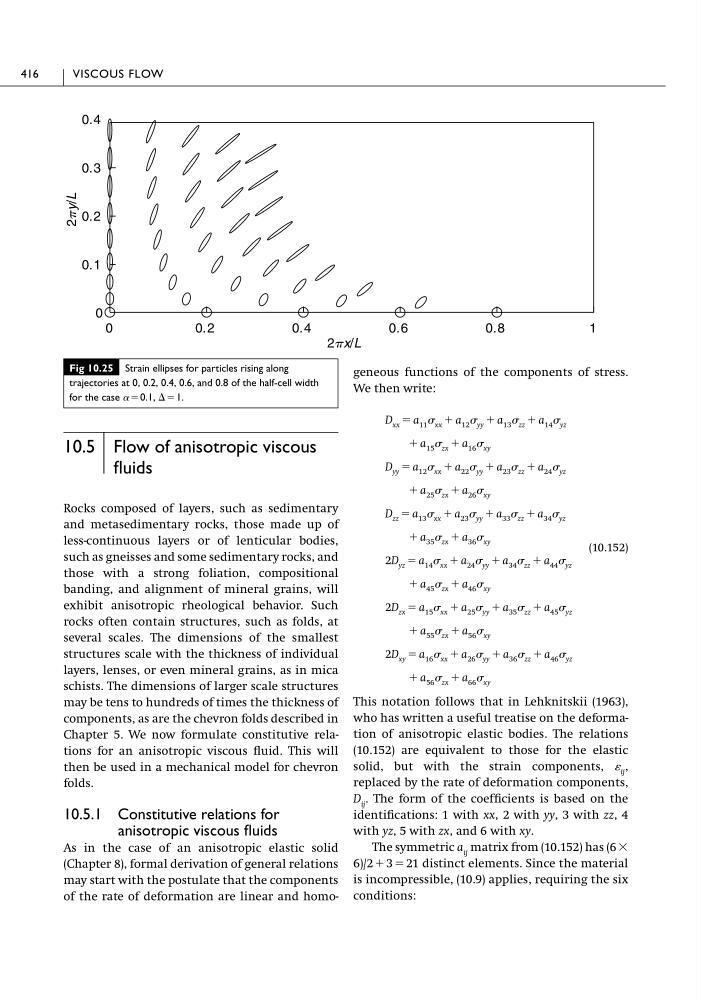
Fig 10.25 Strain ellipses for particles rising along
trajectories at 0, 0.2, 0.4, 0.6, and 0.8 of the half-cell width
for the case ␣ϭ0.1, ⌬ϭ1.
0
0.1
0.2
0.3
0.4
0
0.2
0.4
0.6
0.8
1
2px/L
2py/L
fluids
Rocks composed of layers, such as sedimentary
and metasedimentary rocks, those made up of
less-continuous layers or of lenticular bodies,
such as gneisses and some sedimentary rocks, and
those with a strong foliation, compositional
banding, and alignment of mineral grains, will
exhibit anisotropic rheological behavior. Such
rocks often contain structures, such as folds, at
several scales. The dimensions of the smallest
structures scale with the thickness of individual
layers, lenses, or even mineral grains, as in mica
schists. The dimensions of larger scale structures
may be tens to hundreds of times the thickness of
components, as are the chevron folds described in
Chapter 5. We now formulate constitutive relations for an anisotropic viscous fluid. This will
then be used in a mechanical model for chevron
folds.
10.5.1 Constitutive relations for
anisotropic viscous fluids
As in the case of an anisotropic elastic solid
(Chapter 8), formal derivation of general relations
may start with the postulate that the components
of the rate of deformation are linear and homogeneous functions of the components of stress.
We then write:
(10.152)
This notation follows that in Lehknitskii (1963),
who has written a useful treatise on the deformation of anisotropic elastic bodies. The relations
(10.152) are equivalent to those for the elastic
solid, but with the strain components, ij ,
replaced by the rate of deformation components,
D ij . The form of the coefficients is based on the
identifications: 1 with xx, 2 with yy, 3 with zz, 4
with yz, 5 with zx, and 6 with xy.
The symmetric a ij matrix from (10.152) has (6 ϫ
6)/2 ϩ 3 ϭ 21 distinct elements. Since the material
is incompressible, (10.9) applies, requiring the six
conditions:
ϩ a 56 zx ϩ a 66 xy
2D xy ϭ a 16 xx ϩ a 26 yy ϩ a 36 zz ϩ a 46 yz
ϩ a 55 zx ϩ a 56 xy
2D zx ϭ a 15 xx ϩ a 25 yy ϩ a 35 zz ϩ a 45 yz
ϩ a 45 zx ϩ a 46 xy
2D yz ϭ a 14 xx ϩ a 24 yy ϩ a 34 zz ϩ a 44 yz
ϩ a 35 zx ϩ a 36 xy
D zz ϭ a 13 xx ϩ a 23 yy ϩ a 33 zz ϩ a 34 yz
ϩ a 25 zx ϩ a 26 xy
D yy ϭ a 12 xx ϩ a 22 yy ϩ a 23 zz ϩ a 24 yz
ϩ a 15 zx ϩ a 16 xy
D xx ϭ a 11 xx ϩ a 12 yy ϩ a 13 zz ϩ a 14 yz
416
VISCOUS FLOW
Fig 10.25 Strain ellipses for particles rising along
trajectories at 0, 0.2, 0.4, 0.6, and 0.8 of the half-cell width
for the case ␣ϭ0.1, ⌬ϭ1.
0
0.1
0.2
0.3
0.4
0
0.2
0.4
0.6
0.8
1
2px/L
2py/L