

not directly supply the tensor F of the center point.
A result for ␣ ϭ 0.1, ⌬ϭ1, and k ϭ /4 is shown in
Fig. 10.25. In preparing the figure, a dense set of
particles lying on a circle of very small radius was
followed to assure an adequate approximation to
homogeneity; the resulting strain ellipse was then
enlarged by a factor of about 10. Only the deformation after the element has been underplated can be
evaluated, as indicated by the circular locus at the
base of the wedge. Although we do not expect that
near-surface ductile flow as in this model will be
present in natural accretionary wedges, pressure
solution may result in ductile deformation to
within a few kilometers of the surface. If material
is then not strongly deformed as it moves upward,
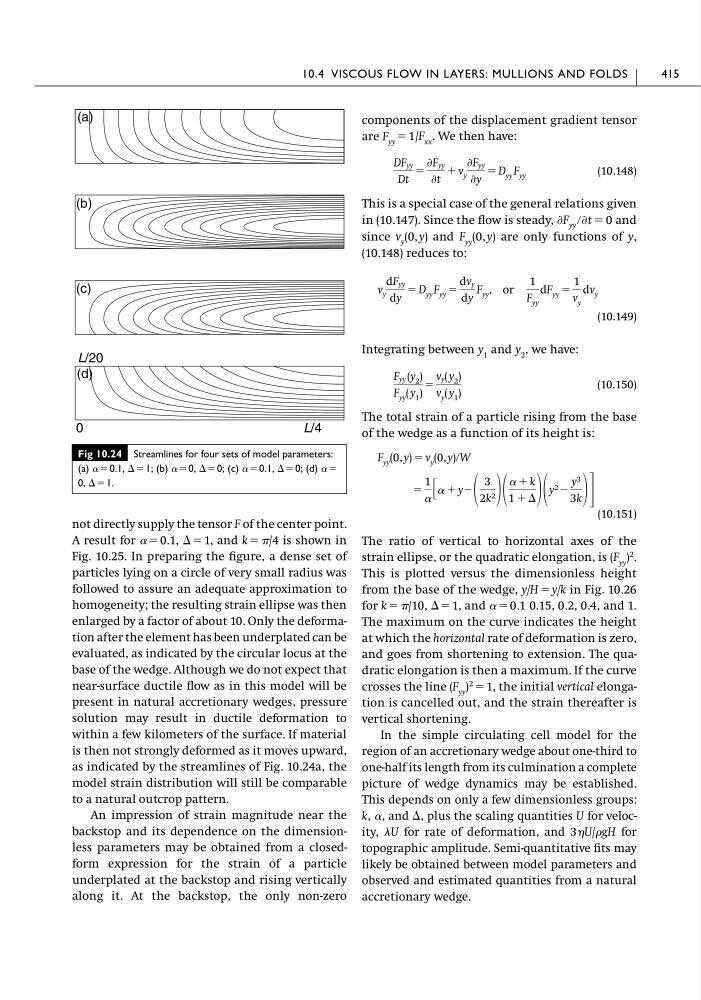
as indicated by the streamlines of Fig. 10.24a, the
model strain distribution will still be comparable
to a natural outcrop pattern.
An impression of strain magnitude near the
backstop and its dependence on the dimensionless parameters may be obtained from a closedform expression for the strain of a particle
underplated at the backstop and rising vertically
along it. At the backstop, the only non-zero
components of the displacement gradient tensor
are F yy ϭ 1/F xx . We then have:
(10.148)
This is a special case of the general relations given
in (10.147). Since the flow is steady,
and
since
and F yy (0, y) are only functions of y,
(10.148) reduces to:
(10.149)
Integrating between y 1 and y 2 , we have:
(10.150)
The total strain of a particle rising from the base
of the wedge as a function of its height is:
(10.151)
The ratio of vertical to horizontal axes of the
strain ellipse, or the quadratic elongation, is (F yy )
2 .
This is plotted versus the dimensionless height
from the base of the wedge, y/H ϭ y/k in Fig. 10.26
for k ϭ /10, ⌬ϭ1, and ␣ ϭ 0.1 0.15, 0.2, 0.4, and 1.
The maximum on the curve indicates the height
at which the horizontal rate of deformation is zero,
and goes from shortening to extension. The quadratic elongation is then a maximum. If the curve
crosses the line (F yy )
2 ϭ 1, the initial vertical elongation is cancelled out, and the strain thereafter is
vertical shortening.
In the simple circulating cell model for the
region of an accretionary wedge about one-third to
one-half its length from its culmination a complete
picture of wedge dynamics may be established.
This depends on only a few dimensionless groups:
k, ␣, and ⌬, plus the scaling quantities U for velocity, U for rate of deformation, and 3U/gH for
topographic amplitude. Semi-quantitative fits may
likely be obtained between model parameters and
observed and estimated quantities from a natural
accretionary wedge.
ϭ
1
␣
΄␣ ϩ yϪ
3
2k 2
␣ ϩ k
1 ϩ ⌬
y 2 Ϫ
y 3
3k ΅
F yy (0, y) ϭ v y (0, y)րW
F yy (y 2 )
F yy ( y 1 )
ϭ
v y ( y 2 )
v y ( y 1 )
v y
dF yy
dy
ϭ D yy F yy ϭ
dv y
dy
F yy , or
1
F yy
dF yy ϭ
1
v y
dv y
v y (0, y)
ѨF yy րѨt ϭ 0
DF yy
Dt
ϭ
ѨF yy
Ѩt
ϩ v y
ѨF yy
Ѩy
ϭ D yy F yy
10.4 VISCOUS FLOW IN LAYERS: MULLIONS AND FOLDS
415
Fig 10.24 Streamlines for four sets of model parameters:
(a) ␣ϭ0.1, ⌬ϭ1; (b) ␣ϭ0, ⌬ϭ0; (c) ␣ϭ0.1, ⌬ϭ0; (d) ␣ϭ
0, ⌬ϭ1.
0
L/4
L/20
(a)
(b)
(c)
(d)
A result for ␣ ϭ 0.1, ⌬ϭ1, and k ϭ /4 is shown in
Fig. 10.25. In preparing the figure, a dense set of
particles lying on a circle of very small radius was
followed to assure an adequate approximation to
homogeneity; the resulting strain ellipse was then
enlarged by a factor of about 10. Only the deformation after the element has been underplated can be
evaluated, as indicated by the circular locus at the
base of the wedge. Although we do not expect that
near-surface ductile flow as in this model will be
present in natural accretionary wedges, pressure
solution may result in ductile deformation to
within a few kilometers of the surface. If material
is then not strongly deformed as it moves upward,
as indicated by the streamlines of Fig. 10.24a, the
model strain distribution will still be comparable
to a natural outcrop pattern.
An impression of strain magnitude near the
backstop and its dependence on the dimensionless parameters may be obtained from a closedform expression for the strain of a particle
underplated at the backstop and rising vertically
along it. At the backstop, the only non-zero
components of the displacement gradient tensor
are F yy ϭ 1/F xx . We then have:
(10.148)
This is a special case of the general relations given
in (10.147). Since the flow is steady,
and
since
and F yy (0, y) are only functions of y,
(10.148) reduces to:
(10.149)
Integrating between y 1 and y 2 , we have:
(10.150)
The total strain of a particle rising from the base
of the wedge as a function of its height is:
(10.151)
The ratio of vertical to horizontal axes of the
strain ellipse, or the quadratic elongation, is (F yy )
2 .
This is plotted versus the dimensionless height
from the base of the wedge, y/H ϭ y/k in Fig. 10.26
for k ϭ /10, ⌬ϭ1, and ␣ ϭ 0.1 0.15, 0.2, 0.4, and 1.
The maximum on the curve indicates the height
at which the horizontal rate of deformation is zero,
and goes from shortening to extension. The quadratic elongation is then a maximum. If the curve
crosses the line (F yy )
2 ϭ 1, the initial vertical elongation is cancelled out, and the strain thereafter is
vertical shortening.
In the simple circulating cell model for the
region of an accretionary wedge about one-third to
one-half its length from its culmination a complete
picture of wedge dynamics may be established.
This depends on only a few dimensionless groups:
k, ␣, and ⌬, plus the scaling quantities U for velocity, U for rate of deformation, and 3U/gH for
topographic amplitude. Semi-quantitative fits may
likely be obtained between model parameters and
observed and estimated quantities from a natural
accretionary wedge.
ϭ
1
␣
΄␣ ϩ yϪ
3
2k 2
␣ ϩ k
1 ϩ ⌬
y 2 Ϫ
y 3
3k ΅
F yy (0, y) ϭ v y (0, y)րW
F yy (y 2 )
F yy ( y 1 )
ϭ
v y ( y 2 )
v y ( y 1 )
v y
dF yy
dy
ϭ D yy F yy ϭ
dv y
dy
F yy , or
1
F yy
dF yy ϭ
1
v y
dv y
v y (0, y)
ѨF yy րѨt ϭ 0
DF yy
Dt
ϭ
ѨF yy
Ѩt
ϩ v y
ѨF yy
Ѩy
ϭ D yy F yy
10.4 VISCOUS FLOW IN LAYERS: MULLIONS AND FOLDS
415
Fig 10.24 Streamlines for four sets of model parameters:
(a) ␣ϭ0.1, ⌬ϭ1; (b) ␣ϭ0, ⌬ϭ0; (c) ␣ϭ0.1, ⌬ϭ0; (d) ␣ϭ
0, ⌬ϭ1.
0
L/4
L/20
(a)
(b)
(c)
(d)