

(10.129)
The conditions at the base of the model are those
that “drive” the flow, since any topography would
decay under the action of gravity alone. We adopt
conditions that lead to a simple solution and flow
pattern. We earlier considered a condition in
which the base of the wedge adheres to the subducting plate. However, estimated horizontal
motions within a natural wedge are generally
much smaller than the subduction velocity. Here,
we specify the basal velocity without relation to
subduction velocity as:
(10.130)
Thus, coupling between subducting plate and
wedge is taken to be greatest at the mid-point of
the cell, x � L/4, from which it tapers off toward
the backstop and the frontstop. We specify a distribution of underplating:
(10.131)
This is maximum at the backstop and, forward of
the mid-point x � L/4, corresponds instead to basal
erosion.
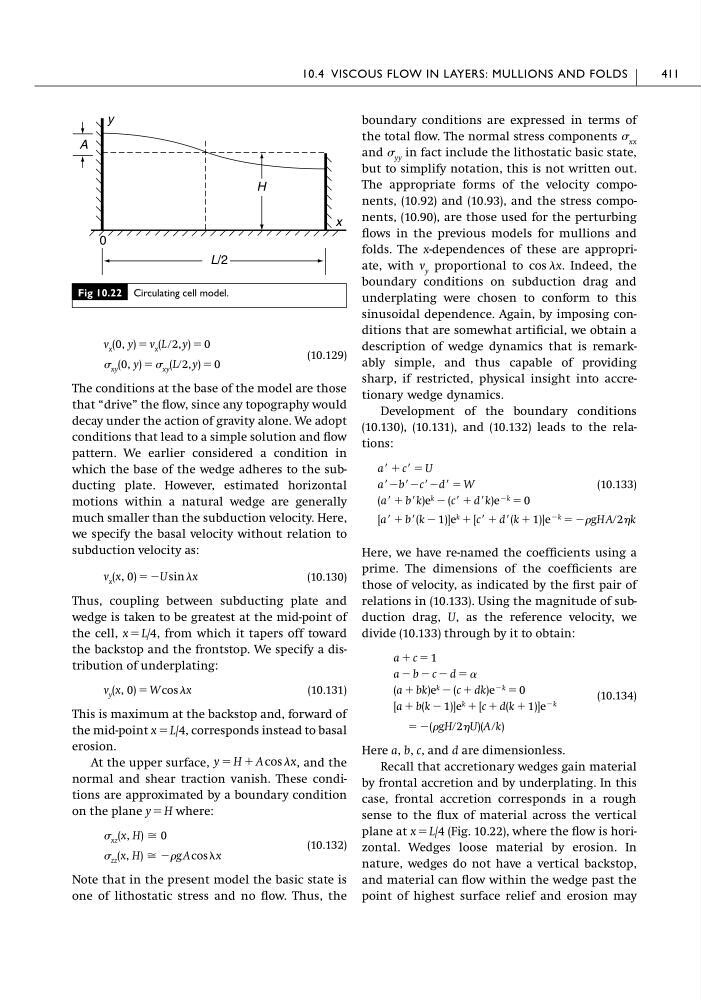
At the upper surface,
, and the
normal and shear traction vanish. These conditions are approximated by a boundary condition
on the plane y � H where:
(10.132)
Note that in the present model the basic state is
one of lithostatic stress and no flow. Thus, the
� zz (x, H) Х ��g A cos �x
� xz (x, H) Х 0
y � H � A cos �x
v y (x, 0) � W cos �x
v x (x, 0) � �U sin �x
� xy (0, y) � � xy (L�2, y) � 0
v x (0, y) � v x (L �2, y) � 0
boundary conditions are expressed in terms of
the total flow. The normal stress components � xx
and � yy in fact include the lithostatic basic state,
but to simplify notation, this is not written out.
The appropriate forms of the velocity components, (10.92) and (10.93), and the stress components, (10.90), are those used for the perturbing
flows in the previous models for mullions and
folds. The x-dependences of these are appropriate, with v y proportional to cos �x. Indeed, the
boundary conditions on subduction drag and
underplating were chosen to conform to this
sinusoidal dependence. Again, by imposing conditions that are somewhat artificial, we obtain a
description of wedge dynamics that is remarkably simple, and thus capable of providing
sharp, if restricted, physical insight into accretionary wedge dynamics.
Development of the boundary conditions
(10.130), (10.131), and (10.132) leads to the relations:
(10.133)
Here, we have re-named the coefficients using a
prime. The dimensions of the coefficients are
those of velocity, as indicated by the first pair of
relations in (10.133). Using the magnitude of subduction drag, U, as the reference velocity, we
divide (10.133) through by it to obtain:
(10.134)
Here a, b, c, and d are dimensionless.
Recall that accretionary wedges gain material
by frontal accretion and by underplating. In this
case, frontal accretion corresponds in a rough
sense to the flux of material across the vertical
plane at x � L/4 (Fig. 10.22), where the flow is horizontal. Wedges loose material by erosion. In
nature, wedges do not have a vertical backstop,
and material can flow within the wedge past the
point of highest surface relief and erosion may
� �(�gH�2�U)(A �k)
[a � b(k � 1)]e k � [c � d(k � 1)]e �k
(a � bk)e k � (c � dk)e �k � 0
a � b � c � d � �
a � c � 1
[a� � b�(k � 1)]e k � [c� � d�(k � 1)]e �k � ��gH A�2�k
(a� � b�k)e k � (c� � d�k)e �k � 0
a��b��c��d� � W
a� � c� � U
10.4 VISCOUS FLOW IN LAYERS: MULLIONS AND FOLDS
411
Fig 10.22 Circulating cell model.
L/2
0
H
A
y
x
The conditions at the base of the model are those
that “drive” the flow, since any topography would
decay under the action of gravity alone. We adopt
conditions that lead to a simple solution and flow
pattern. We earlier considered a condition in
which the base of the wedge adheres to the subducting plate. However, estimated horizontal
motions within a natural wedge are generally
much smaller than the subduction velocity. Here,
we specify the basal velocity without relation to
subduction velocity as:
(10.130)
Thus, coupling between subducting plate and
wedge is taken to be greatest at the mid-point of
the cell, x � L/4, from which it tapers off toward
the backstop and the frontstop. We specify a distribution of underplating:
(10.131)
This is maximum at the backstop and, forward of
the mid-point x � L/4, corresponds instead to basal
erosion.
At the upper surface,
, and the
normal and shear traction vanish. These conditions are approximated by a boundary condition
on the plane y � H where:
(10.132)
Note that in the present model the basic state is
one of lithostatic stress and no flow. Thus, the
� zz (x, H) Х ��g A cos �x
� xz (x, H) Х 0
y � H � A cos �x
v y (x, 0) � W cos �x
v x (x, 0) � �U sin �x
� xy (0, y) � � xy (L�2, y) � 0
v x (0, y) � v x (L �2, y) � 0
boundary conditions are expressed in terms of
the total flow. The normal stress components � xx
and � yy in fact include the lithostatic basic state,
but to simplify notation, this is not written out.
The appropriate forms of the velocity components, (10.92) and (10.93), and the stress components, (10.90), are those used for the perturbing
flows in the previous models for mullions and
folds. The x-dependences of these are appropriate, with v y proportional to cos �x. Indeed, the
boundary conditions on subduction drag and
underplating were chosen to conform to this
sinusoidal dependence. Again, by imposing conditions that are somewhat artificial, we obtain a
description of wedge dynamics that is remarkably simple, and thus capable of providing
sharp, if restricted, physical insight into accretionary wedge dynamics.
Development of the boundary conditions
(10.130), (10.131), and (10.132) leads to the relations:
(10.133)
Here, we have re-named the coefficients using a
prime. The dimensions of the coefficients are
those of velocity, as indicated by the first pair of
relations in (10.133). Using the magnitude of subduction drag, U, as the reference velocity, we
divide (10.133) through by it to obtain:
(10.134)
Here a, b, c, and d are dimensionless.
Recall that accretionary wedges gain material
by frontal accretion and by underplating. In this
case, frontal accretion corresponds in a rough
sense to the flux of material across the vertical
plane at x � L/4 (Fig. 10.22), where the flow is horizontal. Wedges loose material by erosion. In
nature, wedges do not have a vertical backstop,
and material can flow within the wedge past the
point of highest surface relief and erosion may
� �(�gH�2�U)(A �k)
[a � b(k � 1)]e k � [c � d(k � 1)]e �k
(a � bk)e k � (c � dk)e �k � 0
a � b � c � d � �
a � c � 1
[a� � b�(k � 1)]e k � [c� � d�(k � 1)]e �k � ��gH A�2�k
(a� � b�k)e k � (c� � d�k)e �k � 0
a��b��c��d� � W
a� � c� � U
10.4 VISCOUS FLOW IN LAYERS: MULLIONS AND FOLDS
411
Fig 10.22 Circulating cell model.
L/2
0
H
A
y
x