

Coefficients c 1 and c 1 ϩ d 1 may be eliminated
between these pairs of relations to give
(10.119)
Here
Solving for the constants we
find:
(10.120)
Here k ϭ 2h ϭ H, where H is the full layer thickness.
The rate of growth of perturbation amplitude,
from (10.102) and (10.110) is:
(10.121)
Upon further substitution:
(10.122)
The description of the evolution of layer shape for
the single sinusoidal perturbation is completed
by the relations
from which:
(10.123)
It may be more useful to think in terms of the
growth rate in the maximum slope, A, because
this is a dimensionless quantity and we perceive a
fold chiefly by its maximum limb dip or slope.
Since
we have:
(10.124)
Here the quantity q is defined from (10.122) as:
(10.125)
q ϭ Ϫ
2k(1ϪR)
(1ϪR 2 )Ϫ[(1 ϩ R 2 ) sinh k ϩ 2R cosh k]
d( A)
dt
ϭ Ϫ(2 ϩ q) Sgn(D xx ) |D xx |( A)
d րdt ϭ ϪD xx ,
dkրdt ϭ Ϫ2D xx k
dLրdt ϭ D xx L and dHրdt ϭ ϪD xx H
ϫ Sgn(D xx ) |D xx |A
d A
dt
ϭ Ά Ϫ1 ϩ
2k(1ϪR)
(1ϪR 2 )Ϫ[(1 ϩ R 2 ) sinh k ϩ 2R cosh k] ·
ϩ b[h sinh h Ϫ cosh h]}
dA
dt
ϭ ϪD xx A ϩ 2{a cosh (h)
M ϭ k(1ϪR 2 )Ϫ(1ր2k)[(1 ϩ R 2 )sinh k ϩ 2R cosh k]
b ϭ (1րM)(sinh h ϩ R cosh h)2(1ϪR)D xx A
Ϫ(sinh h ϩ R cosh h)] 2(1 Ϫ R)D xx A
a ϭ Ϫ(1րM)[h(cosh h ϩ R sinh h)
R ϭ 1 ր.
ϩ R cosh h) ϭ (1 Ϫ R)D xx A
a(cosh h ϩ R sinh h) ϩ bh(sinh h
ϩ R sinh h) ϭ 0
(aϪb)(sinh h ϩ R cosh h) ϩ bh(cosh h
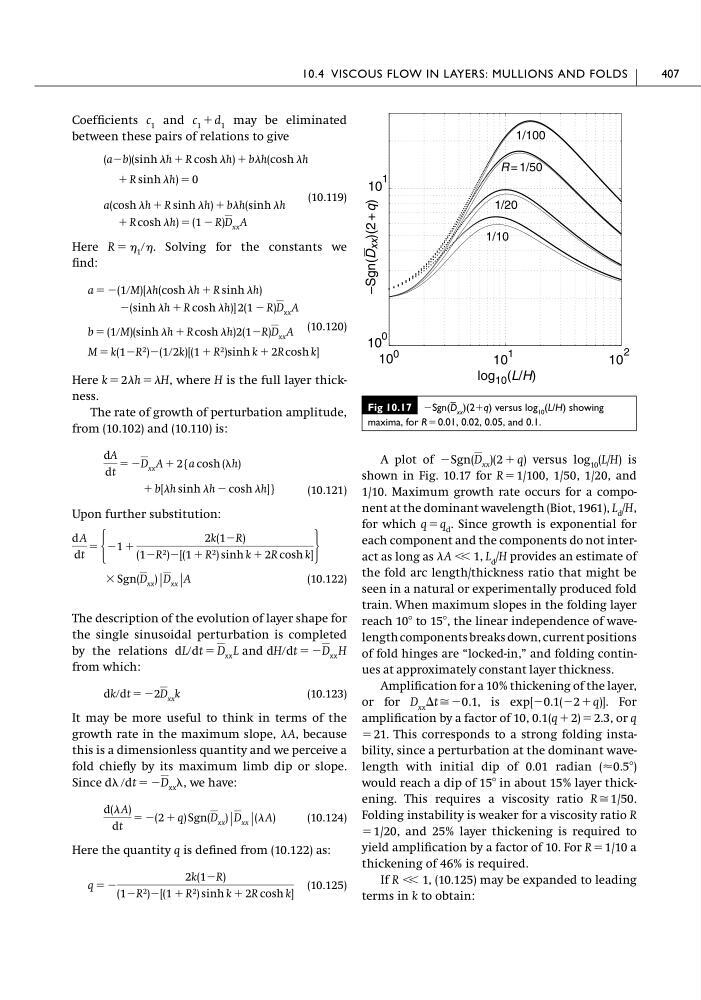
A plot of
versus log 10 (L/H) is
shown in Fig. 10.17 for R ϭ 1/100, 1/50, 1/20, and
1/10. Maximum growth rate occurs for a component at the dominant wavelength (Biot, 1961), L d /H,
for which q ϭ q d . Since growth is exponential for
each component and the components do not interact as long as A Ͻ Ͻ 1, L d /H provides an estimate of
the fold arc length/thickness ratio that might be
seen in a natural or experimentally produced fold
train. When maximum slopes in the folding layer
reach 10Њ to 15Њ, the linear independence of wavelength components breaks down, current positions
of fold hinges are “locked-in,” and folding continues at approximately constant layer thickness.
Amplification for a 10% thickening of the layer,
or for D xx ⌬t Х Ϫ0.1, is exp[Ϫ0.1(Ϫ2 ϩ q)]. For
amplification by a factor of 10, 0.1(q ϩ 2) ϭ 2.3, or q
ϭ 21. This corresponds to a strong folding instability, since a perturbation at the dominant wavelength with initial dip of 0.01 radian (Ϸ0.5Њ)
would reach a dip of 15Њ in about 15% layer thickening. This requires a viscosity ratio R Х 1/50.
Folding instability is weaker for a viscosity ratio R
ϭ 1/20, and 25% layer thickening is required to
yield amplification by a factor of 10. For R ϭ 1/10 a
thickening of 46% is required.
If R Ͻ Ͻ 1, (10.125) may be expanded to leading
terms in k to obtain:
ϪSgn(D xx )(2 ϩ q)
10.4 VISCOUS FLOW IN LAYERS: MULLIONS AND FOLDS
407
Fig 10.17 ϪSgn(D
–
xx
)(2ϩq) versus log 10 (L/H) showing
maxima, for Rϭ0.01, 0.02, 0.05, and 0.1.
10
0
10
1
10
2
10
0
10
1
log 10 (L/H)
R = 1/50
1/100
1/20
1/10
–Sgn(D
xx )(2 +
q)
between these pairs of relations to give
(10.119)
Here
Solving for the constants we
find:
(10.120)
Here k ϭ 2h ϭ H, where H is the full layer thickness.
The rate of growth of perturbation amplitude,
from (10.102) and (10.110) is:
(10.121)
Upon further substitution:
(10.122)
The description of the evolution of layer shape for
the single sinusoidal perturbation is completed
by the relations
from which:
(10.123)
It may be more useful to think in terms of the
growth rate in the maximum slope, A, because
this is a dimensionless quantity and we perceive a
fold chiefly by its maximum limb dip or slope.
Since
we have:
(10.124)
Here the quantity q is defined from (10.122) as:
(10.125)
q ϭ Ϫ
2k(1ϪR)
(1ϪR 2 )Ϫ[(1 ϩ R 2 ) sinh k ϩ 2R cosh k]
d( A)
dt
ϭ Ϫ(2 ϩ q) Sgn(D xx ) |D xx |( A)
d րdt ϭ ϪD xx ,
dkրdt ϭ Ϫ2D xx k
dLրdt ϭ D xx L and dHրdt ϭ ϪD xx H
ϫ Sgn(D xx ) |D xx |A
d A
dt
ϭ Ά Ϫ1 ϩ
2k(1ϪR)
(1ϪR 2 )Ϫ[(1 ϩ R 2 ) sinh k ϩ 2R cosh k] ·
ϩ b[h sinh h Ϫ cosh h]}
dA
dt
ϭ ϪD xx A ϩ 2{a cosh (h)
M ϭ k(1ϪR 2 )Ϫ(1ր2k)[(1 ϩ R 2 )sinh k ϩ 2R cosh k]
b ϭ (1րM)(sinh h ϩ R cosh h)2(1ϪR)D xx A
Ϫ(sinh h ϩ R cosh h)] 2(1 Ϫ R)D xx A
a ϭ Ϫ(1րM)[h(cosh h ϩ R sinh h)
R ϭ 1 ր.
ϩ R cosh h) ϭ (1 Ϫ R)D xx A
a(cosh h ϩ R sinh h) ϩ bh(sinh h
ϩ R sinh h) ϭ 0
(aϪb)(sinh h ϩ R cosh h) ϩ bh(cosh h
A plot of
versus log 10 (L/H) is
shown in Fig. 10.17 for R ϭ 1/100, 1/50, 1/20, and
1/10. Maximum growth rate occurs for a component at the dominant wavelength (Biot, 1961), L d /H,
for which q ϭ q d . Since growth is exponential for
each component and the components do not interact as long as A Ͻ Ͻ 1, L d /H provides an estimate of
the fold arc length/thickness ratio that might be
seen in a natural or experimentally produced fold
train. When maximum slopes in the folding layer
reach 10Њ to 15Њ, the linear independence of wavelength components breaks down, current positions
of fold hinges are “locked-in,” and folding continues at approximately constant layer thickness.
Amplification for a 10% thickening of the layer,
or for D xx ⌬t Х Ϫ0.1, is exp[Ϫ0.1(Ϫ2 ϩ q)]. For
amplification by a factor of 10, 0.1(q ϩ 2) ϭ 2.3, or q
ϭ 21. This corresponds to a strong folding instability, since a perturbation at the dominant wavelength with initial dip of 0.01 radian (Ϸ0.5Њ)
would reach a dip of 15Њ in about 15% layer thickening. This requires a viscosity ratio R Х 1/50.
Folding instability is weaker for a viscosity ratio R
ϭ 1/20, and 25% layer thickening is required to
yield amplification by a factor of 10. For R ϭ 1/10 a
thickening of 46% is required.
If R Ͻ Ͻ 1, (10.125) may be expanded to leading
terms in k to obtain:
ϪSgn(D xx )(2 ϩ q)
10.4 VISCOUS FLOW IN LAYERS: MULLIONS AND FOLDS
407
Fig 10.17 ϪSgn(D
–
xx
)(2ϩq) versus log 10 (L/H) showing
maxima, for Rϭ0.01, 0.02, 0.05, and 0.1.
10
0
10
1
10
2
10
0
10
1
log 10 (L/H)
R = 1/50
1/100
1/20
1/10
–Sgn(D
xx )(2 +
q)