

pair of component waveforms, on the two layer surfaces, at a particular wavelength, L, gives rise to an
independent perturbing flow within the layer and
surrounding medium, i.e. the components are
non-interacting. The perturbing flow associated
with it causes the amplitude of each pair of component waveforms to grow or decay. In layer-parallel shortening, growth always occurs, and is most
rapid at the dominant wavelength, L d , better represented as the ratio L d /H, where H is the layer thickness. The rate of growth decreases for wavelengths
that are longer or shorter than L d . We might guess
that fold arc lengths from one anticlinal or synclinal hinge to the next divided by the local layer
thickness would approximately equal L d /H.
We now set up and solve the problem of cylindrical folding in plane flow in layer-parallel shortening. To go from the results to an interpretation
of the fold arc length/thickness statistics derived
from fold trains or fold train segments such as
that shown in Fig. 10.14 requires additional steps
that will be discussed later. This interpretation
will yield an estimate of the ratio of the viscosity
of the host to that of the layer. Here, we postulate
that these materials may be adequately represented as linear viscous fluids.
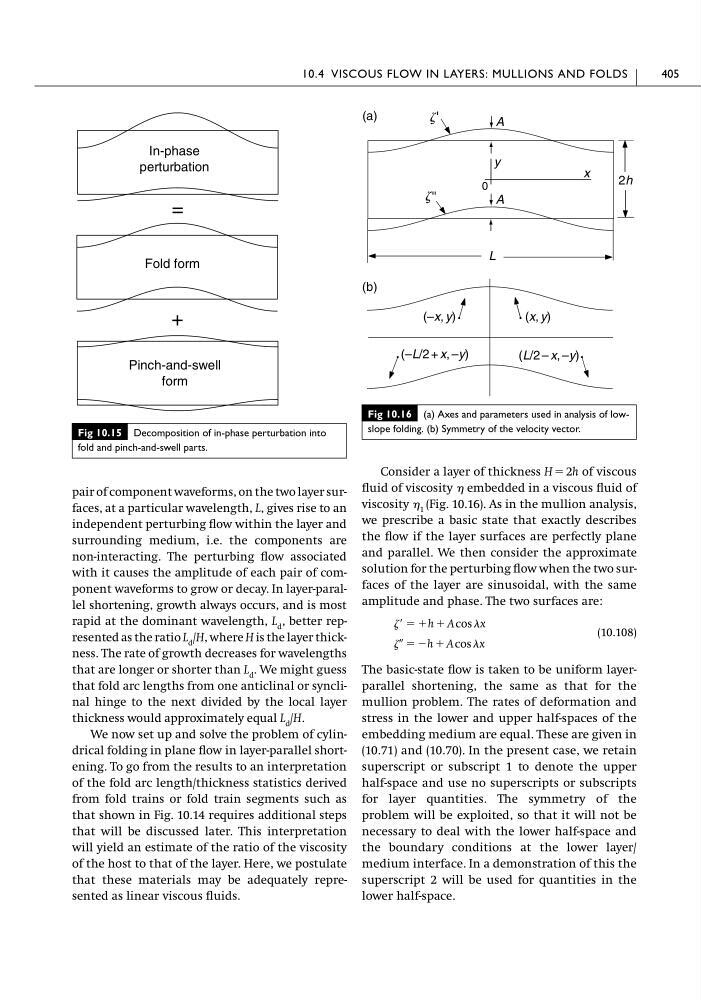
Consider a layer of thickness H ϭ 2h of viscous
fluid of viscosity embedded in a viscous fluid of
viscosity 1 (Fig. 10.16). As in the mullion analysis,
we prescribe a basic state that exactly describes
the flow if the layer surfaces are perfectly plane
and parallel. We then consider the approximate
solution for the perturbing flow when the two surfaces of the layer are sinusoidal, with the same
amplitude and phase. The two surfaces are:
(10.108)
The basic-state flow is taken to be uniform layerparallel shortening, the same as that for the
mullion problem. The rates of deformation and
stress in the lower and upper half-spaces of the
embedding medium are equal. These are given in
(10.71) and (10.70). In the present case, we retain
superscript or subscript 1 to denote the upper
half-space and use no superscripts or subscripts
for layer quantities. The symmetry of the
problem will be exploited, so that it will not be
necessary to deal with the lower half-space and
the boundary conditions at the lower layer/
medium interface. In a demonstration of this the
superscript 2 will be used for quantities in the
lower half-space.
Љ ϭ Ϫh ϩ A cos x
Ј ϭ ϩh ϩ A cos x
10.4 VISCOUS FLOW IN LAYERS: MULLIONS AND FOLDS
405
Fig 10.15 Decomposition of in-phase perturbation into
fold and pinch-and-swell parts.
=
+
In-phase
perturbation
Fold form
Pinch-and-swell
form
Fig 10.16 (a) Axes and parameters used in analysis of lowslope folding. (b) Symmetry of the velocity vector.
x
y
2h
L
(x, y)
(–x, y)
(–L/2 + x, –y)
(L/2 – x, –y)
0
z'
A
(a)
(b)
z''
A
independent perturbing flow within the layer and
surrounding medium, i.e. the components are
non-interacting. The perturbing flow associated
with it causes the amplitude of each pair of component waveforms to grow or decay. In layer-parallel shortening, growth always occurs, and is most
rapid at the dominant wavelength, L d , better represented as the ratio L d /H, where H is the layer thickness. The rate of growth decreases for wavelengths
that are longer or shorter than L d . We might guess
that fold arc lengths from one anticlinal or synclinal hinge to the next divided by the local layer
thickness would approximately equal L d /H.
We now set up and solve the problem of cylindrical folding in plane flow in layer-parallel shortening. To go from the results to an interpretation
of the fold arc length/thickness statistics derived
from fold trains or fold train segments such as
that shown in Fig. 10.14 requires additional steps
that will be discussed later. This interpretation
will yield an estimate of the ratio of the viscosity
of the host to that of the layer. Here, we postulate
that these materials may be adequately represented as linear viscous fluids.
Consider a layer of thickness H ϭ 2h of viscous
fluid of viscosity embedded in a viscous fluid of
viscosity 1 (Fig. 10.16). As in the mullion analysis,
we prescribe a basic state that exactly describes
the flow if the layer surfaces are perfectly plane
and parallel. We then consider the approximate
solution for the perturbing flow when the two surfaces of the layer are sinusoidal, with the same
amplitude and phase. The two surfaces are:
(10.108)
The basic-state flow is taken to be uniform layerparallel shortening, the same as that for the
mullion problem. The rates of deformation and
stress in the lower and upper half-spaces of the
embedding medium are equal. These are given in
(10.71) and (10.70). In the present case, we retain
superscript or subscript 1 to denote the upper
half-space and use no superscripts or subscripts
for layer quantities. The symmetry of the
problem will be exploited, so that it will not be
necessary to deal with the lower half-space and
the boundary conditions at the lower layer/
medium interface. In a demonstration of this the
superscript 2 will be used for quantities in the
lower half-space.
Љ ϭ Ϫh ϩ A cos x
Ј ϭ ϩh ϩ A cos x
10.4 VISCOUS FLOW IN LAYERS: MULLIONS AND FOLDS
405
Fig 10.15 Decomposition of in-phase perturbation into
fold and pinch-and-swell parts.
=
+
In-phase
perturbation
Fold form
Pinch-and-swell
form
Fig 10.16 (a) Axes and parameters used in analysis of lowslope folding. (b) Symmetry of the velocity vector.
x
y
2h
L
(x, y)
(–x, y)
(–L/2 + x, –y)
(L/2 – x, –y)
0
z'
A
(a)
(b)
z''
A