

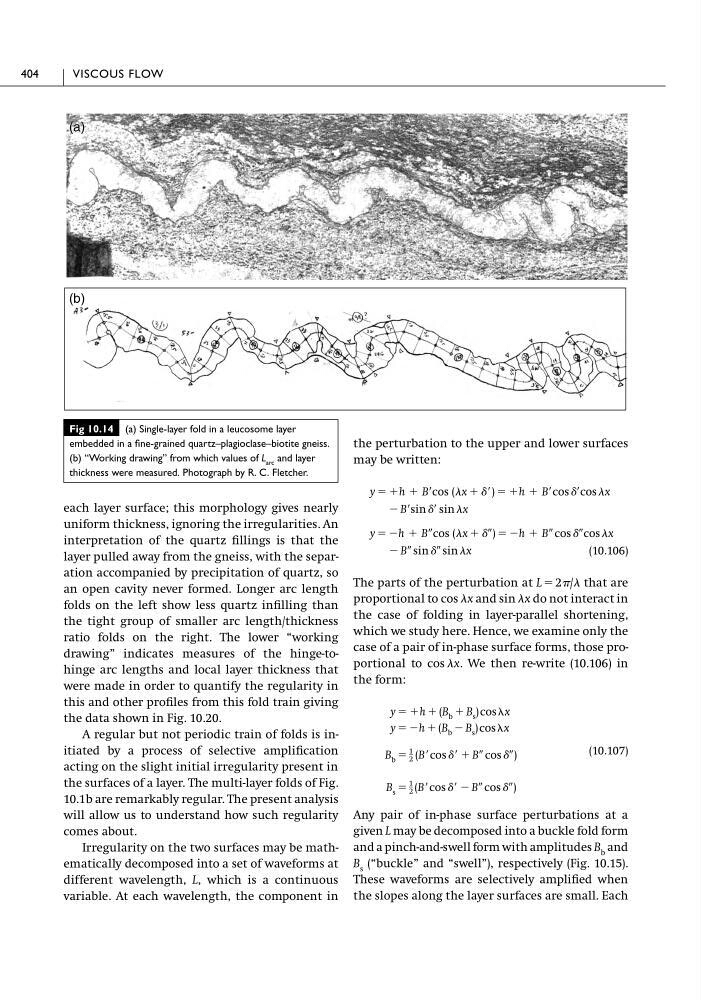
each layer surface; this morphology gives nearly
uniform thickness, ignoring the irregularities. An
interpretation of the quartz fillings is that the
layer pulled away from the gneiss, with the separation accompanied by precipitation of quartz, so
an open cavity never formed. Longer arc length
folds on the left show less quartz infilling than
the tight group of smaller arc length/thickness
ratio folds on the right. The lower “working
drawing” indicates measures of the hinge-tohinge arc lengths and local layer thickness that
were made in order to quantify the regularity in
this and other profiles from this fold train giving
the data shown in Fig. 10.20.
A regular but not periodic train of folds is initiated by a process of selective amplification
acting on the slight initial irregularity present in
the surfaces of a layer. The multi-layer folds of Fig.
10.1b are remarkably regular. The present analysis
will allow us to understand how such regularity
comes about.
Irregularity on the two surfaces may be mathematically decomposed into a set of waveforms at
different wavelength, L, which is a continuous
variable. At each wavelength, the component in
the perturbation to the upper and lower surfaces
may be written:
(10.106)
The parts of the perturbation at L ϭ 2/ that are
proportional to cos x and sin x do not interact in
the case of folding in layer-parallel shortening,
which we study here. Hence, we examine only the
case of a pair of in-phase surface forms, those proportional to cos x. We then re-write (10.106) in
the form:
(10.107)
Any pair of in-phase surface perturbations at a
given L may be decomposed into a buckle fold form
and a pinch-and-swell form with amplitudes B b and
B s (“buckle” and “swell”), respectively (Fig. 10.15).
These waveforms are selectively amplified when
the slopes along the layer surfaces are small. Each
B s ϭ
1
2 (BЈcos ␦Ј Ϫ BЉ cos ␦Љ)
B b ϭ
1
2 (BЈcos ␦Ј ϩ BЉ cos ␦Љ)
y ϭ Ϫh ϩ (B b Ϫ B s ) cos x
y ϭ ϩh ϩ (B b ϩ B s ) cos x
Ϫ BЉ sin ␦Љ sin x
y ϭ Ϫh ϩ BЉcos (x ϩ ␦Љ) ϭ Ϫh ϩ BЉ cos ␦Љcos x
Ϫ BЈ sin ␦Ј sin x
y ϭ ϩh ϩ BЈ cos (x ϩ ␦Ј) ϭ ϩh ϩ BЈ cos ␦Јcos x
404
VISCOUS FLOW
Fig 10.14 (a) Single-layer fold in a leucosome layer
embedded in a fine-grained quartz–plagioclase–biotite gneiss.
(b) “Working drawing” from which values of L arc and layer
thickness were measured. Photograph by R. C. Fletcher.
(a)
(b)
uniform thickness, ignoring the irregularities. An
interpretation of the quartz fillings is that the
layer pulled away from the gneiss, with the separation accompanied by precipitation of quartz, so
an open cavity never formed. Longer arc length
folds on the left show less quartz infilling than
the tight group of smaller arc length/thickness
ratio folds on the right. The lower “working
drawing” indicates measures of the hinge-tohinge arc lengths and local layer thickness that
were made in order to quantify the regularity in
this and other profiles from this fold train giving
the data shown in Fig. 10.20.
A regular but not periodic train of folds is initiated by a process of selective amplification
acting on the slight initial irregularity present in
the surfaces of a layer. The multi-layer folds of Fig.
10.1b are remarkably regular. The present analysis
will allow us to understand how such regularity
comes about.
Irregularity on the two surfaces may be mathematically decomposed into a set of waveforms at
different wavelength, L, which is a continuous
variable. At each wavelength, the component in
the perturbation to the upper and lower surfaces
may be written:
(10.106)
The parts of the perturbation at L ϭ 2/ that are
proportional to cos x and sin x do not interact in
the case of folding in layer-parallel shortening,
which we study here. Hence, we examine only the
case of a pair of in-phase surface forms, those proportional to cos x. We then re-write (10.106) in
the form:
(10.107)
Any pair of in-phase surface perturbations at a
given L may be decomposed into a buckle fold form
and a pinch-and-swell form with amplitudes B b and
B s (“buckle” and “swell”), respectively (Fig. 10.15).
These waveforms are selectively amplified when
the slopes along the layer surfaces are small. Each
B s ϭ
1
2 (BЈcos ␦Ј Ϫ BЉ cos ␦Љ)
B b ϭ
1
2 (BЈcos ␦Ј ϩ BЉ cos ␦Љ)
y ϭ Ϫh ϩ (B b Ϫ B s ) cos x
y ϭ ϩh ϩ (B b ϩ B s ) cos x
Ϫ BЉ sin ␦Љ sin x
y ϭ Ϫh ϩ BЉcos (x ϩ ␦Љ) ϭ Ϫh ϩ BЉ cos ␦Љcos x
Ϫ BЈ sin ␦Ј sin x
y ϭ ϩh ϩ BЈ cos (x ϩ ␦Ј) ϭ ϩh ϩ BЈ cos ␦Јcos x
404
VISCOUS FLOW
Fig 10.14 (a) Single-layer fold in a leucosome layer
embedded in a fine-grained quartz–plagioclase–biotite gneiss.
(b) “Working drawing” from which values of L arc and layer
thickness were measured. Photograph by R. C. Fletcher.
(a)
(b)