

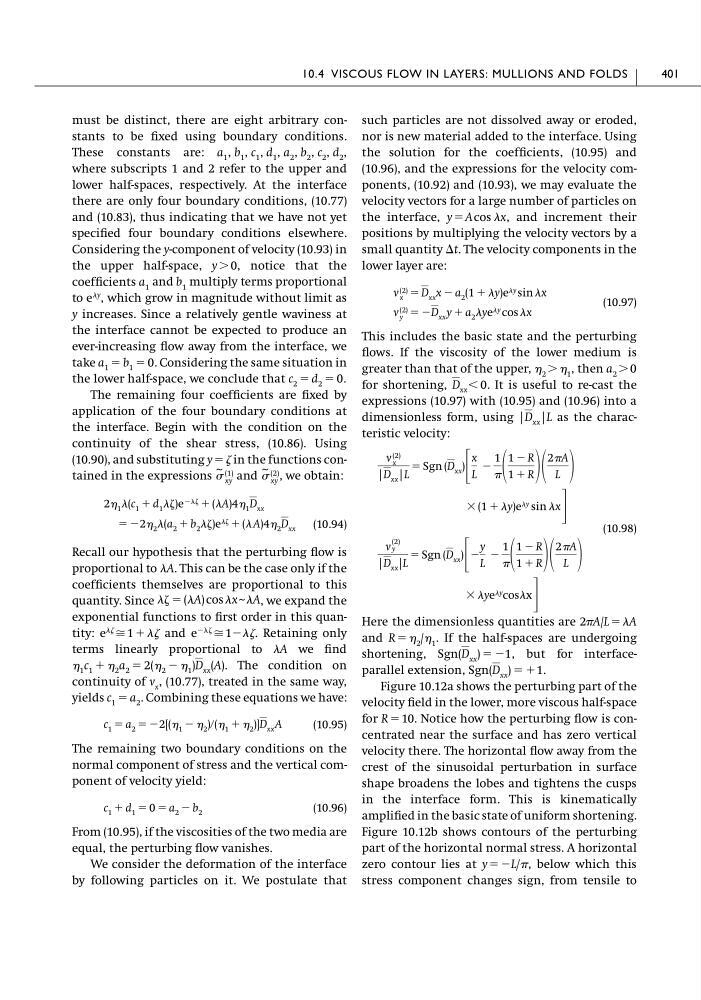
must be distinct, there are eight arbitrary constants to be fixed using boundary conditions.
These constants are:
,
where subscripts 1 and 2 refer to the upper and
lower half-spaces, respectively. At the interface
there are only four boundary conditions, (10.77)
and (10.83), thus indicating that we have not yet
specified four boundary conditions elsewhere.
Considering the y-component of velocity (10.93) in
the upper half-space, y Ͼ 0, notice that the
coefficients a 1 and b 1 multiply terms proportional
to e y , which grow in magnitude without limit as
y increases. Since a relatively gentle waviness at
the interface cannot be expected to produce an
ever-increasing flow away from the interface, we
take
Considering the same situation in
the lower half-space, we conclude that
The remaining four coefficients are fixed by
application of the four boundary conditions at
the interface. Begin with the condition on the
continuity of the shear stress, (10.86). Using
(10.90), and substituting y ϭ in the functions contained in the expressions
we obtain:
(10.94)
Recall our hypothesis that the perturbing flow is
proportional to A. This can be the case only if the
coefficients themselves are proportional to this
quantity. Since
, we expand the
exponential functions to first order in this quantity: e Х 1 ϩ and e
Ϫ
Х 1Ϫ. Retaining only
terms linearly proportional to A we find
. The condition on
continuity of v x , (10.77), treated in the same way,
yields
Combining these equations we have:
(10.95)
The remaining two boundary conditions on the
normal component of stress and the vertical component of velocity yield:
(10.96)
From (10.95), if the viscosities of the two media are
equal, the perturbing flow vanishes.
We consider the deformation of the interface
by following particles on it. We postulate that
c 1 ϩ d 1 ϭ 0 ϭ a 2 Ϫ b 2
c 1 ϭ a 2 ϭ Ϫ2[( 1 Ϫ 2 )ր( 1 ϩ 2 )]D xx A
c 1 ϭ a 2 .
1 c 1 ϩ 2 a 2 ϭ 2( 2 Ϫ 1 )D xx (A)
ϭ (A) cos x ~ A
ϭ Ϫ2 2 (a 2 ϩ b 2 )e ϩ ( A)4 2 D xx
2 1 (c 1 ϩ d 1 )e Ϫ ϩ (A)4 1 D xx
~ (1)
xy and
~ (2)
xy ,
c 2 ϭ d 2 ϭ 0.
a 1 ϭ b 1 ϭ 0.
a 1 , b 1 , c 1 , d 1 , a 2 , b 2 , c 2 , d 2
such particles are not dissolved away or eroded,
nor is new material added to the interface. Using
the solution for the coefficients, (10.95) and
(10.96), and the expressions for the velocity components, (10.92) and (10.93), we may evaluate the
velocity vectors for a large number of particles on
the interface, y ϭ Acos x, and increment their
positions by multiplying the velocity vectors by a
small quantity ⌬t. The velocity components in the
lower layer are:
(10.97)
This includes the basic state and the perturbing
flows. If the viscosity of the lower medium is
greater than that of the upper, 2 Ͼ 1 , then a 2 Ͼ 0
for shortening,
It is useful to re-cast the
expressions (10.97) with (10.95) and (10.96) into a
dimensionless form, using
as the characteristic velocity:
(10.98)
Here the dimensionless quantities are 2A/L ϭ A
and R ϭ 2 / 1 . If the half-spaces are undergoing
shortening,
but for interfaceparallel extension,
Figure 10.12a shows the perturbing part of the
velocity field in the lower, more viscous half-space
for R ϭ 10. Notice how the perturbing flow is concentrated near the surface and has zero vertical
velocity there. The horizontal flow away from the
crest of the sinusoidal perturbation in surface
shape broadens the lobes and tightens the cusps
in the interface form. This is kinematically
amplified in the basic state of uniform shortening.
Figure 10.12b shows contours of the perturbing
part of the horizontal normal stress. A horizontal
zero contour lies at y ϭϪL/, below which this
stress component changes sign, from tensile to
Sgn(D xx ) ϭ ϩ1.
Sgn(D xx ) ϭ Ϫ1,
ϫ ye y cosx ΅
v
(2)
y
|D xx |L
ϭ Sgn (D xx )
΄
Ϫ
y
L
Ϫ
1
1 Ϫ R
1 ϩ R
2A
L
ϫ (1 ϩ y)e y sin x ΅
v (2)
x
|D xx |L
ϭ Sgn (D xx ) ΄
x
L
Ϫ
1
1 Ϫ R
1 ϩ R
2A
L
|D xx |L
D xx Ͻ 0.
v (2)
y ϭ ϪD xx y ϩ a 2 ye y cos x
v (2)
x ϭ D xx x Ϫ a 2 (1 ϩ y)e y sin x
10.4 VISCOUS FLOW IN LAYERS: MULLIONS AND FOLDS
401
These constants are:
,
where subscripts 1 and 2 refer to the upper and
lower half-spaces, respectively. At the interface
there are only four boundary conditions, (10.77)
and (10.83), thus indicating that we have not yet
specified four boundary conditions elsewhere.
Considering the y-component of velocity (10.93) in
the upper half-space, y Ͼ 0, notice that the
coefficients a 1 and b 1 multiply terms proportional
to e y , which grow in magnitude without limit as
y increases. Since a relatively gentle waviness at
the interface cannot be expected to produce an
ever-increasing flow away from the interface, we
take
Considering the same situation in
the lower half-space, we conclude that
The remaining four coefficients are fixed by
application of the four boundary conditions at
the interface. Begin with the condition on the
continuity of the shear stress, (10.86). Using
(10.90), and substituting y ϭ in the functions contained in the expressions
we obtain:
(10.94)
Recall our hypothesis that the perturbing flow is
proportional to A. This can be the case only if the
coefficients themselves are proportional to this
quantity. Since
, we expand the
exponential functions to first order in this quantity: e Х 1 ϩ and e
Ϫ
Х 1Ϫ. Retaining only
terms linearly proportional to A we find
. The condition on
continuity of v x , (10.77), treated in the same way,
yields
Combining these equations we have:
(10.95)
The remaining two boundary conditions on the
normal component of stress and the vertical component of velocity yield:
(10.96)
From (10.95), if the viscosities of the two media are
equal, the perturbing flow vanishes.
We consider the deformation of the interface
by following particles on it. We postulate that
c 1 ϩ d 1 ϭ 0 ϭ a 2 Ϫ b 2
c 1 ϭ a 2 ϭ Ϫ2[( 1 Ϫ 2 )ր( 1 ϩ 2 )]D xx A
c 1 ϭ a 2 .
1 c 1 ϩ 2 a 2 ϭ 2( 2 Ϫ 1 )D xx (A)
ϭ (A) cos x ~ A
ϭ Ϫ2 2 (a 2 ϩ b 2 )e ϩ ( A)4 2 D xx
2 1 (c 1 ϩ d 1 )e Ϫ ϩ (A)4 1 D xx
~ (1)
xy and
~ (2)
xy ,
c 2 ϭ d 2 ϭ 0.
a 1 ϭ b 1 ϭ 0.
a 1 , b 1 , c 1 , d 1 , a 2 , b 2 , c 2 , d 2
such particles are not dissolved away or eroded,
nor is new material added to the interface. Using
the solution for the coefficients, (10.95) and
(10.96), and the expressions for the velocity components, (10.92) and (10.93), we may evaluate the
velocity vectors for a large number of particles on
the interface, y ϭ Acos x, and increment their
positions by multiplying the velocity vectors by a
small quantity ⌬t. The velocity components in the
lower layer are:
(10.97)
This includes the basic state and the perturbing
flows. If the viscosity of the lower medium is
greater than that of the upper, 2 Ͼ 1 , then a 2 Ͼ 0
for shortening,
It is useful to re-cast the
expressions (10.97) with (10.95) and (10.96) into a
dimensionless form, using
as the characteristic velocity:
(10.98)
Here the dimensionless quantities are 2A/L ϭ A
and R ϭ 2 / 1 . If the half-spaces are undergoing
shortening,
but for interfaceparallel extension,
Figure 10.12a shows the perturbing part of the
velocity field in the lower, more viscous half-space
for R ϭ 10. Notice how the perturbing flow is concentrated near the surface and has zero vertical
velocity there. The horizontal flow away from the
crest of the sinusoidal perturbation in surface
shape broadens the lobes and tightens the cusps
in the interface form. This is kinematically
amplified in the basic state of uniform shortening.
Figure 10.12b shows contours of the perturbing
part of the horizontal normal stress. A horizontal
zero contour lies at y ϭϪL/, below which this
stress component changes sign, from tensile to
Sgn(D xx ) ϭ ϩ1.
Sgn(D xx ) ϭ Ϫ1,
ϫ ye y cosx ΅
v
(2)
y
|D xx |L
ϭ Sgn (D xx )
΄
Ϫ
y
L
Ϫ
1
1 Ϫ R
1 ϩ R
2A
L
ϫ (1 ϩ y)e y sin x ΅
v (2)
x
|D xx |L
ϭ Sgn (D xx ) ΄
x
L
Ϫ
1
1 Ϫ R
1 ϩ R
2A
L
|D xx |L
D xx Ͻ 0.
v (2)
y ϭ ϪD xx y ϩ a 2 ye y cos x
v (2)
x ϭ D xx x Ϫ a 2 (1 ϩ y)e y sin x
10.4 VISCOUS FLOW IN LAYERS: MULLIONS AND FOLDS
401