

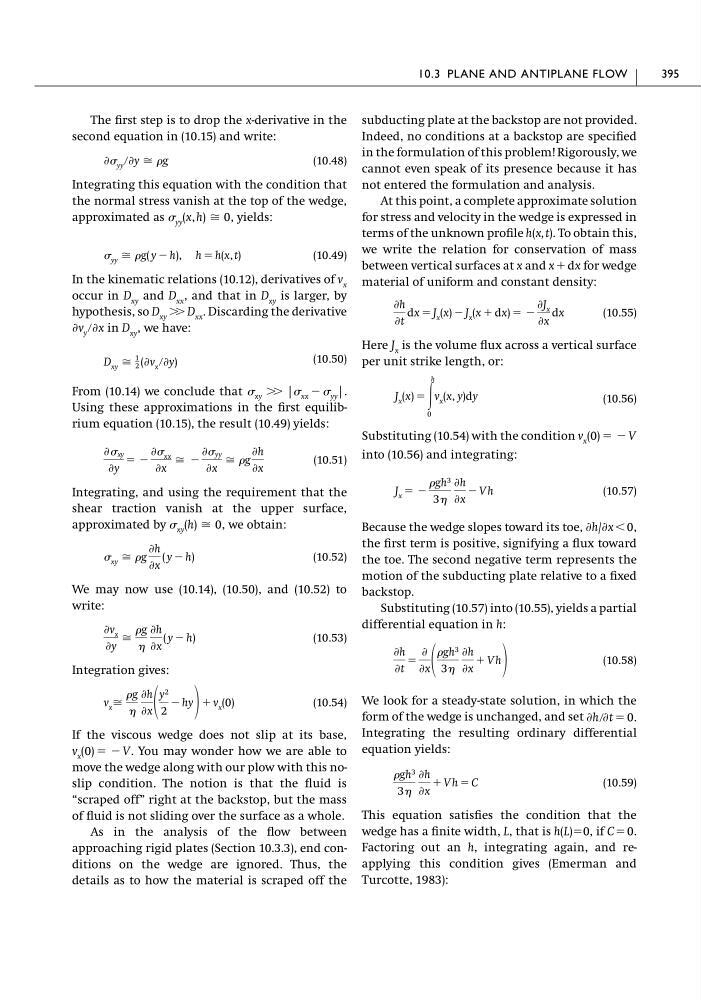
The first step is to drop the x-derivative in the
second equation in (10.15) and write:
(10.48)
Integrating this equation with the condition that
the normal stress vanish at the top of the wedge,
approximated as
yields:
(10.49)
In the kinematic relations (10.12), derivatives of v x
occur in D xy and D xx , and that in D xy is larger, by
hypothesis, so
. Discarding the derivative
in D xy , we have:
(10.50)
From (10.14) we conclude that
.
Using these approximations in the first equilibrium equation (10.15), the result (10.49) yields:
(10.51)
Integrating, and using the requirement that the
shear traction vanish at the upper surface,
approximated by
we obtain:
(10.52)
We may now use (10.14), (10.50), and (10.52) to
write:
(10.53)
Integration gives:
(10.54)
If the viscous wedge does not slip at its base,
. You may wonder how we are able to
move the wedge along with our plow with this noslip condition. The notion is that the fluid is
“scraped off” right at the backstop, but the mass
of fluid is not sliding over the surface as a whole.
As in the analysis of the flow between
approaching rigid plates (Section 10.3.3), end conditions on the wedge are ignored. Thus, the
details as to how the material is scraped off the
v x (0) ϭ Ϫ V
v x Х
g
Ѩh
Ѩx
y 2
2
Ϫ hy
ϩ v x (0)
Ѩv x
Ѩy
Х
g
Ѩh
Ѩx
( y Ϫ h)
xy Х g
Ѩh
Ѩx
( y Ϫ h)
xy (h) Х 0,
Ѩ xy
Ѩy
ϭ Ϫ
Ѩ xx
Ѩx
Х Ϫ
Ѩ yy
Ѩx
Х g
Ѩh
Ѩx
xy ϾϾ | xx Ϫ yy |
D xy Х
1
2 (Ѩv x րѨy)
Ѩv y րѨx
D xy Ͼ Ͼ D xx
yy Х g( y Ϫ h), h ϭ h(x, t)
yy (x, h) Х 0,
Ѩ yy րѨy Х g
subducting plate at the backstop are not provided.
Indeed, no conditions at a backstop are specified
in the formulation of this problem! Rigorously, we
cannot even speak of its presence because it has
not entered the formulation and analysis.
At this point, a complete approximate solution
for stress and velocity in the wedge is expressed in
terms of the unknown profile h(x,t). To obtain this,
we write the relation for conservation of mass
between vertical surfaces at x and x ϩ dx for wedge
material of uniform and constant density:
(10.55)
Here J x is the volume flux across a vertical surface
per unit strike length, or:
(10.56)
Substituting (10.54) with the condition
into (10.56) and integrating:
(10.57)
Because the wedge slopes toward its toe, Ѩh/Ѩx Ͻ 0,
the first term is positive, signifying a flux toward
the toe. The second negative term represents the
motion of the subducting plate relative to a fixed
backstop.
Substituting (10.57) into (10.55), yields a partial
differential equation in h:
(10.58)
We look for a steady-state solution, in which the
form of the wedge is unchanged, and set
Integrating the resulting ordinary differential
equation yields:
(10.59)
This equation satisfies the condition that the
wedge has a finite width, L, that is h(L)ϭ0, if C ϭ 0.
Factoring out an h, integrating again, and reapplying this condition gives (Emerman and
Turcotte, 1983):
gh 3
3
Ѩh
Ѩx
ϩ Vh ϭ C
ѨhրѨt ϭ 0.
Ѩh
Ѩt
ϭ
Ѩ
Ѩx
gh 3
3
Ѩh
Ѩx
ϩ Vh
J x ϭ Ϫ
gh 3
3
Ѩh
Ѩx
Ϫ Vh
v x (0) ϭ Ϫ V
J x (x) ϭ Ύ
h
0
v x (x, y)dy
Ѩh
Ѩt
dx ϭ J x (x) Ϫ J x (x ϩ dx) ϭ Ϫ
ѨJ x
Ѩx
dx
10.3 PLANE AND ANTIPLANE FLOW
395
second equation in (10.15) and write:
(10.48)
Integrating this equation with the condition that
the normal stress vanish at the top of the wedge,
approximated as
yields:
(10.49)
In the kinematic relations (10.12), derivatives of v x
occur in D xy and D xx , and that in D xy is larger, by
hypothesis, so
. Discarding the derivative
in D xy , we have:
(10.50)
From (10.14) we conclude that
.
Using these approximations in the first equilibrium equation (10.15), the result (10.49) yields:
(10.51)
Integrating, and using the requirement that the
shear traction vanish at the upper surface,
approximated by
we obtain:
(10.52)
We may now use (10.14), (10.50), and (10.52) to
write:
(10.53)
Integration gives:
(10.54)
If the viscous wedge does not slip at its base,
. You may wonder how we are able to
move the wedge along with our plow with this noslip condition. The notion is that the fluid is
“scraped off” right at the backstop, but the mass
of fluid is not sliding over the surface as a whole.
As in the analysis of the flow between
approaching rigid plates (Section 10.3.3), end conditions on the wedge are ignored. Thus, the
details as to how the material is scraped off the
v x (0) ϭ Ϫ V
v x Х
g
Ѩh
Ѩx
y 2
2
Ϫ hy
ϩ v x (0)
Ѩv x
Ѩy
Х
g
Ѩh
Ѩx
( y Ϫ h)
xy Х g
Ѩh
Ѩx
( y Ϫ h)
xy (h) Х 0,
Ѩ xy
Ѩy
ϭ Ϫ
Ѩ xx
Ѩx
Х Ϫ
Ѩ yy
Ѩx
Х g
Ѩh
Ѩx
xy ϾϾ | xx Ϫ yy |
D xy Х
1
2 (Ѩv x րѨy)
Ѩv y րѨx
D xy Ͼ Ͼ D xx
yy Х g( y Ϫ h), h ϭ h(x, t)
yy (x, h) Х 0,
Ѩ yy րѨy Х g
subducting plate at the backstop are not provided.
Indeed, no conditions at a backstop are specified
in the formulation of this problem! Rigorously, we
cannot even speak of its presence because it has
not entered the formulation and analysis.
At this point, a complete approximate solution
for stress and velocity in the wedge is expressed in
terms of the unknown profile h(x,t). To obtain this,
we write the relation for conservation of mass
between vertical surfaces at x and x ϩ dx for wedge
material of uniform and constant density:
(10.55)
Here J x is the volume flux across a vertical surface
per unit strike length, or:
(10.56)
Substituting (10.54) with the condition
into (10.56) and integrating:
(10.57)
Because the wedge slopes toward its toe, Ѩh/Ѩx Ͻ 0,
the first term is positive, signifying a flux toward
the toe. The second negative term represents the
motion of the subducting plate relative to a fixed
backstop.
Substituting (10.57) into (10.55), yields a partial
differential equation in h:
(10.58)
We look for a steady-state solution, in which the
form of the wedge is unchanged, and set
Integrating the resulting ordinary differential
equation yields:
(10.59)
This equation satisfies the condition that the
wedge has a finite width, L, that is h(L)ϭ0, if C ϭ 0.
Factoring out an h, integrating again, and reapplying this condition gives (Emerman and
Turcotte, 1983):
gh 3
3
Ѩh
Ѩx
ϩ Vh ϭ C
ѨhրѨt ϭ 0.
Ѩh
Ѩt
ϭ
Ѩ
Ѩx
gh 3
3
Ѩh
Ѩx
ϩ Vh
J x ϭ Ϫ
gh 3
3
Ѩh
Ѩx
Ϫ Vh
v x (0) ϭ Ϫ V
J x (x) ϭ Ύ
h
0
v x (x, y)dy
Ѩh
Ѩt
dx ϭ J x (x) Ϫ J x (x ϩ dx) ϭ Ϫ
ѨJ x
Ѩx
dx
10.3 PLANE AND ANTIPLANE FLOW
395